

Brine Storage Tanks
Brine Storage Tanks for De-Icing, Anti-Icing, and Dust Control
Corrosion-resistant polyethylene tanks engineered for municipal brine storage, mixing, and dispensing. Choose from vertical, horizontal, and double-wall configurations built for chloride solutions and demanding seasonal operations.
Brine Storage Tanks
for De-Icing, Anti-Icing, and Dust Control
Corrosion-resistant polyethylene tanks engineered for municipal brine storage, mixing, and dispensing. Choose from vertical, horizontal, and double-wall configurations built for chloride solutions and demanding seasonal operations.
Polyethylene Brine Storage for Year-Round Road Maintenance
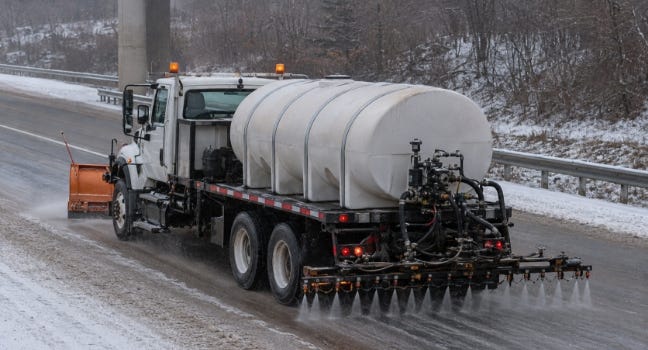
Brine is a high salt concentration dissolved in water, and it has become one of the most versatile tools in municipal road maintenance. The brines used on roads are chloride solutions, most commonly calcium chloride, magnesium chloride, and sodium chloride (salt brine). Departments spray them on pavement to fight ice in winter and on unpaved roads to hold down dust in summer. All of these brines share the trait that drives tank selection: they are chloride-rich, so they corrode metal but store safely in polyethylene.
At Tank Depot we build brine storage around HDLPE and XLPE polyethylene, in vertical, horizontal, and double-wall configurations, with the fittings, containment, and cold-weather management a municipal brine operation needs.
Polyethylene Brine Storage for Year-Round Road Maintenance
Brine is a high salt concentration dissolved in water, and it has become one of the most versatile tools in municipal road maintenance. The brines used on roads are chloride solutions, most commonly calcium chloride, magnesium chloride, and sodium chloride (salt brine). Departments spray them on pavement to fight ice in winter and on unpaved roads to hold down dust in summer. All of these brines share the trait that drives tank selection: they are chloride-rich, so they corrode metal but store safely in polyethylene.
At Tank Depot we build brine storage around HDLPE and XLPE polyethylene, in vertical, horizontal, and double-wall configurations, with the fittings, containment, and cold-weather management a municipal brine operation needs.
Which Brine: Calcium, Magnesium, or Sodium Chloride?
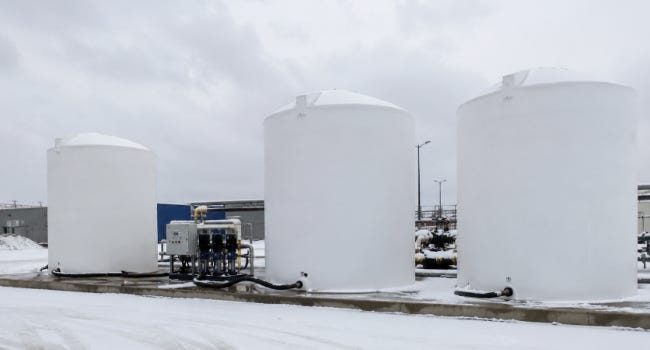
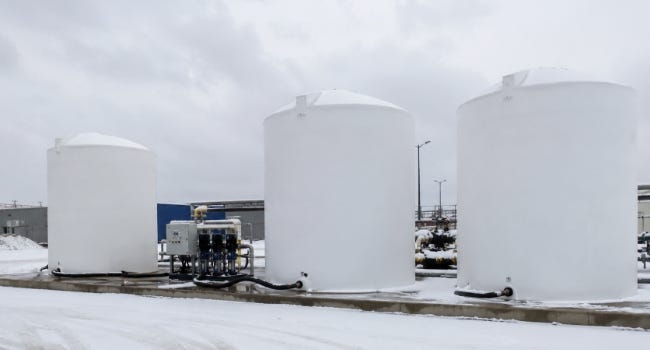
The word brine covers several chloride solutions, and the right one depends on the season and the temperature:
From a storage standpoint the differences are small: all three are chloride brines that call for the same tank materials, so this page covers brine storage across the board. For chemistry-specific density and behavior, follow the links to the individual pages.
Which Brine: Calcium, Magnesium, or Sodium Chloride?
The word brine covers several chloride solutions, and the right one depends on the season and the temperature:
From a storage standpoint the differences are small: all three are chloride brines that call for the same tank materials, so this page covers brine storage across the board. For chemistry-specific density and behavior, follow the links to the individual pages.
How Municipalities Use Brine
Brine does double duty across the year, which is a big part of why fleets invest in bulk storage for it.
Winter: Ice and Snow Control
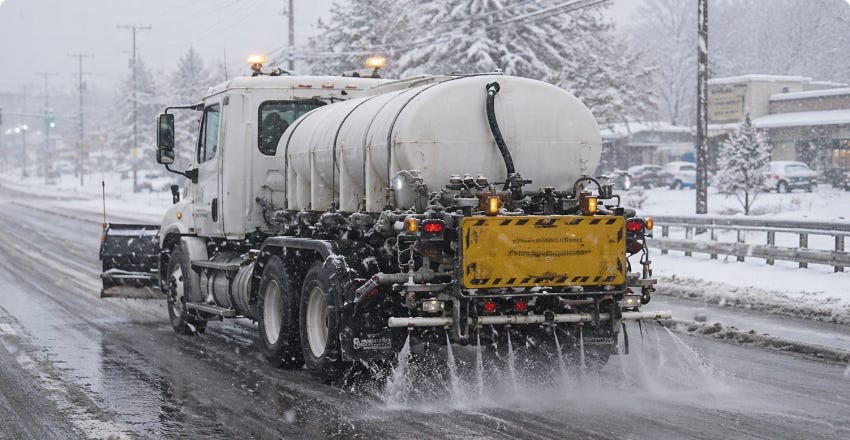
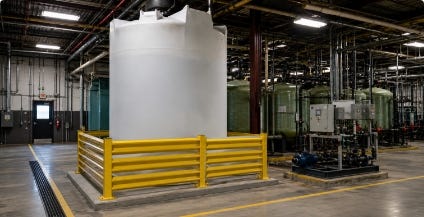
✅ Anti-icing. Liquid brine applied to pavement and bridge decks before a storm keeps snow and ice from bonding to the surface. It is a proactive strategy that agencies report is significantly more efficient than de-icing after the bond has already formed.
✅ Pre-wetting salt. Brine sprayed onto rock salt at the spreader helps it stick to the road instead of bouncing and scattering off, and activates it to melt faster, so less solid salt is needed. Any of the three chlorides can be used to pre-wet.
Summer: Dust and Surface Care
✅ Dust control. On gravel and unpaved roads, construction sites, haul routes, and mining operations, hygroscopic calcium and magnesium chloride brines pull moisture from the air to keep the surface damp and lock fine dust in place. A single liquid application can suppress dust for weeks to months.
✅ Surface stabilization. The same moisture-binding action compacts the surface and reduces washboarding, rutting, and material loss, extending the life of unpaved roads.
Year-Round
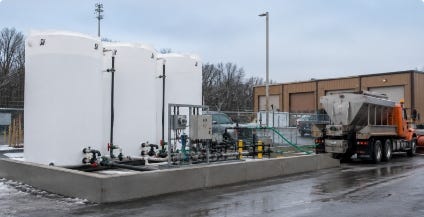
✅ On-site brine production and storage. Many departments make and store their own brine, sized to the fleet and the season, so it is ready when conditions turn.
Vertical, Horizontal, and Mixing Tank Configurations
Brine operations use more than one tank shape, and the right one depends on the job

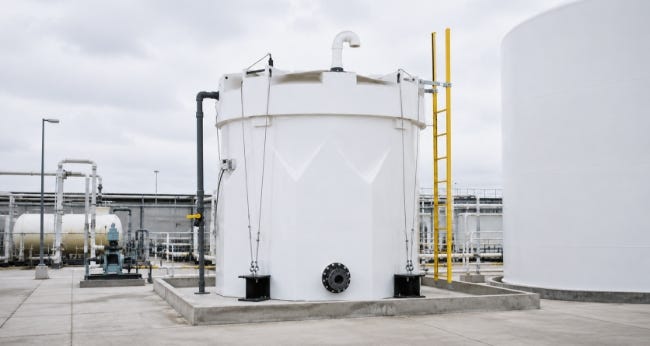
Vertical Bulk Storage Tanks
Hold the season’s brine in the smallest floor footprint and are the standard for a fixed brine yard or garage.
Horizontal (Leg) Tanks
Sit lower and are easier to fill, move, and transport, which suits nurse tanks, satellite sites, and installations with height limits.

Brine Double-Wall Tanks
Keep brine contained and compliant in a single footprint. No external dike needed. Built-in 110% secondary containment stops chloride spills before they reach the ground.

Closed-Top Design for Storage
Bulk brine storage tanks are closed-top to keep debris, contamination, and rain out of the solution. Open-top tanks are used for batch mixing, not for finished-brine storage.
Vertical, Horizontal, and Mixing Tank Configurations
Brine operations use more than one tank shape, and the right one depends on the job
Vertical Bulk Storage Tanks
Hold the season’s brine in the smallest floor footprint and are the standard for a fixed brine yard or garage.
Horizontal (Leg) Tanks
Sit lower and are easier to fill, move, and transport, which suits nurse tanks, satellite sites, and installations with height limits.
Brine Double-Wall Tanks
Keep brine contained and compliant in a single footprint. No external dike needed. Built-in 110% secondary containment stops chloride spills before they reach the ground.
Closed-Top Design for Storage
Bulk brine storage tanks are closed-top to keep debris, contamination, and rain out of the solution. Open-top tanks are used for batch mixing, not for finished-brine storage.
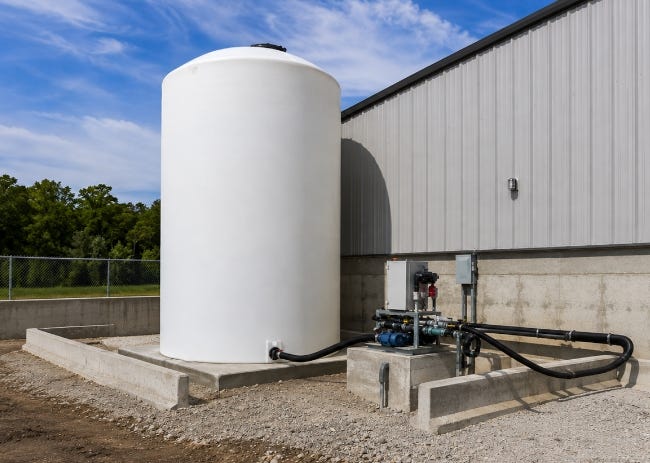
Making and Keeping Brine in Spec
Salt brine is made by filling a mixing tank roughly two-thirds with water and adding rock salt gradually while agitating, with a mechanical agitator, an air bubbler, or a recirculation pump, until it reaches 23.3%, verified with a salometer or hydrometer at about 1.176 specific gravity. Calcium and magnesium chloride brines are usually delivered as liquids at their working concentration, though they can also be mixed from flake or pellet.
Keeping brine in spec over the season comes down to a few habits:
Making and Keeping Brine in Spec
On-Site Mixing: Salt vs. Calcium & Magnesium Chloride
While sodium chloride (salt brine) is routinely batch-mixed on site using rock salt, liquid calcium chloride and magnesium chloride are often delivered pre-mixed at working concentrations. However, if your operation mixes calcium or magnesium chloride on site from dry flake or pellet:

Manage Exothermic Heat
Dissolving dry calcium or magnesium chloride releases intense heat (an exothermic reaction). Mixing tanks must be rated for elevated liquid temperatures—typically requiring high-density heavy-duty polyethylene (HDLPE/XLPE) with an appropriate temperature safety buffer.

Agitation & Heat Dissipation
Heavy mechanical agitation or high-volume recirculation pumps are required to dissolve dry flake quickly and prevent severe hot spots at the tank base during batching.

Process vs. Storage Split
Always perform batching in dedicated cone-bottom or open-top mixing tanks designed for agitation and thermal expansion. Once cooled and fully dissolved, transfer the finished brine into closed-top vertical or double-wall tanks for long-term storage.
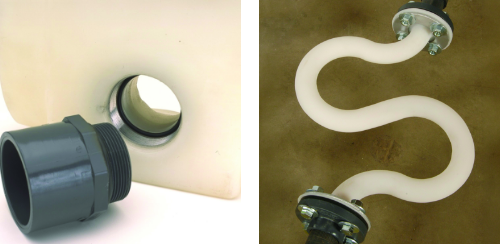
Fittings, Hardware, and Connections for Brine Tanks
Fittings, Hardware, and Connections for Brine Tanks
Foundation, Installation, and Temperature
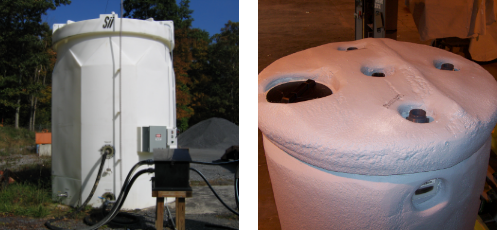
Foundation, Installation, and Temperature
Other Approved Materials
Polyethylene covers the great majority of municipal brine storage, but a couple of alternatives fit specific cases:
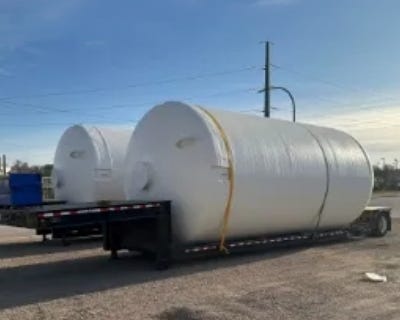
For very large, rigid outdoor tanks, with routine inspection of seams and joints.
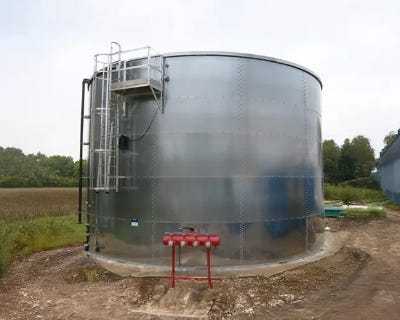
For high-cycle brine production lines or outdoor installations where UV exposure and mechanical durability are priorities. Bare carbon steel is not suitable, because chloride corrodes it.
Other Approved Materials
Polyethylene covers the great majority of municipal brine storage, but a couple of alternatives fit specific cases:
For very large, rigid outdoor tanks, with routine inspection of seams and joints.
For high-cycle brine production lines or outdoor installations where UV exposure and mechanical durability are priorities. Bare carbon steel is not suitable, because chloride corrodes it.
Maintenance and Monitoring

Concentration Checks
With a salometer or hydrometer to confirm the brine stays at its target strength.

Recirculation and Inspection
For settled salt or scale, especially at the base and outlet.

Routine Inspection
Of fittings, connections, and high-stress areas for wear.

Leak Detection
In the interstitial space or containment for early warning of a breach.

Build the Right Brine Storage System for Your Operation
Our team helps you match the whole system to your operation: brine chemistry, tank size and shape, resin, SG rating, fittings, containment, and cold-weather protection. Request a quote or call to talk it through with a storage specialist.
Brine Storage System for Your Operation
Our team helps you match the whole system to your operation: brine chemistry, tank size and shape, resin, SG rating, fittings, containment, and cold-weather protection. Request a quote or call to talk it through with a storage specialist.


