

Application Fire Suppression
Fiberglass Fire Suppression Tanks
Why Are Fiberglass Fire Suppression Tanks the Superior Choice for NFPA 22 Compliance
Engineering a dependable life-safety system requires a water source that remains structurally sound long before an emergency occurs. Fiberglass fire suppression tanks offer an inert, non-corrosive alternative that eliminates the risk of catastrophic wall thinning or particulate clogs in sprinkler heads. These FRP fire protection tanks are purpose-built to exceed NFPA 22 and AWWA D120 standards, providing civil engineers and facility managers with a “set-and-forget” solution.
Fiberglass Fire Suppression Tanks
Why Are Fiberglass Fire Suppression Tanks the Superior Choice for NFPA 22 Compliance
Engineering a dependable life-safety system requires a water source that remains structurally sound long before an emergency occurs. Fiberglass fire suppression tanks offer an inert, non-corrosive alternative that eliminates the risk of catastrophic wall thinning or particulate clogs in sprinkler heads.
Where are Fiberglass Fire Suppression Tanks Used?
The superior strength and inert nature of fiberglass make it the perfect choice for any application where water quality is paramount.
Where are Fiberglass Fire Suppression Tanks Used?
The superior strength and inert nature of fiberglass make it the perfect choice for any application where water quality is paramount.
Which Fiberglass Tank Configurations Are Available for Fire Suppression Systems?
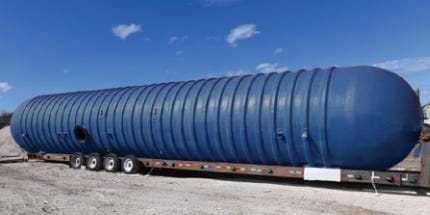
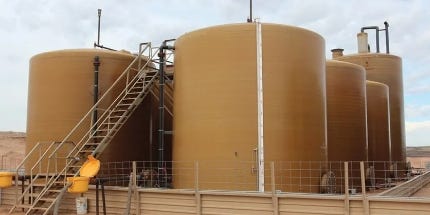
Tailored for commercial and industrial job sites, these above ground configurations provide immediate accessibility for inspections and simple plumbing alignment with your fire pump house. They are manufactured with opaque, premium UV-resistant gel coats that shield the structure from intense solar radiation, preventing material degradation and ensuring long-term structural integrity. These units provide exceptional flexibility for the custom placement of flanged nozzles, access manways, and heavy-duty ladders.
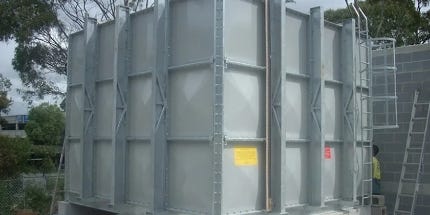
Built specifically for urban retrofits and indoor commercial installations with limited access and that lack the clearance required to place a standard monolithic tank. Constructed from high-pressure molded GRP panels, these modular systems are shipped flat on pallets and bolted together on-site. This allows project teams to construct massive fire suppression system water tanks inside cramped basements, tight mechanical rooms, confined spaces, or on reinforced rooftops without tearing out structural walls or renting specialized cranes.
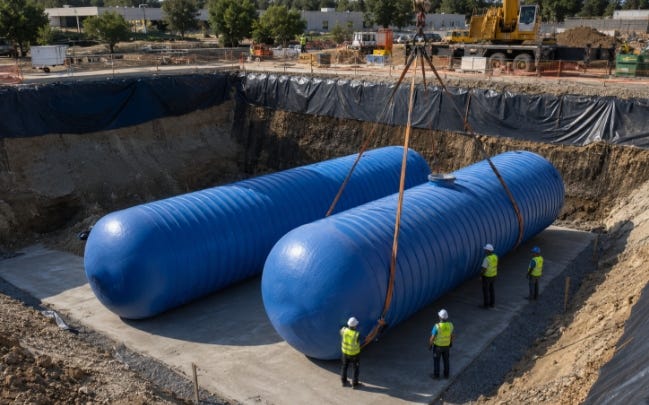
Designed to preserve valuable surface real estate by placing your emergency reserve out of sight. Our underground FRP fire protection tank models are engineered to handle the intense external hydrostatic pressures of deep burials and high water tables. When specified for installation beneath parking lots, perimeter fire lanes, or facility access roads, these below ground units are structurally reinforced to support H-20 traffic loading, keeping your emergency water reserves safe and fully functional out of sight.
Tailored for commercial and industrial job sites, these above ground configurations provide immediate accessibility for inspections and simple plumbing alignment with your fire pump house.
Built specifically for urban retrofits and indoor commercial installations with limited access and that lack the clearance required to place a standard monolithic tank. Constructed from high-pressure molded GRP panels, these modular systems are shipped flat on pallets and bolted together on-site.
Designed to preserve valuable surface real estate by placing your emergency reserve out of sight. Our underground FRP fire protection tank models are engineered to handle the intense external hydrostatic pressures of deep burials and high water tables.
What Regulations and Certifications Govern Fiberglass Fire Protection Storage Tanks?
Securing compliance for life-safety infrastructure requires rigorous adherence to national engineering standards and regional safety codes. Our fiberglass fire suppression tanks are manufactured in strict accordance with industry regulations to ensure seamless approval from insurance underwriters and the local Authority Having Jurisdiction (AHJ).

NFPA 22 Standard Compliance
This is the primary benchmark regulating water tanks for private fire protection. Our engineering team integrates all mandated mechanical features into the tank build, including anti-vortex plates on suction lines to prevent pump cavitation, specific interior and exterior ladder clearances, screened vents, and code-compliant water-level indicators to ensure the system is constantly monitored.

AWWA D120 Certifications
For municipal water storage and industrial integration, our tanks conform to the American Water Works Association standard for fiberglass-reinforced plastic tanks. This standard dictates precise resin selection, glass-to-resin structural ratios, and composite laminate sequencing to guarantee the tank wall withstands continuous hydrostatic pressure without structural deformation or weeping.

Seismic and Wind Design Standards
In high-risk territories, tanks must meet ASCE 7 structural design requirements. We engineer our tanks with reinforced anchoring systems, heavy-duty fiberglass deadman anchors, and anti-flotation ribs to secure the water storage against lateral seismic forces, extreme wind uplift, or buoyant forces caused by high groundwater tables.

NFPA 1142 Rural Infrastructure
This standard governs water supplies for suburban and rural firefighting, providing the recognized methodology to calculate minimum water volumes required for structural firefighting in areas lacking municipal hydrants. We engineer our fire suppression fiberglass storage tanks to accommodate the specific dry hydrant connections and heavy-duty drafting plumbing required by rural fire departments to quickly draw from these dedicated water reserves.

NSF/ANSI Standard 61 Certification
Essential for dual-use water systems that combine municipal drinking water reserves with emergency fire protection storage. This certification guarantees that the interior resin formulation does not leach harmful chemical contaminants into the water, allowing the tank to safely interface with public water lines without violating cross-contamination or backflow prevention rules.

FM Approvals (Factory Mutual) Standards
Frequently mandated by commercial property insurers and industrial risk managers to minimize asset liability. Fabricating a fiberglass design to comply with Factory Mutual criteria ensures that the tank configuration, structural margins, and material testing benchmarks meet the high asset-protection metrics demanded by major global insurance underwriters.

ASTM D3299 and D4097 Manufacturing
These standards govern the structural fabrication of the vessels, with ASTM D3299 covering filament-wound tanks and ASTM D4097 covering contact-molded glass-fiber-reinforced designs. Adhering to these guidelines establishes the exact baseline for laminate consistency, glass-to-resin ratios, and wall thickness uniformity that civil engineers verify during the technical submittal review phase.

Local Fire Marshal Approval
Beyond national frameworks, compliance often hinges on regional amendments and fire codes. We provide comprehensive engineering submittal packages, including wet-stamped structural calculations, to satisfy the stringent requirements of local fire marshals, commercial building inspectors, and industrial insurance risk managers.
By choosing a high-strength composite material, you ensure that your fire suppression water storage meets the strictest requirements of the Authority Having Jurisdiction (AHJ) while significantly reducing the total cost of ownership.
By choosing a high-strength composite material, you ensure that your fire suppression water storage meets the strictest requirements of the Authority Having Jurisdiction (AHJ) while significantly reducing the total cost of ownership.
Buying Guide: Sizing and Logistics for Fire Water Storage
Procuring a fire suppression water tank involves more than just selecting a capacity; it requires coordinating with local fire marshals and ensuring site-ready logistics.

Calculating Required Capacity
The “usable volume” of your tank is the primary metric used by the Authority Having Jurisdiction (AHJ). This is calculated by multiplying the required fire flow (GPM) by the required duration (typically 60 to 120 minutes) as dictated by NFPA 13 or NFPA 14. For example, a system requiring 1,000 GPM for 90 minutes necessitates a minimum usable capacity of 90,000 gallons. We recommend accounting for “dead volume”, the water below the suction intake, to ensure your total tank size meets the net usable requirements.
Logistics and Site Preparation
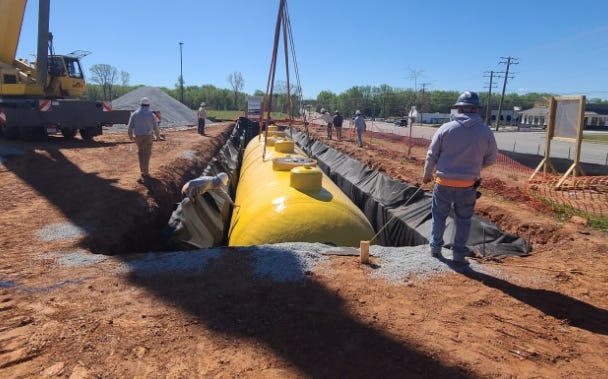
Before choosing a fiberglass fire suppression tank, consider your site access, foundation requirements, and project timeline. Fiberglass tanks are lightweight enough for delivery on standard trailers, but the route to the installation area must still accommodate the tank’s full diameter and length. Most jurisdictions now require a reinforced concrete slab or ring wall, especially in seismic zones such as California, where gravel foundations may be restricted to help maintain level support and prevent stress fractures. Because fiberglass tanks are precision-engineered, lead times can vary, so we recommend engaging our specialists early in the design-development phase to secure production availability and coordinate installation requirements with your civil contractor.
Logistics and Site Preparation
Before choosing a fiberglass fire suppression tank, consider your site access, foundation requirements, and project timeline. Fiberglass tanks are lightweight enough for delivery on standard trailers, but the route to the installation area must still accommodate the tank’s full diameter and length. Most jurisdictions now require a reinforced concrete slab or ring wall, especially in seismic zones such as California, where gravel foundations may be restricted to help maintain level support and prevent stress fractures. Because fiberglass tanks are precision-engineered, lead times can vary, so we recommend engaging our specialists early in the design-development phase to secure production availability and coordinate installation requirements with your civil contractor.
Why Fiberglass is the Standard for Fire Suppression Systems
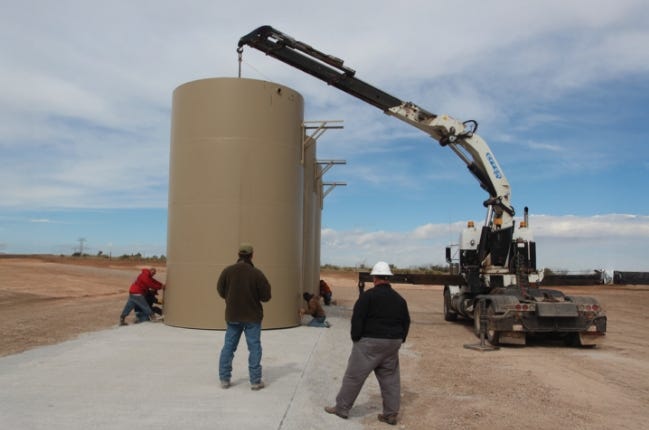
Choosing the right material for life-safety water storage involves balancing long-term structural integrity with ease of installation. Fiberglass-reinforced plastic (FRP) is a high-performance choice for engineering firms and contractors who prioritize reliability and simplified logistics.
Finding the Right Fiberglass Water Tank for Your Project
With a vast range of options fiberglass potable water tanks for sale, we help you with the siting and selection process:

A Size for Every Need
Whether you need a 1,000-gallon fiberglass potable water tank for a farm or a 50,000-gallon tank for a municipality, we have a solution. Our inventory covers capacities from under 1000 gallons to over 60,000 gallons.

Configuration & Customization
We offer tanks for both above-ground and below-ground installation, complete with all necessary fittings like manways, inlets, outlets, and vents tailored to your specific requirements.

Technical Solution Design
The final fiberglass potable water tank price depends on size, configuration, and shipping. Contact our team of experts for a detailed quote and guidance on the best solution for your project. We have a network of fiberglass tank manufacturers to ensure you get the best product for the job.

Protecting What Matters with Proven FRP Technology
Secure your facility’s future with a fire protection water storage system that won’t degrade when you need it most. Browse our full range of fire suppression storage tanks or contact our engineering specialists today to receive a quote and technical submittals for your next project.
Protecting What Matters with Proven FRP Technology
Secure your facility’s future with a fire protection water storage system that won’t degrade when you need it most. Browse our full range of fire suppression storage tanks or contact our engineering specialists today to receive a quote and technical submittals for your next project.


