

Application Rainwater Harvesting
Fiberglass Rainwater Harvesting Tanks
Industrial-Grade Fiberglass Rainwater Harvesting Tanks
Water is no longer just a utility; it is a volatile operating cost. For facility managers, municipal engineers, and commercial developers, the dual pressure of rising municipal water rates and strict stormwater runoff regulations has created a new financial reality. Fiberglass Rainwater Harvesting Tanks offer a permanent, scalable solution to these challenges, turning a liability (stormwater runoff) into a reusable asset.
Fiberglass Rainwater Harvesting Tanks
Industrial-Grade Fiberglass Rainwater Harvesting Tanks
Fiberglass Rainwater Harvesting Tanks offer a permanent, scalable solution to these challenges, turning a liability (stormwater runoff) into a reusable asset.
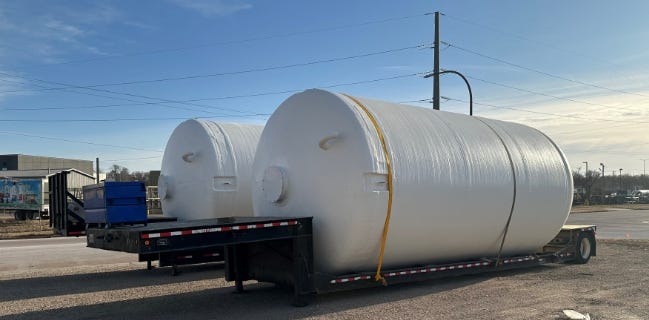
Built to Protect Water Quality for Decades
Unlike residential "rain barrels," industrial rainwater collection requires structural resilience and massive capacity. Whether you are offsetting cooling tower make-up water, irrigating a municipal park, or designing a LEED-Platinum commercial complex, you need a storage vessel that can withstand decades of underground hydrostatic pressure without cracking or corroding.
Applications of Fiberglass Rainwater Tanks: Scalable Water Capture for Any Site Profile
Rainwater harvesting is not a "one-size-fits-all" engineering challenge. A sprawling distribution center has different constraints than a downtown high-rise retrofit. We configure fiberglass storage solutions, ranging from monolithic underground cisterns to sectional modular tanks, to fit the specific hydraulic and spatial demands of your project.
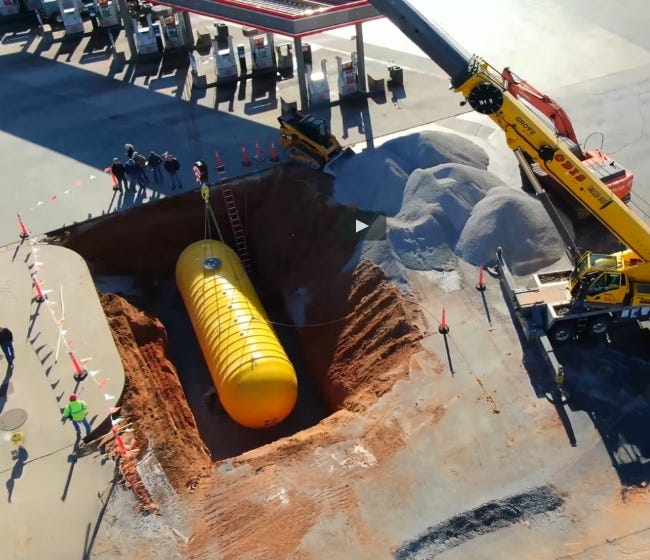
Applications of Fiberglass Rainwater Tanks: Scalable Water Capture for Any Site Profile
Rainwater harvesting is not a "one-size-fits-all" engineering challenge. A sprawling distribution center has different constraints than a downtown high-rise retrofit. We configure fiberglass storage solutions, ranging from monolithic underground cisterns to sectional modular tanks, to fit the specific hydraulic and spatial demands of your project.
FRP Rainwater Harvesting Tanks for Every Site Profile
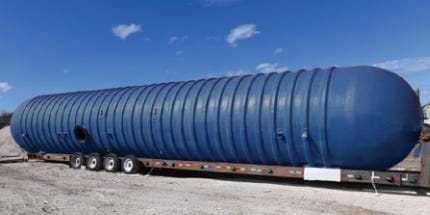
Free up valuable surface real estate by burying your rainwater collection system. Our underground FRP rainwater tanks are engineered to handle the intense hydrostatic pressure of deep burials and high water tables while protecting your water from freezing temperatures. When installed beneath parking lots, fire lanes, or access roads, these below ground fiberglass tanks can be structurally reinforced for H-20 traffic loading, ensuring your stormwater detention system operates safely out of sight.
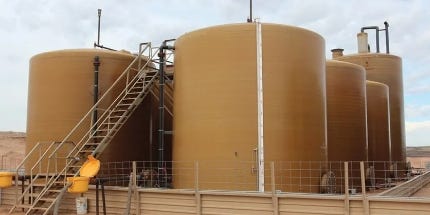
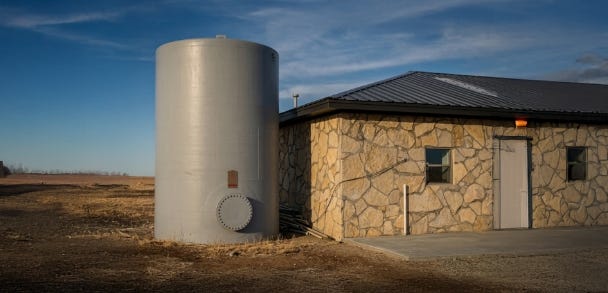
For facilities with available outdoor footprint or adjacent mechanical yards, our above ground fiberglass rainwater tanks offer exceptional accessibility and simplified plumbing integration. When staged outdoors, these FRP cisterns are finished with a premium, opaque UV-resistant gel coat that blocks sunlight transmission, completely preventing algae growth in your harvested water. They provide maximum design flexibility, allowing for custom placement of flanged nozzles, access manways, and ladders to connect directly to your irrigation or process water loops.
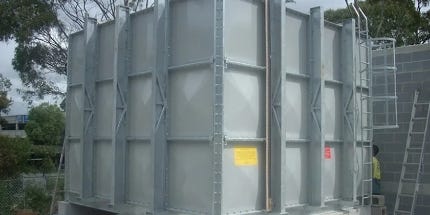
Urban building retrofits and indoor commercial installations often lack the access required to drop in a standard monolithic tank. Modular fiberglass rainwater tanks solve this logistical nightmare. Constructed from high-pressure molded GRP panels, these systems are shipped flat on pallets and bolted together on-site. This approach empowers developers to build massive, scalable rainwater harvesting systems inside cramped basements, tight mechanical rooms, or on reinforced rooftops without tearing out walls or renting specialized cranes.
Our underground FRP rainwater tanks are engineered to handle the intense hydrostatic pressure of deep burials and high water tables while protecting your water from freezing temperatures.
For facilities with available outdoor footprint or adjacent mechanical yards, our above ground fiberglass rainwater tanks offer exceptional accessibility and simplified plumbing integration.
Constructed from high-pressure molded GRP panels, these systems are shipped flat on pallets and bolted together on-site. This approach empowers developers to build massive, scalable rainwater harvesting systems.

The Engineering Advantage: Why Fiberglass for Rainwater Collection?
In the commercial sector, material selection dictates the system's ROI. While polyethylene is excellent for smaller applications and steel serves well in specific industrial contexts, Fiberglass Reinforced Plastic (FRP) offers the optimal balance of structural capacity, chemical inertness, and zero-maintenance longevity for mid-to-large scale harvesting systems.
The Engineering Advantage: Why Fiberglass for Rainwater Collection?
In the commercial sector, material selection dictates the system's ROI. While polyethylene is excellent for smaller applications and steel serves well in specific industrial contexts, Fiberglass Reinforced Plastic (FRP) offers the optimal balance of structural capacity, chemical inertness, and zero-maintenance longevity for mid-to-large scale harvesting systems.

Technical Specifications & Compliance
In commercial and municipal projects, a tank failure is not just a leak; it is a liability event. Our fiberglass rainwater vessels are engineered to meet the strictest national codes, ensuring your system passes inspection and performs for decades.

NSF/ANSI 61 (Potable Safety)
Certified for drinking water system components. Even if you are using rainwater for flushing or irrigation, this certification guarantees the rainwater fiberglass tank resin will not leach styrene or toxins into the water.

IAPMO/ANSI Z1002 (Rainwater Specific)
The dedicated standard for “Rainwater Harvesting Tanks.” It validates that the fiberglass tank design (inlet/outlet positioning, overflow capacity) is optimized specifically for catchment systems.

AASHTO H-20 / HS-20 (Traffic Loading)
When buried with 3+ feet of cover, our structural ribbed frp tanks withstand 32,000 lbs per axle. This allows for installation under parking lots, fire lanes, or heavy-duty loading docks without requiring a separate concrete vault.

ASTM D3753 (Manufacturing Consistency)
The standard specification for Glass-Fiber-Reinforced Polyester manholes and wetwells. It ensures uniform wall thickness, hoop strength, and chemical resistance across the entire vessel.
At Tank Depot, we supply high-performance fiberglass (FRP) cisterns engineered for the toughest environments. From NSF-61 certified potable water systems to high-volume stormwater detention, our frp tanks provide the structural integrity of concrete with the chemical resistance of advanced composites—ensuring your water security for 50+ years.
At Tank Depot, we supply high-performance fiberglass (FRP) cisterns engineered for the toughest environments. From NSF-61 certified potable water systems to high-volume stormwater detention, our frp tanks provide the structural integrity of concrete with the chemical resistance of advanced composites—ensuring your water security for 50+ years.
Buying Guide: Sizing, Sourcing & ROI
Specifying a commercial rainwater system involves more than just picking a gallon capacity. To ensure your system performs efficiently and fits your budget, consider these critical engineering and logistical factors:
Calculate Your Potential Yield
Don't guess at your capacity needs. Use this industry-standard formula to determine exactly how much water your facility can capture annually:
Harvested Volume (gal) = Roof Area (ft^2) X Rainfall (in) X 0.623 X Runoff Coefficient
- Metal Roof Coefficient: 0.95 (Highly efficient)
- Asphalt/Concrete Coefficient: 0.90
- Green Roof Coefficient: 0.50 (Absorbs water significantly)
Total Cost of Ownership (TCO)
While the upfront sticker price of a fiberglass tank may be higher than a polyethylene equivalent (in small sizes) or a raw steel vessel, the long-term math favors fiberglass. Steel tanks often require re-lining every 10–15 years to prevent rust, a maintenance procedure that can cost tens of thousands of dollars in downtime and labor. Fiberglass requires zero internal maintenance, offering a lower 20-year TCO.

Total Cost of Ownership (TCO)
While the upfront sticker price of a fiberglass tank may be higher than a polyethylene equivalent (in small sizes) or a raw steel vessel, the long-term math favors fiberglass. Steel tanks often require re-lining every 10–15 years to prevent rust, a maintenance procedure that can cost tens of thousands of dollars in downtime and labor. Fiberglass requires zero internal maintenance, offering a lower 20-year TCO.

Logistics & Site Access
Our 40,000 to 60,000-gallon tanks are massive, monolithic structures shipped on 53-foot drop-deck trailers. Before ordering, verify that your site has a stabilized access road capable of supporting the truck and a crane with sufficient boom reach to lift the tank from the trailer to the excavation pit.
Ballast Requirements
If your site has a high water table, you must budget for the installation of concrete deadmen anchors or a pour-in-place bottom ballast. Skipping this step to save money on the install puts the entire asset at risk of catastrophic flotation failure during heavy saturation events.

Ballast Requirements
If your site has a high water table, you must budget for the installation of concrete deadmen anchors or a pour-in-place bottom ballast. Skipping this step to save money on the install puts the entire asset at risk of catastrophic flotation failure during heavy saturation events.
Critical Installation Factor: Counteracting Buoyancy
The most common cause of underground tank failure is not the tank itself, it is flotation. An empty 40,000-gallon fiberglass tank displaces approximately 334,000 lbs of water. In high water table environments, this creates a massive upward buoyant force that can pop a tank out of the ground like a cork. The Engineering Solution: We do not guess; we calculate. We design every underground installation with a Safety Factor against Flotation of 1.2.

Deadmen Anchors
Concrete beams buried parallel to the frp tank, connected by fiberglass hold-down straps.

Configuration & Customization
Pouring a concrete collar or bottom slab to add counter-weight.

Friction Calculation
We factor in the “soil shear” weight of the backfill to minimize the amount of concrete needed, saving you material costs while ensuring stability.

Ready to Engineer Your Water Security?
Whether you need a simple irrigation buffer or a complex, NSF-61 compliant potable system, Tank Depot has the technical expertise to deliver a solution that lasts for generations. Connect with our Applications Engineers for sizing assistance, buoyancy calculations, and a comprehensive project estimate.
Ready to Engineer Your Water Security?
Whether you need a simple irrigation buffer or a complex, NSF-61 compliant potable system, Tank Depot has the technical expertise to deliver a solution that lasts for generations.


