The store will not work correctly in the case when cookies are disabled.
JavaScript seems to be disabled in your browser.
For the best experience on our site, be sure to turn on Javascript in your browser.
Industrial Poly Tanks
Industrial Poly Chemical Storage Tanks Safe, Reliable Industrial Solutions for Storing and Processing Chemicals
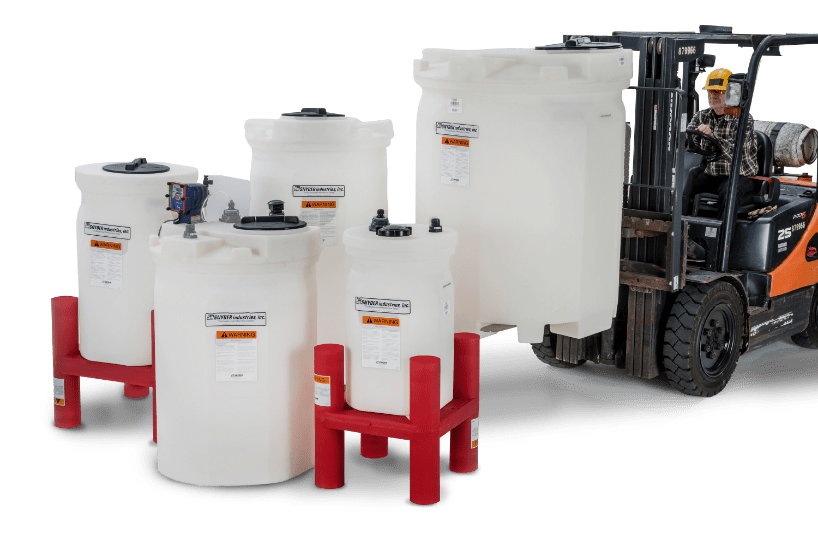
Industrial operations demand total chemical containment. Tank Depot delivers it. Our heavy duty chemical tanks are engineered for superior safety and long-term reliability. We specialize in industrial poly chemical tanks, the proven standard for storing aggressive materials. These primary tanks are crafted from High-Density Linear Polyethylene (HDLPE) or fortified Cross-Linked Polyethylene (XLPE). Each material is chosen for its exceptional strength and resistance to corrosive chemicals like sulfuric acid, HCL, and sodium hypochlorite.
Send Us Your Project Drawings for a Fast, Free Estimate!
Chemical Tank Types Explore our range of chemical storage tanks designed for various applications, each crafted for safety and efficiency.
Why Safe Chemical Storage Matters Our industrial chemical storage tanks are designed to comply with strict ASTM standards, providing reliable solutions for corrosive environments. Whether you’re storing acids, alkalis, or other chemicals, our tanks provide safe, durable, and reliable containment solutions.
Exceed Environmental & EPA Standards
The seamless, one-piece construction of our industrial plastic chemical tanks eliminates the seams, welds, and joints that are common points of failure in other tanks. This robust design provides superior leak protection, helping you prevent hazardous spills and exceed EPA requirements.
Maintains Chemical Purity and Stability
The high-purity, FDA-compliant virgin resin used in our polyethylene chemical storage tanks is chemically inert. This prevents leaching or contamination, preserving the purity and stability of your stored materials. For temperature-sensitive applications, we offer options like insulation and heat tracing to maintain consistent conditions.
Superior Durability for Worker Safety
Crafted from industrial-grade HDLPE and XLPE, our heavy duty chemical processing tanks are impact-resistant and built to withstand harsh plant environments. This inherent durability minimizes the risk of tank failure, protecting your team from exposure and costly workplace accidents.
Built to Strict ASTM D-1998 Standards
Peace of mind comes from proven engineering. Our polyethylene chemical storage tanks are designed and manufactured to meet the stringent ASTM D-1998 standards for polyolefin tanks, ensuring you receive a certified, reliable containment solution.
Solutions for Diverse Industrial Applications
Our industrial poly chemical tanks are trusted across a wide range of critical sectors. We provide dedicated storage solutions for water and wastewater treatment, chemical manufacturing and distribution, agriculture, food and beverage processing, and metal finishing.
Versatile Designs for Any Operational Footprint
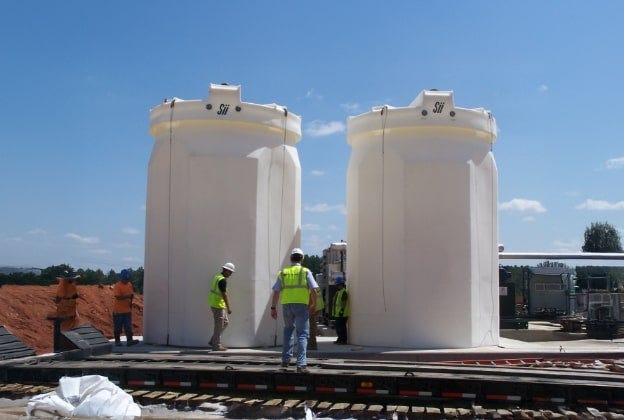
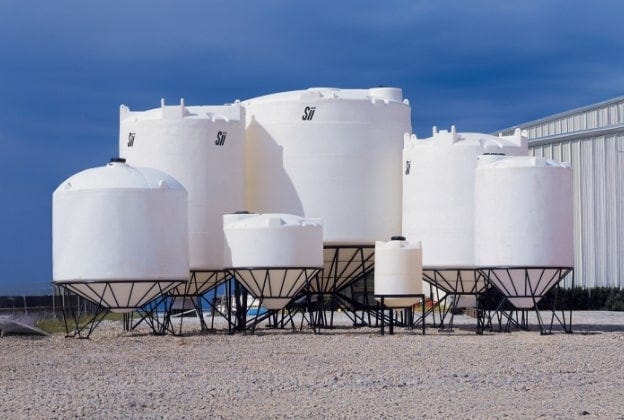
From compact vertical tanks for indoor use to large-capacity cone-bottom tanks that allow for complete drainage, our versatile configurations integrate into any facility layout. We provide high-capacity storage solutions engineered to optimize your operational space.
Engineered Chemical Storage Solutions Our expertise also covers chemical storage and processing tanks for highly specialized applications. The tank material range includes Polypropylene (PP) for high-temperature performance and Polyvinylidene Fluoride (PVDF) for unmatched chemical purity and resistance. We also supply Polyvinyl Chloride (PVC) tanks to meet specific compatibility requirements. This comprehensive material selection ensures we can architect the precise storage solution for any process, including the handling of salts like calcium chloride, aluminum sulfate, or common industrial glycols.
From bulk storage to critical chemical handling, we have you covered. With sizes ranging up to 20,000 gallons and designs like double-walled containment systems, our commercial chemical tanks meet and exceed all industry standards.
Customize Your Chemical Storage Tank When a standard tank doesn't meet your specific operational or site requirements, our fabrication team will engineer a solution tailored to your exact needs. We work with a complete range of industrial materials to solve complex storage challenges.
Our Customization Capabilities Include: Let our team work from your specifications to build a chemical tank that integrates perfectly with your operation.
Advanced Material Options
We fabricate custom tanks from a wide array of materials, including:
High-Density & Cross-Linked Polyethylene (HDLPE/XLPE)
Polypropylene (PP), Polyvinylidene Fluoride (PVDF), Polyvinyl Chloride (PVC)
Stainless Steel (SS 304/316L)
Coated & Lined Carbon Steel
Corrugated Steel
Custom Fittings & Modifications:
We can modify tanks with any component your process requires, such as:
Flanges, Nozzles, and Bulkhead Fittings in any size or style
Custom Manways and Access Ports
Ladders, Cages, and Walkways for safe access
Seismic and Wind Load Restraints
Mounts for Agitators, Mixers, and other equipment
Customize Your Chemical Storage Tank When a standard tank doesn't meet your specific operational or site requirements, our fabrication team will engineer a solution tailored to your exact needs. We work with a complete range of industrial materials to solve complex storage challenges.
Our Customization Capabilities Include: Let our team work from your specifications to build a chemical tank that integrates perfectly with your operation.
Advanced Material Options
We fabricate custom tanks from a wide array of materials, including:
High-Density & Cross-Linked Polyethylene (HDLPE/XLPE)
Polypropylene (PP), Polyvinylidene Fluoride (PVDF), Polyvinyl Chloride (PVC)
Stainless Steel (SS 304/316L)
Coated & Lined Carbon Steel
Corrugated Steel
Custom Fittings & Modifications:
We can modify tanks with any component your process requires, such as:
Flanges, Nozzles, and Bulkhead Fittings in any size or style
Custom Manways and Access Ports
Ladders, Cages, and Walkways for safe access
Seismic and Wind Load Restraints
Mounts for Agitators, Mixers, and other equipment
Chemical Specific Tanks
Vertical Sulfuric Acid Storage Tanks
Our vertical sulfuric acid storage tanks are available in commercial and industrial design standards.
Our sulfuric acid tanks are available in HDLPE - High-density linear polyethylene and XLPE - High-density cross linked polyethylene.
Sulfuric acid resin available for tanks up to 15,000 gallons.
Our Sulfuric Acid storage tanks are made for Sulfuric Acid concentrations up to 99%
Tanks rated with at least 1.9 specific gravity recommended.
Welded-in Polyethylene flanges or couplings, or CPVC threaded fittings with viton gaskets recommended.
Sulfuric Acid Storage Challenges
Due to the weight of Sulfuric Acid it will push the limits of mechanical integrity of any plastic or polyethylene tank.
Adding water to sulfuric acid that is concentrated can lead to sulfuric acid aerosol dispersal and in the worst case scenario - an explosion.
The accidental spillage of sulfuric acid on metals can produce highly flammable hydrogen gas.
Sulfuric acid burns are severe - sulfuric acid dehydrates whatever it comes into contact with and the heat produced from the reaction can cause second degree burns.
Sulfuric acid should not be stored with organic materials or within specific metal containers to prevent fire, explosion or the generation of toxic fumes and flammable gases.
Important Sulfuric Acid Storage Tank Considerations
HDPE or XLPE should be used for the entire tank to attain a higher tensile strength and improved sulfuric acid chemical resistance.
High Density linear resin is considered the best poly chemical barrier, with the most chemical resistance and in turn prolongs tank life and is repairable by welding if the tank is damaged.
Sulfuric Acid containers should be kept in a cool, dry and well ventilated area. Containers should be tightly sealed to prevent exposure to foreign materials and temperature changes.
Sulfuric Acid ≤ 98% (Ambient Temperature) Recommendations
Tank Material: HDLPE or XLPE
Fitting Material: CPVC
Gasket Material: Viton
Bolt Material: Hastelloy
Tank Specifications
Ferric Chloride Tanks available in HDLPE (High Density Linear Polyethylene) with a 1.9 specific gravity rating or in HDXLPE (High Density Crosslinked Polyethylene) also with a 1.9 specific gravity rating.
Full Drain Option
SUMO (Snyder Unitized Molded Outlet)
Available on single wall ferric chloride vertical tanks in 2,000 to 12,500 gallon range.
Encapsulated Hastelloy or Titanium threaded ring with PVC adapter.
Double Wall Ferric Chloride Tanks
Mini-Captor and CAPTOR Containment Systems (CCS) - 35 to 10,000 gallons.
Primary Tank - HDLPE, 1.9 specific gravity rating (ASTM D-1998 - 600 psi hoop stress design) or HDXLPE with 1.9 specific gravity rating.
Secondary Containment Tank made from HDLPE with 1.5 specific gravity rating.
Ferric Chloride Tank Fittings
Fittings made from PVC (schedule 80)
Gasket material: EPDM (Ethylene Propylene Diene Monomer)
Bolts made from Hastelloy or Titanium
Ferric Chloride Tank Plumbing
Flexible Connections with fittings required.
4% Vertical and lateral expansion and contraction of the tank to be expected.
Flexible Ferric Chloride Tank Connections reduces vibrations from pumps and piping stress on the tank, its fitting and gaskets.
Connections, piping and valves must all have structural support independent of the sidewalls of the tank and tank dome.
Ferric Chloride Tank Venting
Ferric Chloride Tanks are designed for use at atmospheric pressure. Pressure or a vacuum may cause the tank to deform or for damage to occur to the tank and void the tank’s warranty.
Venting equipment must be sized to limit the pressure or vacuum in the tank to a maximum of 1/2” water column which corresponds to 0.018 PSI. Pneumatically filled tanks may require additional pressure relief.
Ferric Chloride Tank Foundation & Restraints
Ferric Chloride Tanks should be positioned on a smooth concrete or asphalt pad to provide the tank with adequate support. Make sure the pad is clean, smooth and level so there is no deflection in the bottom support of the Ferric Chloride Tank.
If seismic restraint must be employed use a pad that is large enough for anchor plate attachments per the requirements in the seismic code.
Ferric Chloride Tank Temperature
Ferric Chloride Tanks should not be exposed to temperatures greater than 100 degrees Fahrenheit during delivery or storage.
Tank Specifications
HDLPE, 1.9 SpGr rating (ASTM D-1998 - 600 psi hoop stress design)
Indoors - Natural Color
Outdoors - Opaque White Resin #880059 or Natural color with insulation with mastic coating. * Opaque White Resin #880059 available on tanks up to 12,500 gallons
Full Drain Option
SUMO™ (Snyder Unitized Molded Outlet):
Available on single wall vertical tanks 2000 to 12,500 gallons.
Encapsulated Titanium threaded ring with PVC adapter.
Double Wall Sodium Hypochlorite Tanks
Mini-Captor™ and CAPTOR™ Containment Systems (CCS) – 35 to 12,500 gallons
Primary Tank
HDLPE, 1.9 SpGr, Natural color (ASTM D-1998 - 600 psi hoop stress design)
Outdoors - HDLPE, 1.9 SpGr, Opaque White Resin #880059
Secondary Containment Tank - HDLPE, 1.5 SpGr, Natural color
Sodium Hypochlorite Tank Fittings
Material of Construction: Fitting: PVC or CPVC (schedule 80), Gasket: Viton®,Bolt: Titanium
Sodium Hypochlorite Tank Plumbing
Required use of flexible connections with fittings
Allows for 4% lateral and vertical expansion and contraction of the tank
Reduces pump and piping vibration stress on the tank, fittings, and gaskets
Flexible connections, piping, and valves must have structural support independent of tank sidewall and dome
Sodium Hypochlorite Tank Venting
Tanks are designed for use at atmospheric pressure. Pressure or vacuum situation can cause excessive deformation or damage to the tanks and void warranty. Venting equipment should be sized to limit pressure or vacuum in the tank to a maximum of ½” water column (0.018 PSI). If the tank will be pneumatically filled (through tanker discharge) additional pressure relief may be required.
Sodium Hypochlorite Tank Foundations & Restraints
Tanks should be positioned on a smooth concrete or asphalt pad providing adequate support. The pad should be clean, smooth and level so it fully supports the entire tank bottom with no deflection. If a seismic restraint system is used the pad must be adequate in size for anchor plate attachments per the seismic code.
Sodium Hypochlorite Tank Temperature
Product should not exceed 100 degrees F at delivery or during storage to reduce decomposition of the Sodium Hypochlorite
Caution - The life of a tank is affected by the quality of the sodium hypochlorite stored. Tank owners are cautioned to use high quality sodium hypochlorite with low iron, nickel, and copper content. These metals contribute to the decomposition of the sodium hypochlorite and accelerate the oxidation and degradation of the tank.
Tank Specifications
HDLPE - High Density Linear Polyethylene with 1.9 specific gravity rating and meets ASTM D-1998 standards - 600 psi hoop stress design.
HDXLPE - High Density Cross Linked Linear Polyethylene with a 1.9 specific gravity rating and meets ASTM D-1998 standards - 600 psi hoop stress design.
Full Drain Option
SUMO™ (Snyder Unitized Molded Outlet)
Available on all single wall Snyder tanks in the 2000 to 12,500 gallon range.
Encapsulated 316SS threaded ring with PVC adapter.
Double Wall Sodium Hydroxide Tanks
Mini-Captor™ & CAPTOR™ Containment Systems. 35 to 10,000 gallon range.
Primary Tank is made of HDLPE or HDXLPE depending on customer preference and has a specific gravity rating of 1.9.
Secondary Containment Tank is made out of HDLPE with a specific gravity rating of 1.5.
Sodium Hydroxide Tank Fittings
Fitting: PVC & CPVC (schedule 80), PP or 316SS.
Gasket: (EPDM) - Ethylene Propylene Diene Monomer.
Bolt: 316SS
Heat Tracing & Insulation
Sodium Hydroxide is susceptible to freezing at 55 degrees Fahrenheit. In order to prevent the freezing of Sodium Hydroxide or crystallization you may need to keep the contents of your tank heated with a heat maintenance system.
Heat tracing and insulation is available on both our single and double wall Snyder polyethylene tanks.
Sodium Hydroxide Tank Plumbing
Sodium Hydroxide tanks require flexible connections with fittings.
You need to allow for %4 lateral and vertical contraction / expansion of the Sodium Hydroxide Tank.
The flexible connections, additional piping and valves must be supported independently of the tank sidewall and dome.
Sodium Hydroxide Tank Venting
Our Sodium Hydroxide Tanks are designed for use at atmospheric pressure. Pressuring or a vacuum can damage the tank and cause deformation. Venting equipment needs to be sized appropriately to limit pressure or the creation of a vacuum in the tank to a maximum amount of 1/2” water column.
Pneumatically filled tanks may require additional pressure relief.
Sodium Hydroxide Tank Foundations & Restraints
Tanks should be positioned on a smooth surface such as a concrete or asphalt pad that can provide adequate support for the tank. Make sure the pad is clean, smooth and level so there is no deflection in the bottom support of the tank. Seismic restraints should be attached using seismic anchor plate attachments per your local seismic code.
Sodium Hydroxide Tank Temperature
Product should not be stored or exposed to temperatures in excess of 100 degrees Fahrenheit.
Calcium Fertilizer Storage
Calcium - Ca is often blended with other chemicals / nutrients to act as a liquid fertilizer. Our tanks are perfect for Calcium storage when blending your own liquid fertilizer. Calcium promotes promotes plant growth and can help younger plants establish their roots.
Calcium Fertilizer decreases the chance of blossom-end rot on tomatoes, increases tomato growth and vigor.
Magnesium Fertilizer Storage
Poly and plastic tanks are a great choice for Magnesium - Mg liquid fertilizer storage and blending. We offer tanks in HDPE and XLPE models for superior storage abilities.
Magnesium fertilizer regulates plant food absorption and aids in formation of seeding.
A variety of plants see direct benefits from Magnesium liquid fertilizer including blueberries and azaleas. These type of plants grow in acidic soil so blending your own liquid fertilizer consisting of sulfur, magnesium and iron will encourage ideal size and color.
Nitrogen Liquid Fertilizer Storage
Nitrogen - N is an essential plant nutrient which promotes full plant development. For example your lawn requires a high level of nitrogen because the grass is constantly growing. Our HDLPE and XLPE tanks are great storage containers for Nitrogen that is going to be mixed to produce your own liquid fertilizer.
Phosphorus Plant Fertilizer Tanks
Phosphorus helps strengthen roots and increases the average bloom size of your plants. Phosphorus is commonly used as a fertilizer for flowers to encourage bigger blooms when the flower is in season.
Potassium - K Fertilizer Storage
Potassium is one of the more aggressive promoters of growth and helps strengthen a plant’s immune system. Potassium is commonly used as a liquid fertilizer in agricultural applications to promote fruit growth.
Fertilizer Tank Guidelines
Above Ground Liquid Fertilizer Tanks TFI Guidelines for Mechanical Integrity
Sulfur Tanks
Sulfur - S also gives plants a more vivid green color and can be used alone or in combination with Potassium to promote vigor plant growth.
Blending your own liquid fertilizer can be complicated but it is important that you have the proper capacity tank to mix your chemicals. Plastic and Poly tanks are a great storage container for Liquid Fertilizers.
Tank Specifications
HDLPE, 1.9 SpGr rating (ASTM D-1998 - 600 psi hoop stress design)
Full Drain
SUMO™ (Snyder Unitized Molded Outlet):
Available on single wall vertical tanks 2000 to 12,500 gallons.
Encapsulated Hastelloy threaded ring with PVC adapter.
Double Wall Sodium Hydrochloric Acid Tanks
Mini-Captor™ and CAPTOR™ Containment Systems (CCS) – 35 to 12,500 gallons
Primary Tank - HDLPE, 1.9 SpGr, Natural color (ASTM D-1998 - 600 psi hoop stress design)
Secondary Containment Tank - HDLPE, 1.5 SpGr, Natural color
Hydrochloric Acid Tank Fittings
Material of Construction: Fitting: PVC (schedule 80), Gasket: Viton®,Bolt: Hastelloy
Hydrochloric Acid Tank Plumbing
Required use of flexible connections with fittings
Allows for 4% lateral and vertical expansion and contraction of the tank
Reduces pump and piping vibration stress on the tank, fittings, and gaskets
Flexible connections, piping, and valves must have structural support independent of tank sidewall and dome
Hydrochloric Acid Tank Venting
Tanks are designed for use at atmospheric pressure. Pressure or vacuum situation can cause excessive deformation or damage to the tanks and void warranty. Venting equipment should be sized to limit pressure or vacuum in the tank to a maximum of ½” water column (0.018 PSI). If the tank will be pneumatically filled (through tanker discharge) additional pressure relief may be required.
Hydrochloric acid in concentrations above 10-20% is a volatile liquid and will start fuming at ambient temperatures. These fumes can be corrosive to the environment around the tank. For this reason a bolted and sealed (fume tight) manway should be considered for hydrochloric acid tanks and special considerations should be taken for venting the tank to a scrubber system.
Hydrochloric Acid Tank Foundation and Restraints
Tanks should be positioned on a smooth concrete or asphalt pad providing adequate support. The pad should be clean, smooth and level so it fully supports the entire tank bottom with no deflection. If a seismic restraint system is used the pad must be adequate in size for anchor plate attachments per the seismic code.
Hydrochloric Acid Tank Temperature
Product should not exceed 100 degrees F at delivery or during storage.
Tank Specifications
Magnesium Chloride Tanks available in HDLPE (High Density Linear Polyethylene) with a 1.9 specific gravity rating or in HDXLPE (High Density Crosslinked Polyethylene) also with a 1.9 specific gravity rating.
Full Drain Option
SUMO (Snyder Unitized Molded Outlet)
Available on single wall magnesium chloride vertical tanks in 2,000 to 12,500 gallon range.
Encapsulated Hastelloy or Titanium threaded ring with PVC adapter.
Double Wall Magnesium Chloride Tanks
Mini-Captor and CAPTOR Containment Systems (CCS) - 35 to 10,000 gallons.
Primary Tank - HDLPE, 1.9 specific gravity rating (ASTM D-1998 - 600 psi hoop stress design) or HDXLPE with 1.9 specific gravity rating.
Secondary Containment Tank made from HDLPE with 1.5 specific gravity rating.
Magnesium Chloride Tank Fittings
Fittings made from PVC (schedule 80)
Gasket material: EPDM (Ethylene Propylene Diene Monomer)
Bolts made from Hastelloy or Titanium
Magnesium Chloride Tank Plumbing
Flexible Connections with fittings required.
4% Vertical and lateral expansion and contraction of the tank to be expected.
Flexible Magnesium Chloride Tank Connections reduces vibrations from pumps and piping stress on the tank, its fitting and gaskets.
Connections, piping and valves must all have structural support independent of the sidewalls of the tank and tank dome.
Magnesium Chloride Tank Venting
Magnesium Chloride Tanks are designed for use at atmospheric pressure. Pressure or a vacuum may cause the tank to deform or for damage to occur to the tank and void the tank’s warranty.
Venting equipment must be sized to limit the pressure or vacuum in the tank to a maximum of 1/2” water column which corresponds to 0.018 PSI. Pneumatically filled tanks may require additional pressure relief.
Magnesium Chloride Tank Foundation & Restraints
Magnesium Chloride Tanks should be positioned on a smooth concrete or asphalt pad to provide the tank with adequate support. Make sure the pad is clean, smooth and level so there is no deflection in the bottom support of the Magnesium Chloride Tank.
If seismic restraint must be employed use a pad that is large enough for anchor plate attachments per the requirements in the seismic code. Magnesium Chloride Tank Temperature:
Magnesium Chloride Tank Temperature
Magnesium Chloride Tanks should not be exposed to temperatures greater than 100 degrees Fahrenheit during delivery or storage.
Tank Specifications
Calcium Chloride Tanks available in HDLPE (High Density Linear Polyethylene) with a 1.9 specific gravity rating or in HDXLPE (High Density Crosslinked Polyethylene) also with a 1.9 specific gravity rating.
Full Drain
SUMO (Snyder Unitized Molded Outlet)
Available on single wall calcium chloride vertical tanks in 2,000 to 12,500 gallon range.
Encapsulated Hastelloy or Titanium threaded ring with PVC adapter.
Double Wall Calcium Chloride Tanks
Mini-Captor and CAPTOR Containment Systems (CCS) - 35 to 10,000 gallons.
Primary Tank - HDLPE, 1.9 specific gravity rating (ASTM D-1998 - 600 psi hoop stress design) or HDXLPE with 1.9 specific gravity rating.
Secondary Containment Tank made from HDLPE with 1.5 specific gravity rating.
Calcium Chloride Tank Fittings
Fittings made from PVC (schedule 80)
Gasket material: EPDM (Ethylene Propylene Diene Monomer)
Bolts made from Hastelloy or Titanium
Calcium Chloride Tank Plumbing
Flexible Connections with fittings required.
4% Vertical and lateral expansion and contraction of the tank to be expected.
Flexible Calcium Chloride Tank Connections reduces vibrations from pumps and piping stress on the tank, its fitting and gaskets.
Connections, piping and valves must all have structural support independent of the sidewalls of the tank and tank dome.
Calcium Chloride Tank Venting
Calcium Chloride Tanks are designed for use at atmospheric pressure. Pressure or a vacuum may cause the tank to deform or for damage to occur to the tank and void the tank’s warranty.
Venting equipment must be sized to limit the pressure or vacuum in the tank to a maximum of 1/2” water column which corresponds to 0.018 PSI. Pneumatically filled tanks may require additional pressure relief.
Calcium Chloride Tank Foundation & Restraints
Calcium Chloride Tanks should be positioned on a smooth concrete or asphalt pad to provide the tank with adequate support. Make sure the pad is clean, smooth and level so there is no deflection in the bottom support of the Calcium Chloride Tank.
If seismic restraint must be employed use a pad that is large enough for anchor plate attachments per the requirements in the seismic code.
Calcium Chloride Tank Temperature
Calcium Chloride Tanks should not be exposed to temperatures greater than 100 degrees Fahrenheit during delivery or storage.
Get a Free Consultation or Custom Tank Quote Our experts are here to help you select the best storage solution to meet your specific needs.
Get a Free Consultation or Our experts are here to help you select the best storage solution to meet your specific needs.
FAQs: Industrial Poly Chemical Storage Tanks
Materials & Compatibility
Expert Guidance and Support