Custom Poly Tank Ordering & Industrial Fabrication Guide
In the world of liquid handling, "standard" only takes you so far. Whether you are navigating the tight footprint of an existing mechanical room or managing a highly aggressive chemical profile, an off-the-shelf vessel often falls short of operational requirements. At Tank Depot, we categorize these specialized solutions into one "custom fabricated" bucket, a comprehensive approach to custom tank ordering that bridges the gap between a project concept and a structurally sound, code-compliant reality.
Delivering customized tanks to industrial and commercial facilities isn't a one-size-fits-all process. Depending on your specific gravity requirements, temperature fluctuations, and volume needs, your project will fall into one of three distinct "pillars" of customization:
- Industrial Poly Tank Modifications: Precision-engineered add-ons to existing high-quality vessels.
- Custom Welded Tanks: Exceptional thermoplastic fabrication built from sheet stock to fit unique geometries.
- Custom Molded Tanks: Scalable, proprietary designs created through the rotational molding process.
The goal is to move beyond simple storage. By aligning your project with the right manufacturing path, we ensure your tank is built to the highest relevant industry benchmarks. Whether that is ASTM D-1998 standards for seamless rotationally molded vertical cylindrical tanks, or German D.V.S. welding standards for fabricated units. When you order a custom molded tank or a fabricated unit from us, you aren't just buying a container; you are partnering with an engineering team dedicated to getting the design right the first time.
Route 1: Industrial Poly Tank Modifications (The Speed Route)
When project timelines are tight, starting from a blank CAD file isn’t always the most efficient move. For many industrial applications, the most effective route is industrial poly tank modifications. This process involves taking a high-quality, off-the-shelf vessel, frequently a Snyder tank customization project, and retrofitting it with permanent, high-performance components.
This is more than just "adding parts." We transform a standard storage vessel into a functional piece of equipment by integrating specialized accessories:
- Integrated Access & Safety: We install OSHA-compliant ladder and cage assemblies and platforms, ensuring your team can safely service top-mounted equipment or perform manual inspections.
- Structural Reinforcements: For blending applications, we provide heavy-duty, powder-coated steel mixer stands. By mounting your agitator on a dedicated stand rather than the tank dome, we eliminate vibration stress and significantly extend the life of your equipment.
Note: To ensure the fastest delivery, these specialized components are shipped directly from our manufacturing partners and arrive ready for integration with your vessel.
- Precision Fluid Connections: To ensure a leak-proof system, our technicians utilize German D.V.S. welding standards for all welded tank fittings, nozzles, and flanges. This technique creates a homogenous molecular bond with the tank wall, making the connection an integral part of the vessel.
- Environmental Protection: We can apply industrial-grade foam insulation and heating blankets to maintain critical process temperatures, as well as seismic and wind restraints for outdoor or high-risk installations.
By leveraging our national network and existing inventory, this path is often the fastest way of delivering customized tanks to your job site, often shaving weeks off the lead time compared to a full scratch-build.
Route 2: Custom Welded Tanks (The Geometric Path)
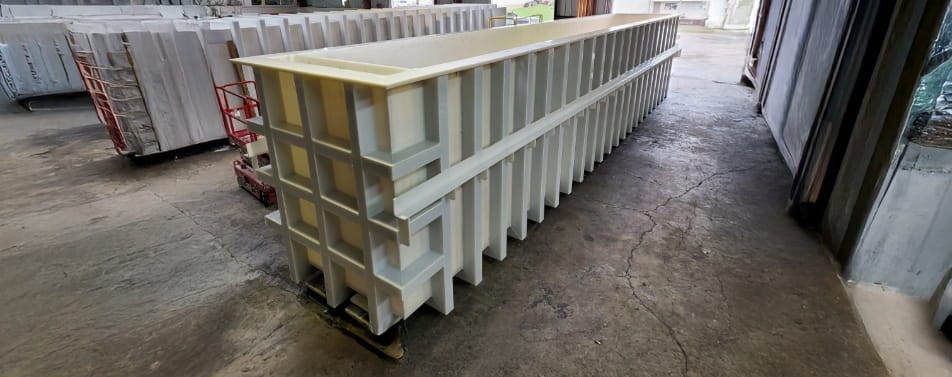
When a project demands a footprint that doesn’t exist in a catalog, such as a rectangular brine tank for a tight mechanical room or a square plating vat, the solution is full thermoplastic fabrication. Unlike standard molding, this path involves building the vessel from high-density sheet stock, offering the ultimate flexibility in dimensions and material selection.
This is the preferred route for custom tank ordering when standard HDPE isn’t enough. By using sheet stock, we can facilitate projects requiring high-performance materials like Polypropylene (PP) or PVDF for aggressive, high-temperature chemical applications.
Structural Integrity in Fabrication
In custom fabrication, we don't simply "pick" a sheet thickness based on a guess. For every build, the wall thickness is an engineered value calculated to withstand the specific hydrostatic head pressure (P) at the base of the tank. This pressure is a direct result of the fluid’s height and its specific gravity (the density of the chemical being stored).
To ensure structural safety, we utilize the Hoop Stress formula (often referred to as Barlow’s formula or the thin-shell equation). This allows our engineers to determine the stress acting circumferentially around the vessel wall to ensure the material never reaches its deformation point.
The variables in our equation represent:
- S (Hoop Stress): The stress acting circumferentially around the vessel wall.
- P (Internal Pressure): The hydrostatic pressure exerted by the fluid, calculated based on the maximum hydrostatic head at the base of the tank and the chemical's specific gravity.
- D (Outer Diameter/Width): The primary dimension (diameter or width) of the vessel.
- T (Wall Thickness): The required thickness to safely contain the load.
Performance and Versatility
- The Homogenous Bead: Once the thickness (T) is determined, our technicians utilize German D.V.S. welding standards to join the sheets. This creates a weld bead that is molecularly identical to the base material—resulting in a homogenous molecular bond. This permanent, integral seal handles industrial hydrostatic pressure without the risk of stress cracking.
- Material Versatility: This route allows us to work with specialized materials that aren't easily roto-molded, such as PVDF for high-heat processes or PP for specific chemical environments, ensuring your tank is perfectly matched to its chemical profile.
Whether your project requires a specific rectangular shape to maximize a narrow floor layout or a high-performance PVDF liner for a high-heat process, the custom welding route ensures you never have to compromise on safety or facility efficiency. Beyond external dimensions, this fabrication method allows for high-value internal configurations that standard molding cannot achieve, including:
- 100% Drainage (Drain-Dry Capability): We can engineer specific floor slopes to ensure total evacuation of liquids, which is critical for sanitation in food processing or high-purity chemical applications.
- Integrated Baffle Systems: For tanks involving agitation or mobile transport, we install custom baffles to manage fluid slosh and maintain structural stability.
- Compartmentalized Designs: We can fabricate single-vessel units with internal dividers, allowing you to store or process multiple materials within the same footprint.
- Specific Dimensional Restrictions: We build to the inch, ensuring your tank fits perfectly between existing structural columns or inside specialized equipment housings.
Route 3: Custom Molded Tanks (The Volume Route)
While modifications and welding solve immediate footprint or material challenges, there are times when your project requires a completely proprietary shape, one that might need to be replicated 50 or 100 times. This is where you would order a custom molded tank.
This route utilizes rotational molding (or "roto-molding"). Unlike welding, where we join sheets of plastic, roto-molding involves heating resin inside a custom-built steel or aluminum mold that rotates on two axes. The result is a seamless, stress-free, one-piece vessel with high structural integrity.
Navigating the "Tooling" Investment
The biggest hurdle for most engineers when considering custom tank ordering via molding is the upfront cost. Since we are building a physical mold specifically for your design, there are tooling fees to consider. However, the trade-off is often worth it for larger runs:
- Lower Per-Unit Cost: Once the mold is built, the cost to "pull" each custom tank is significantly lower than the labor-intensive welding process.
- Complex Geometry: Roto-molding allows for curves, integrated handles, and unique structural ribbing that would be nearly impossible to fabricate by hand.
- Proprietary Designs: If your equipment requires a custom storage tank that fits into a very specific chassis or housing, molding ensures every single unit is identical.
Is Molding Right for You?
We typically recommend this path for clients who need delivering customized storage tanks in higher volumes or those with complex, repeatable designs that welding can't achieve. While the lead time is longer, often 12 to 15 weeks to account for mold fabrication, the result is a professional, seamless product that is "brand-ready" and engineered for longevity.
The "Big Three" Design Inputs
Before we even think about custom tank ordering, we have to nail down these variables:
- Chemical Compatibility: It’s not just "poly." We have to ensure the resin (HDPE, XLPE, or PP) is a perfect match for your specific concentration of chemicals. Storing 98% sulfuric acid requires a very different approach than 15% sodium hypochlorite.
- Operating Temperatures: Plastics have a "memory" and a thermal expansion coefficient. We account for material softening at higher temperatures to ensure the storage tank doesn't lose its structural "muscle" during a process cycle.
- Environmental Conditions: Is your tank heading to a climate-controlled facility or the Texas sun? We help you select the right material grade and color that suits your environment. Choosing a UV-stabilized resin or a black-tinted tank can prevent material "embrittlement" and significantly extend the life of an outdoor installation.
Rigorous Testing Protocols
To satisfy ASTM D-1998 standards, we don't just "hope" the liquid storage tank holds; we prove it. Every custom build undergoes a gauntlet of quality assurance tests, including:
- Ultrasonic Thickness Testing: We use high-frequency sound waves to verify that the wall thickness is consistent and meets the engineered design specs at every single point on the tank.
- Hydrostatic & Pressure Testing: This is the "real world" test. We fill the vessel to capacity to simulate the exact liquid load and stress it will face in your facility.
- Impact Testing: We verify the material’s ductility. You want a tank that can handle the mechanical stresses of an industrial environment without cracking.
A Note on Spark Testing: You might hear this term in industrial steel or FRP (Fiberglass) circles. However, when you order a custom molded tank made of polyethylene, spark testing is generally irrelevant because poly is non-conductive and cannot be grounded. If your process requires a grounded, conductive vessel for volatile fluids, that’s the moment we pivot the conversation toward steel or specialized FRP solutions.

Logistics, Lead Times, and "The Point of No Return"
Understanding the timeline is critical for project managers balancing multiple contractors. When delivering customized tanks, we operate on a tiered schedule based on the complexity of your build.
Realistic Timeline Benchmarks
- Design & Engineering (1–2 Weeks): Once we have your initial specs, our team gets to work. This period covers the back-and-forth required to move from a "rough idea" to a final, submittal-ready engineered drawing.
- Production – The Modification Route (4–8 Weeks): If we are performing industrial poly tank modifications on an in-stock vessel, the turnaround is remarkably fast.
- Production – The Fabricated/Molded Route (8–15 Weeks): A custom welded tank typically sits on the shorter end of this window, while a project where we must order a custom molded tank involving steel tool fabrication can take up to 15 weeks.
NB: Disclaimer: Please note that the durations listed above are estimated benchmarks for the design and manufacturing phases only. Actual project lifecycles are subject to variance based on technical complexity, material availability, and third-party variables. For instance, municipal or government-contracted projects often involve multi-stage regulatory approvals, environmental impact assessments, and rigorous submittal reviews that may extend the total project timeline from several months to over a year. We recommend engaging our engineering team early in your planning phase to establish a project-specific critical path.
The Collaborative Workflow: The Iteration Loop
We don't expect the first drawing to be the final one. In fact, for complex industrial setups, it’s common to go through 6 to 20 different versions of a drawing. We "thrash out" every nuance, fitting placements, wall thickness, and accessory clearance, with your engineers until the design is flawless.
The Final Sign-Off: The Point of No Return
This is the most critical stage of the process. Once the final engineering drawing is approved and signed, the project moves into the production queue. At this moment, the order becomes non-cancellable. Because custom tanks are built to your specific, non-standard requirements, they cannot be restocked or repurposed. We emphasize this "Point of No Return" to ensure every stakeholder is 100% confident in the design before the first bead is welded or the first pound of resin is dropped into a mold.
The National Network Advantage
Freight is often the "hidden cost" in tank procurement. We combat this by leveraging a national network of manufacturing and fabrication hubs. By routing your order to the facility closest to your job site, we significantly reduce shipping costs and transit times, ensuring that delivering customized tanks remains cost-effective regardless of your location.
Comparing Poly Custom Modifications to Plastic Welding and Molding Techniques
| Feature | Poly Modifications | Custom Welded |
Custom Molded |
| Lead Time | 4–8 Weeks | 8–15 Weeks | 12–15 Weeks |
| Best For | Speed / Standard Shapes | Unique Footprints / Heat | High Volume / Proprietary |
| Materials | HDPE / XLPE | HDPE / PP / PVDF | HDPE / XLPE |
| Tooling Cost | Zero | Low | High (Steel/Alum Molds) |
| Unit Cost | Moderate | High (Labor Intensive) | Lowest (At high volume) |
| Geometry | Cylindrical / Vertical | Rectangular / Square | Complex / Curved |
| Seams | Seamless (Base tank) | Welded (Homogenous Bead) | 100% Seamless |
| Qty Ideal for ROI | 1–10 units | 1–5 units | 20+ units |
| Engineering | Fitting Layouts | Full Structural Design | Full Mold Design |
| Testing Focus | Leak / Hydrostatic | D.V.S. Weld Integrity | Wall Thickness / Impact |
Beyond the Tank | Full-System Integration
For a factory manager or lead engineer, the tank is rarely the end of the project—it’s the center of a larger liquid handling ecosystem. One of the primary advantages of custom tank ordering through Tank Depot is our ability to provide a "one-stop" integrated solution.
Instead of sourcing your vessel from one vendor, your flow control from another, and your monitoring sensors from a third, we provide full-system integration to simplify your procurement and project management.
The Complete Liquid Handling Ecosystem
When we design your custom or modified tank, we can simultaneously spec and supply the critical components required for operation:
- Flow Control & Pumping: Precision-matched pumps and valving designed to handle the specific gravity and viscosity of your stored media.
- Advanced Monitoring: From simple sight gauges to ultrasonic level sensors and leak detection systems that integrate directly into your facility’s PLC or SCADA system.
- Instrumentation & Safety: Integrated vent assemblies, heating blankets for temperature-sensitive chemicals, and OSHA-compliant access systems.
By centralizing these components, you ensure that every fitting, mount, and sensor is compatible with the storage tank's material and structural design. This holistic approach reduces the risk of field-fitting errors and ensures that your system is operational the moment it arrives on-site.
Tank Depot: Engineering Your Success
Whether your project requires the rapid turnaround of industrial poly tank modifications, the unique geometry of a custom welded vessel, or the scalable efficiency of a proprietary mold, Tank Depot has the technical expertise to deliver. We don't just sell tanks; we partner with you to engineer a solution that meets ASTM D-1998 standards and exceeds your operational goals.
Ready to transition from a project need to a structural reality?