


On a working farm, water is the one input you cannot run short on. A dry trough means stressed animals and lost weight gain. A cracked tank in a far field means a wasted afternoon hauling replacements. And the wrong tank for liquid fertilizer can bulge or split under a load it was never built to hold. Getting your water storage right protects your livestock, your crops, and your operating budget all at once.
Farm tanks also take a beating: relentless sun, freezing nights, and the structural stress of liquid sloshing around during field transport. This guide walks through the eight best farm water tank containers for agriculture, matched to the jobs you actually need them for, from daily livestock watering to field transfer and dense chemical storage. Stick around for the bonus on Tank Depot's Omni Series deployable concrete tanks paired with InstaSlab foundation pads, for operations that want concrete's durability without the excavation.
1. Heavy-Duty Poly Stock Tanks & Livestock Troughs
For daily cattle, horse, and livestock watering, heavy-duty poly stock tanks earn their keep. Where galvanized steel troughs rust, dent, and corrode from mineral-heavy water, seamless polyethylene resists cracking even in sub-zero cold. Smooth, rounded rims protect animals from injury, and molded bottom drain plugs turn the regular scrub-out into a quick job instead of a wrestling match. To match a trough to your herd, review our guide to 100-gallon stock tank dimensions.
2. Agricultural Nurse Trailer Tanks (Field Transfer)
When you are moving water, liquid fertilizer, or spray mixes out to fields far from the yard, nurse tanks on a field trailer do the hauling. Their low horizontal profile and internal baffles keep the center of gravity down and cut the liquid slosh that can make a full tank feel like it is steering the trailer over rough ground. Look for agricultural nurse transfer tanks with heavy-duty steel support hoops and a sump base so you can drain them out completely.
3. Food-Grade IBC Tote Tanks (275 to 330 Gallon Modular Storage)
Intermediate bulk containers (IBC totes) are the flexible workhorse for small farms, homesteads, greenhouse drip systems, and sap collection. Caged in galvanized steel on a stackable pallet, a 275 or 330 gallon tote lifts easily with tractor forks or a skid steer and takes well to DIY plumbing. One rule protects your animals and crops: for drinking water or crop irrigation, only use totes molded from food-grade, FDA-approved, BPA-free virgin polyethylene (resin compliant with FDA 21 CFR 177.1520), and never one that has held industrial chemicals.
4. Bulk Vertical Plastic Storage Tanks
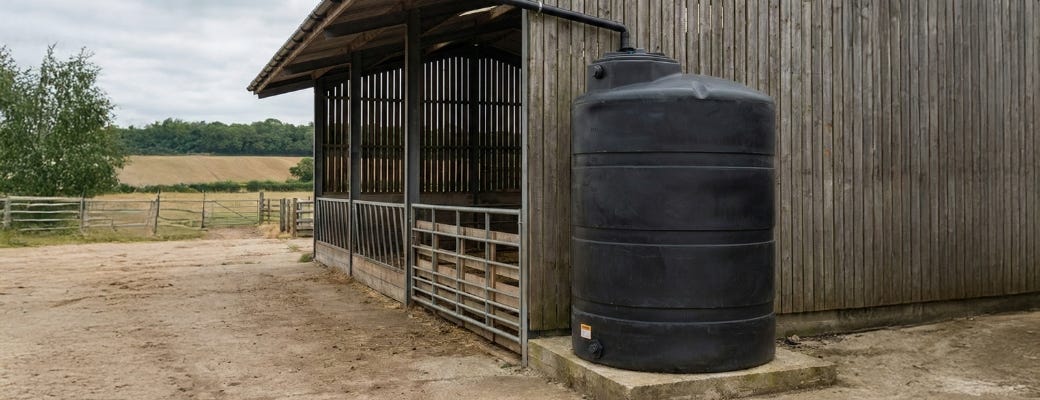
For a central, stationary water supply, vertical poly tanks pack the most gallons into the smallest footprint, from about 500 up to 15,500 gallons. UV-stabilized dark green or black walls block sunlight so algae never gets the light it needs to turn your water green. Sitting on a pad by the barn or outbuilding, they feed washdowns, equipment cleaning, and gravity-fed troughs. To keep stored water clean between fills, see our tips on keeping stored water fresh.
5. Horizontal Leg Hauling Tanks (Pickup Truck & Trailer Water Transfer)
When the job is hauling water in a pickup bed or on a flatbed, horizontal leg tanks are built for the road. Molded legs replace separate cradle supports, and pin-down steel bands strap the tank straight to the bed floor so it does not shift on you mid-haul. Translucent walls with molded gallon markers let you check your level at a glance. Check out pickup truck water hauling tanks contoured to clear the wheel wells so you never waste bed space.
6. Specific Gravity Rated Chemical & Fertilizer Tanks
This is where the wrong tank fails expensively. A standard water tank is rated for liquids up to 1.0 specific gravity, about 8.3 lbs per gallon. But liquid fertilizers and ag chemicals are heavier: UAN nitrogen solution runs about 11 lbs per gallon, and dense suspensions and liquid lime can reach roughly 14 lbs per gallon (around 1.3 to 1.7 specific gravity). Store those in a standard tank and the walls can bulge or split. Specific-gravity-rated tanks are built with thicker, reinforced walls rated for 1.5 to 1.9 specific gravity, so they hold dense agricultural fluids without deforming or failing.
7. Corrugated Galvanized Steel Water Storage Tanks
For large operations that need tens of thousands of gallons for crop irrigation, feedlots, or rural fire protection, corrugated galvanized steel tanks bring industrial capacity. An internal NSF-certified flexible poly liner keeps stored water off the metal, while the steel shell shrugs off decades of weather, extreme heat, and wildfire exposure. Learn more in our guide on steel tanks for agricultural fire suppression and supply.
8. Subterranean Agricultural Poly Cisterns
In hard-freeze country, or where farmyard surface space is at a premium, underground poly cisterns take the freeze problem off the table. Heavy-duty ribbed sidewalls handle the soil load, and sitting below the frost line keeps water temperature-stable year-round, feeding automatic waterers and pump stations without icing up in winter. For how buried poly compares with concrete, see our guide to polyethylene vs concrete underground tanks.
Strategic Farm Water Planning & Drought Resilience
Good farm water planning comes down to matching daily demand against seasonal supply. A lactating dairy cow can drink 30 to 50 gallons a day in summer heat, and beef cattle 10 to 20 gallons a head, so demand adds up fast across a herd. To build drought resilience across your acreage:
- Size Your Demand First: Add up total daily livestock and crop irrigation needs before you buy.
- Link Tanks in Series: Use high-flow, corrosion-resistant heavy-duty bulkhead fittings to connect multiple storage tanks and expand capacity as you grow.
- Catch Rainwater Off Your Roofs: Supplement well water by harvesting off barn and shed roofs. Our guide to rainwater harvesting tanks covers the tank options, and our farm water storage strategies for drought resilience guide digs into the planning frameworks.
- Follow Trusted Standards: Reference the USDA Natural Resources Conservation Service (NRCS) agricultural water standards and Penn State Extension livestock watering guidelines.
Bonus Solution: Omni Series Deployable Concrete Tanks & InstaSlab Foundations
Polyethylene and steel cover most daily farm needs, but large feedlots, dairies, and processing facilities often want the structural durability, thermal insulation, and fire resistance of concrete. The catch with traditional poured concrete is heavy crane delivery, expensive excavation, and weeks of curing. Tank Depot's Omni Series deployable concrete tanks change that math:
- Eco-Friendly Low-Carbon Concrete: Made with sustainable mix designs that meaningfully lower embodied carbon versus traditional poured concrete.
- Instant Aboveground Deployment: Sets on a flat pad aboveground, eliminating excavation labor, soil-pressure risks, and water-table flotation.
- Paired With InstaSlab Foundations: Team the tank with InstaSlab roll-out concrete foundation slabs for a pre-engineered, high-load-bearing pad in hours, with no mixer trucks or 28-day cure.
- Wildfire & Thermal Protection: High thermal mass keeps livestock drinking water cool through summer heatwaves and gives you a dependable fire-suppression reserve during rural wildfires.
Agricultural Consultation & Custom Sizing
Need a hand sizing a livestock watering system, calculating field-transfer payload weights, or choosing the right specific-gravity-rated tank for farm chemicals? Contact our agricultural tank specialists today for guidance tailored to your operation.


