


Deployment Guide: Setting Up a Large Water Bladder Tank in the Field
A water bladder is only as good as the setup behind it. On paper, a large pillow tank looks simple. It folds flat, ships in one crate, and holds thousands of gallons when you need them. In the field, the details decide everything. A full bladder is heavy, the ground under it is rarely perfect, and a rushed fill can undo hours of work in minutes.
This guide walks through how to deploy a large water bladder the right way, from planning the site to draining and repacking. It is written for crews who need bulk water where there is no plumbing: fire and emergency teams, remote job sites, farms, and mobile operations. It focuses on closed pillow bladders, which Tank Depot stocks from 25 gallons up to 20,000 gallons. If you are still deciding which flexible tank fits your job, our guide to heavy-duty bladder tanks covers materials and selection.
Here we focus on one thing: getting the bladder water tank set up and filled without a problem.
Before You Deploy: Plan the Site and the Load
Water is heavy. Every gallon weighs about 8.34 pounds [3.78 kg]. A 2,000 gallon pillow bladder holds close to 16,700 pounds [7,570 kg] of water when full. A 5,000 gallon bladder holds more than 41,000 pounds [18,600 kg], and a 20,000 gallon bladder tops 166,000 pounds [75,300 kg]. That weight sits on whatever is under the tank, so the ground and the layout matter as much as the tank itself.
Start with three questions.
- How much water do you need to store at once?
- How will you get water in and out?
- And what will the tank sit on?
Answer these before anything leaves the truck. Oversizing wastes setup time and space. Undersizing means you run dry mid-job. Match the capacity to the real demand, then add a small margin.
Also confirm what the water is for. Drinking water needs a potable-grade tank. Tank Depot offers potable water bladders built from NSF/ANSI 61 approved material for exactly this reason. Non-potable uses like dust control, irrigation, or equipment supply give you more options at lower cost. Never store drinking water in a tank rated for another liquid.
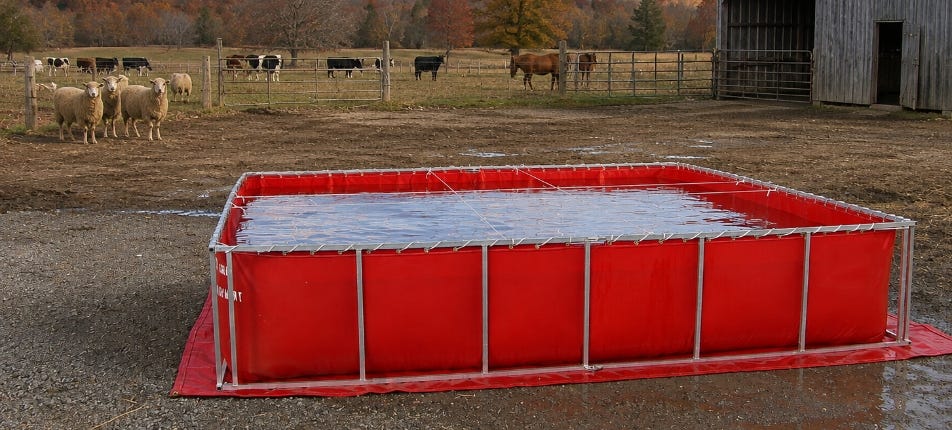
Choosing Your Deployment Footprint: Bladder, Onion, or Folding Frame
Not every inflatable tank deploys the same way, and the right choice often comes down to your ground and how you draw water. This is a deployment decision, not just a shopping one. Tank Depot groups all of these under temporary water storage, so you can compare styles side by side.
A closed pillow bladder sits low, seals the water from dust and sun, and works well for potable supply and longer staging. It is the quiet workhorse for clean water you plan to hold for a while. Tank Depot stocks closed potable water bladders from 25 up to 5,000 gallons, plus a 20,000 gallon model, all built from NSF/ANSI 61 approved material. This guide covers setting up that closed pillow style.
When you need to dump water in fast from a tender or dip it from the top, an open-top tank is better. Self-supporting onion tanks rise on a foam collar and set up in under a minute, which is why fire crews reach for them, and they run all the way up to 20,000 gallons.
Folding frame tanks give you a firm, framed reservoir that holds its shape on rougher ground. These open-top styles set up differently than a closed bladder, so if that is your tank, look for a dedicated setup guide. For the very largest open reservoirs, such as 10,000 and 14,000 gallons, onion tanks are the practical choice.
If you are managing spills or diverting water rather than storing it, vinyl bladder dikes are a separate tool for that job. Not sure which footprint fits your site? Our team can size it with you before you deploy.
Site Selection and Ground Preparation
This is where most field problems start. A bladder needs a flat, cleared, and level spot. Aim for ground that slopes no more than a few degrees, and check the manufacturer sheet for the exact slope limit on your model. Water always finds the low side, so even a small slope pushes the load to one end and can stress the seams.
Clear the area down to bare, smooth ground. Remove rocks, sticks, roots, glass, and anything sharp. A single stone under a full load becomes a puncture waiting to happen. Rake the surface, then walk it and check it with your own eyes and hands.
Always use a ground cover. A cover or tarp under the tank is cheap insurance against punctures and abrasion, and it makes cleanup and repacking easier. Tank Depot sells ground covers sized for temporary tanks for this exact job. Give yourself extra room around the tank too, so crews can walk the perimeter, reach the fittings, and watch for leaks.
Gear and Fittings You Need On Hand
Set out your gear before you unfold anything. For a large bladder you want the fill and discharge fittings, a length of hose rated for your pump, the pump itself, and any adapters between them. Most large bladders use cam-lock fittings and bulkhead fittings, with vent sizing set by the manufacturer. Confirm every connection is the right size and thread before water moves.
Keep a repair kit within reach. Even a rugged collapsible tank can take a nick in the field, and a patch on hand beats a lost load. Tank Depot carries the fittings, valves, hoses, and pumps that match these tanks, so you can spec a complete kit under one roof.
Step by Step: Unfolding and Positioning the Bladder Tank
- Carry the folded bladder to the center of your prepared ground cover. A large bladder is heavy even empty, so use the lift handles and enough hands.
- Open it in the direction of your final layout. Do not drag it across the ground, which grinds the fabric against grit.
- Unroll or unfold it fully, then square it up so the fill and discharge ports face where your pump and hose will sit.
- Smooth out folds and wrinkles. A flat start helps the tank fill evenly.
- Attach the fittings and cap any port you are not using. Follow the manufacturer setup steps for your model.
Take your time here. Five extra minutes on layout saves an hour of fixing a crooked, half-filled tank.
Filling the Water Bladder Tank Safely
Fill slowly, especially at the start. A slow initial fill lets the flexible tank find its shape and settle evenly on the ground. A fast fill can push water to one side, lift folds into stress points, and shift the whole tank.
Watch the tank the entire time it fills. Check that it spreads evenly, that no corner is climbing a slope, and that fittings are not weeping. Keep the fill hose steady so it does not whip or pull on the port.
Never overfill. A bladder has a rated capacity and a safe fill height, and going past it stresses the seams and fittings. Stop at the rated volume. If you are storing drinking water, keep the fill line, hoses, and hands clean so you do not contaminate the supply.
Field Proven: How US Wildland Crews Deploy Flexible Water Storage
Few groups deploy flexible water tanks harder than American wildland fire crews. In remote country with no hydrants, portable tanks are how water reaches the line. The National Wildfire Coordinating Group, the federal body that sets wildland fire standards, lists the folding tank as a standard piece of field water equipment.
Crews use these tanks in tough spots: on slopes, on cleared ground, and under helicopter rotor wash that can lift a light tank. That is why setup discipline matters. Tanks are placed on prepared ground, anchored where needed, and matched to the job. Open-top onion and folding frame tanks serve as dump tanks and drafting reservoirs, while sealed pillow bladders hold potable water at base camps and staging areas.
The equipment behind this work is not exotic. The US Forest Service has relied on Husky Portable Containment tanks for over a decade, and Fol-Da-Tank builds GSA-approved Forest Service models up to 10,000 and 20,000 gallons. Those are the same two brands Tank Depot stocks for temporary water storage. The takeaway for any crew is simple: the tank is proven, so the outcome comes down to how well you deploy it.
Keeping the Bladder Tank Stable While In Use
A deployed inflatable bladder tank needs light, regular checks. Walk the perimeter and look for weeping seams, damp ground, or a corner that has shifted. Check tie-downs and anchoring if wind or rotor wash is a factor, and keep the vent clear so heat does not build pressure in a sealed tank. If you are drawing water out and refilling over days, keep an eye on the ground cover and the fittings, which see the most wear. A simple sight check or a tank level monitor helps you track supply without guessing. Small problems caught early stay small.
Draining, Cleaning, and Repacking
When the job is done, drain fully through the discharge port. Let gravity do most of the work, then use the pump to pull the last of it. A tank packed away with water still inside grows mold and adds weight you do not want to carry.
Rinse the inside if the tank held anything other than clean water, and follow the manufacturer cleaning steps for temporary storage tanks. Let it dry as much as the schedule allows before folding. Fold along the original creases where you can, keep grit out, and store it dry in its bag. A clean, dry repack is what lets the same tank deploy fast next time.
Common Field Mistakes to Avoid
- Skipping the ground cover to save time, then fixing a puncture under a full load.
- Filling fast and ending up with a lopsided, stressed tank.
- Setting up on a slope because it was the closest flat-ish spot.
- Storing drinking water in a tank rated for another liquid.
- Packing the tank away damp.
The Bottom Line
A large water bladder tank gives you thousands of gallons almost anywhere, but only if the deployment is done right. Prepare the ground, use a cover, fill slow, watch the load, and pack it clean. Do those five things and the temporary tank will do its job every time you need it. In case you need a heavier-duty bladder tank rated for chemical storage, we have you covered.
Talk to an Expert
Not sure which tank or size fits your site and your water? Tank Depot can help you spec the right water bladder, onion, or folding frame tank and the fittings to match. Call our team at (866) 926-5603 or reach out online to get set up before your next deployment.


