


The 2026 Fuel Squeeze: How Your Fleet Can Outrun Rising Diesel Prices
If you feel like your fleet’s fuel budget is under siege, the data suggests you’re right. As of late April 2026, the national average for on-highway diesel has climbed to $5.35 per gallon, representing a staggering $1.83 jump compared to this time last year. While regular gasoline has seen its own share of volatility, settling around $4.12, the widening gap between diesel fuel prices vs. gasoline is what’s keeping fleet managers awake at night. Now, more than ever before, it is imperative to understand why bulk fuel and oil storage may be the lifeline for your enterprise.
At Tank Depot, we look at this through the lens of a "Global Energy Clot." The escalating conflict in the Middle East and the resulting naval blockade of the Strait of Hormuz have essentially frozen a quarter of the world's seaborne oil supply. This isn't just a "bottleneck"; it’s a structural disruption that has removed millions of barrels from the global market overnight.
However, the "why" goes deeper than just the price of crude oil. According to the latest EIA (Energy Information Administration) data, we are currently navigating a massive "Refining Gap." With major U.S. refineries like the Phillips 66 Wilmington complex and Valero’s Benicia facility recently shuttered, our domestic capacity to turn crude into usable diesel is shrinking. When you combine limited supply with the "Summer Blend" transition and record-high refining margins, the result is the extreme price action we’re seeing at the retail pump, including wholesale spikes of over 70 cents in a single day in regions like the Midwest.
Understanding this landscape is the first step toward reclaiming control. We aren't just looking at a temporary spike; we are witnessing a fundamental repricing of how your fleet gets from Point A to Point B.
2026 Diesel Price Snapshot: Regional Impact
Data Source: EIA Weekly Update (April 27 – May 1, 2026)
|
Region / State |
Current Retail Avg. |
1-Year Price Surge |
Market Status |
|
California |
$7.501 |
+49.7% |
CRITICAL |
|
New England |
$5.834 |
+50.7% |
VOLATILE |
|
Central Atlantic |
$5.843 |
+59.3% |
VOLATILE |
|
Washington State |
$6.670 |
+49.7% |
CRITICAL |
|
U.S. National Avg |
$5.351 |
+50.2% |
UNSTABLE |
THE TAKEAWAY: If you are operating in a "Critical" or "Volatile" zone, the gap between retail pump prices and wholesale bulk delivery has never been wider. Waiting for a "dip" in these regions is no longer a viable strategy—locking in storage is the only way to stabilize your Q3 margins.
Breaking the "Just-in-Time" Habit: The Massive ROI of On-Site Bulk Storage
For decades, many fleets have operated on a "Just-in-Time" refueling model—sending drivers to retail stations as needed. In a stable market, this is convenient. In the current 2026 energy landscape, it is a financial drain.
The retail price you see at the pump isn't just the cost of fuel; it’s a complex stack of overhead. According to current EIA cost components, the price of crude oil now only accounts for roughly 41% of what you pay for diesel. The real "invisible tax" lies in Refining (18%) and Distribution & Marketing (24%). Combined, these two factors now represent 42% of every gallon’s cost.
When you send a truck to a retail station, you aren't just paying for diesel; you are paying for the retail station’s real estate, their marketing, and their specific regional refining margins, all of which are currently at record highs. Not to mention, the resin price hikes have drastically increased the cost of new fuel storage units (poly).
The "California Hedge": A Case Study in Bulk Savings
Nowhere is the failure of the "Just-in-Time" model more apparent than on the West Coast. With California diesel fuel prices averaging a staggering $7.50 per gallon, the spread between retail and wholesale diesel fuel prices has widened into a chasm.
- Retail Pump Price (CA): ~$7.50 / gal
- Estimated Bulk Delivery Price: ~$5.00 - $5.50 / gal (depending on volume)
- The "Delta": ~$2.00+ savings per gallon.
For a fleet consuming just 1,250 gallons a month—roughly the amount needed for two or three heavy-duty trucks—bulk diesel fuel storage tanks can save your operation over $2,500 every single month. In this environment, an on-site tank isn't just an equipment purchase; it is a strategic asset that often pays for itself in less than two quarters.
By transitioning to on-site storage, you are effectively "buying the dip." You gain the ability to fill your private strategic reserve when wholesale rates soften, rather than being at the mercy of the 70-cent daily spikes seen at the retail pump.
Building Your Strategic Fuel Reserve: The "How" of Modern Fuel Infrastructure
Once the math of on-site storage becomes clear, the next step is implementation. In 2026, building a "Private Strategic Bulk Fuel Reserve" isn't about just buying a barrel; it’s about deploying certified, high-performance infrastructure that can withstand both the elements and the rapid pace of your operations.
The Gold Standard: UL-142 Above Ground Bulk Steel Fuel Storage Tanks
For stationary fleet operations, the backbone of your reserve should be UL-142 above ground bulk steel fuel storage tanks. These aren't standard steel containers; they are shop-fabricated, double-walled powerhouses engineered specifically for the safe storage of flammable and combustible liquids. The UL-142 certification ensures you have 110% secondary containment, essentially a "tank within a tank", which eliminates the need for expensive external concrete dikes and protects your facility from environmental liability.
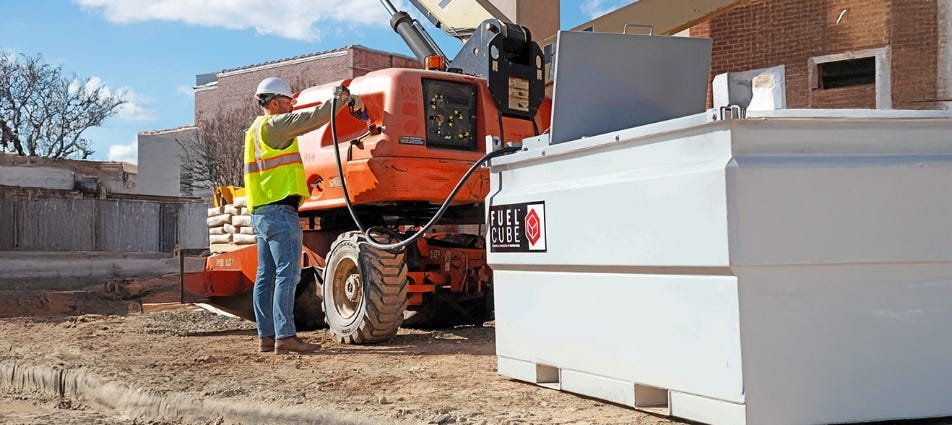
Mobility Without the Wait: The Western Global TransCube
If your fleet is mobile, serving construction sites, remote agricultural fields, or decentralized logistics hubs, the Western Global TransCube is the industry’s answer to the "Just-in-Time" crisis. These units are more than storage; they are transportable fuel hubs.
- Multi-Equipment Feeding: These hauling tanks can fuel up to three pieces of equipment simultaneously, cutting downtime across your entire job site.
- Rapid Deployment: Unlike stationary units that require permanent permits and pads, a TransCube can be relocated between sites in minutes, allowing you to move your fuel reserve exactly where the work is happening.
Beating the 14-Day Logistics Gap: The Tank Depot Advantage
As we noted in our recent market research, global supply chain clogs have pushed lead times for heavy infrastructure to 14 days or longer in many regions. Waiting two weeks for a fuel storage tank while fuel prices spike 70 cents overnight is a risk no fleet can afford.
To solve this, we’ve pivoted our own operations. Tank Depot’s Regional Stocking in Texas and other key hubs is designed to bypass the logistics gap. By maintaining deep inventory on-site, from 100-gallon mobile refuelers to 2,000-gallon stationary units, we ensure that when you decide to lock in your fuel strategy, the hardware is ready to ship, not stuck in a manufacturing queue. By having the right steel on the ground, you move from a position of vulnerability to a position of stability.
Beyond the Barrel: Why "Panic Storing" is Your Biggest Liability Risk
When fuel prices jump 70 cents in a single morning, the instinct to "fill every container you have" is strong. But in the world of industrial fleet management, a storage mistake is far more expensive than a fuel price hike.
The recent Red Hill Bulk Fuel Storage crisis serves as a sobering reminder of what happens when infrastructure fails. What began as a series of pipeline and joint failures led to thousands of gallons of jet fuel contaminating a major freshwater aquifer. The result wasn't just a loss of fuel; it was a multi-billion dollar environmental disaster that displaced families and shuttered operations indefinitely.
At Tank Depot, we use the Red Hill event as a case study to explain why secondary containment is non-negotiable. Whether you are a small farm or a massive logistics hub, you are responsible for every drop you store.
Navigating the SPCC and UL-142 Maze
To stay on the right side of the law (and the EPA), your strategy needs to be built on two pillars:
- The Tank (UL-142): This is the industry gold standard for above ground steel tanks. A UL-142 certified fuel tank has been pressure-tested and engineered specifically for flammable liquids. Choosing a double-walled UL-142 design means your "secondary containment" is built directly into the unit, providing a 110% safety net without the need for site-built concrete berms.
- The Plan (SPCC): The EPA’s Spill Prevention, Control, and Countermeasure (SPCC) rule generally kicks in if your facility has an above-ground storage capacity of more than 1,320 gallons. If you cross this threshold, you are legally required to have a written spill prevention plan.
The 119-Gallon "Sweet Spot" for Mobile Fleets
Many smaller operations worry that they need a CDL or a Hazmat endorsement just to move fuel around their own property. Here is a technical "shortcut" that can save you a massive administrative headache: The DOT 119-Gallon Threshold.
According to bulk fuel storage requirements, as long as your single mobile container has a capacity of 119 gallons or less, you are generally exempt from the more complex Department of Transportation (DOT) Hazmat regulations. (Note: Total capacity should be below 1,000 gallons.) This makes a 115-gallon transfer tank the perfect "starter" for a private strategic reserve. This amount is sufficient to keep a small fleet running for days without the need for specialized driver certifications or placards.
Move Your Fleet from Vulnerability to Stability with Tank Depot
In a market defined by 70-cent daily spikes and global supply clots, "waiting it out" is no longer a viable strategy. Every morning your fleet starts without a private fuel reserve is a morning you are essentially writing a blank check to the retail energy market. Our in-depth guide further explains the ROI of on-site fuel storage for commercial, agricultural, and industrial ventures.
Operational continuity shouldn't be a gamble. By investing in commercial bulk fuel storage, you aren’t just buying equipment; you are building a firewall around your margins. You are gaining the power to buy the dips, bypass retail convenience taxes, and ensure that while your competitors are stalled at the pump, your team is already in the field.
Consult with a Tank Depot Expert for Your Fuel Strategy
Don't navigate this transition alone. Our team understands the nuances of UL-142 compliance, the administrative benefits of the 119-gallon DOT threshold, and the immediate ROI of high-volume delivery.
Whether you need a Western Global TransCube for a fast-moving construction site or a stationary Newberry bulk steel tank to anchor your agricultural hub, we have the regional inventory in Texas and across the country to get you online before the next market adjustment.


