


The DIY Low-Profile Septic Tank Installation Blueprint for the Modern Homeowner
Installing a septic system used to be synonymous with heavy machinery, massive cranes, and high-tensile concrete. For the modern homeowner or off-gridder, that’s no longer the case. The rise of low-profile plastic septic tanks has shifted the landscape, making DIY septic tank installation more accessible than ever before.
While the prospect of managing your own wastewater might seem daunting, this blueprint is designed to demystify the process. By choosing a low-profile poly tank, you aren't just buying a product; you’re choosing a system designed for easier excavation, manual maneuverability, and long-term durability. However, before you break ground, remember: while you can do much of the work, local regulations and health department permits are the ultimate gatekeepers of your project.
Why Low-Profile Plastic Septic Tanks are the DIY Gold Standard for Modern Homes
When it comes to how to install a septic tank without a professional crew and a 20-ton crane, material choice is everything. Here is why high-density polyethylene (HDPE) low-profile tanks are the preferred choice for owner-builders.
1. The Weight Advantage: No Crane Required
The most significant barrier to DIY installation is weight. A standard 1,000-gallon concrete tank can weigh upwards of 10,000 lbs, requiring a specialized boom truck just to set it in the hole. In contrast, a low profile plastic septic tank installation is a lightweight affair.
- Maneuverability: Most low-profile poly tanks, even at 1,000-gallon or 1,500-gallon capacities, weigh between 300 and 600 lbs..
- Equipment: You can often move and position these tanks with a small backhoe, a tractor with pallet forks, or even a team of four or five people and some sturdy straps. This drastically reduces the "Effort" and cost of the project.
2. The Shallow Dig Advantage: Conquering High Water Tables and Rock
The "Low-Profile" design isn't just about looks but depth as well. Traditional "deep-profile" tanks require a massive, deep pit that can be dangerous and difficult to dig.These usually reach depths of 8 to 10 feet deep.
- High Water Tables: If your property has a high water table, digging a deep hole often leads to a pit filled with water before the tank is even delivered. Excavate so that the tank has a minimum of 6” and a maximum of 36” of cover over the top. Exceeding 36” of soil cover can cause structural failure and voids the warranty.
- Rocky Soil: If you hit bedrock at 4 feet, a traditional tank is a non-starter. A low-profile tank allows you to install a full-capacity system while staying within the "soft" upper layers of soil.
- Bedding Requirements (Sand vs. Pea Gravel): You cannot place a poly tank on raw, native soil. The foundation requires a leveled bed of well-packed sand or pea gravel.
- Soil Terrain: 6” minimum bedding depth.
- Rock Terrain: 12” minimum bedding depth.
- Width: Excavate to allow 18” to 24” of clearance on all sides and ends of the tank for proper backfill compaction.
What You’ll Need Before Installing Your Low Profile Septic Tank
Before you turn the first shovelful of dirt, you need to clear two major hurdles: the paperwork and the toolbox. Installing a septic system is a high-stakes project; an error in planning can lead to environmental contamination or a "red tag" from the county that halts your project indefinitely.
The Homeowner’s Septic System Installation Arsenal
To pull off a DIY septic tank installation, you’ll need more than just a shovel. Here is the essential equipment list for a low-profile poly tank install:
- The Heavy Hitter: A Mini-Excavator or Backhoe. (While poly tanks are light, the hole you’re digging is not. A mini-excavator is preferred for its precision in tight residential spots.)
- Precision Tools: A Laser Transit and Grade Pole. You cannot "eye-ball" a 1/8" slope; the physics of gravity-fed systems require exact measurements.
- The "Perc" Kit: A hand auger (or post-hole digger), a 100-foot tape measure, and a stopwatch.
- Materials: Sch. 40 PVC (Inlet), leaching chambers (Leach field).
Navigating the Health Department: Securing Your Septic Install Permit
In almost every U.S. jurisdiction, a septic tank installation permit is a legal requirement.
- Submit Your Site Plan: You’ll need a drawing showing the tank location relative to the house, property lines, and water wells (usually a 50–100 ft "setback" is required).
- The "Owner-Builder" Variance: Some states require a licensed contractor to perform the install. However, many rural counties allow a "Homeowner’s Install" if you pass a basic competency test or provide a detailed engineered design.
- The Pre-Construction Meeting: Often, a sanitarian from the health department will visit your site before you dig to approve your layout. Do not skip this.
The "Perc" (Percolation) Test: Why It Matters
The Perc Test is the heart of your system design. It measures how quickly your soil can absorb liquid. If the soil drains too fast, it won't filter the waste; if it drains too slow, your yard becomes a swamp.
How to DIY a Perc Test:
- Dig the Holes: Dig 3 to 4 holes (6–12 inches wide and 24–30 inches deep) in the area where you want your leach field.
- The Pre-Soak: Fill the holes with water and keep them saturated for at least 4 hours (ideally overnight). This simulates the "worst-case scenario" of a rainy season.
- The Measurement: Refill the hole to a depth of 6 inches. Measure how long it takes for the water level to drop exactly 1 inch.
- The Math: If the water drops 1 inch in 30 minutes, your "Perc Rate" is 30 Minutes Per Inch (MPI). Your local health department uses this number to tell you exactly how many feet of leach field you need to buy.
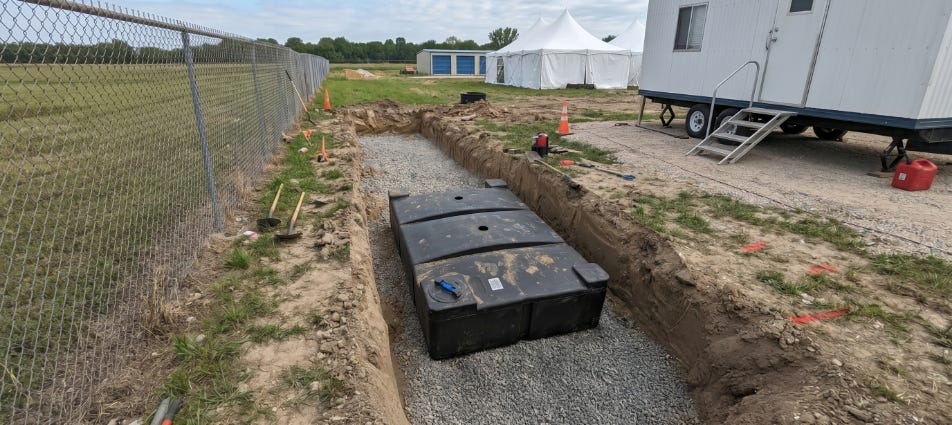
Steps to Installing a Buried Low Profile Septic Tank
Phase 1: Site Prep & Excavation
Once you have your permits in hand and your mini-excavator on-site, it’s time to move dirt. The success of a plastic septic tank installation depends entirely on the geometry of the hole and the quality of the floor you build inside it.
Calculating Your Slope: The 1/8" Rule
A gravity-fed septic system is a low-energy machine that relies on a very specific pitch.
- The Sweet Spot: Your inlet pipe (from the house to the tank) should have a slope of 1/8" to 1/4" per foot.
- The Risk of Over-Sloping: A common DIY mistake is making the pipe too steep. If the pitch is too aggressive, the liquids will outrun the solids, leaving the "heavy stuff" behind to clog your pipes.
- The Execution: Use your laser transit to set your "benchmarks." If your septic system is 40 feet from the house, the inlet of the tank should sit exactly 5 inches lower than where the pipe exits your home foundation.
Septic Tank Bedding Requirements: Sand vs. Pea Gravel
You cannot place a poly tank on raw, native soil. Large rocks or uneven clumps can create "pressure points" that crack the plastic over time.
- The Foundation & Tank Bed: Excavate to a depth that allows for a minimum of 6” and a maximum of 36” of cover over the top of the tank. Allow 18” to 24” of clearance on all sides and ends of the tank for proper backfilling.
- Bedding Materials: You cannot place a poly septic tank on raw, native soil. The buried tank bed must be level and prepared with well-packed bedding material:
- Soil Terrain: 6” minimum sand or pea gravel.
- Rock Terrain: 12” minimum sand or pea gravel.
Native soil can only be used if it is flowable, compactable, rock-free, and provides uniform support in the recessed rib areas of the tank.
Phase 2: Placing and Leveling the Wastewater Tank
Lowering the septic tank into the pit is the "Point of No Return." Because poly tanks are lightweight, they are susceptible to shifting during the backfilling process.
The "Water-Fill" Trick: Vital for Structural Integrity
Unlike concrete, an empty plastic tank is essentially a giant bubble. If you backfill a dry tank, the weight of the surrounding soil (especially if it gets wet) can cause the sides to "egg in" or collapse.
- Step 1: Once the septic tank is leveled on its bedding, begin filling it with fresh water.
- Step 2: Add water in 6-inch to 12-inch increments.
- Step 3: Simultaneously add backfill around the outside of the tank to match the water level inside. This equalizes the internal and external pressure, keeping the tank walls stable.
- The "Floating" Warning: If it rains while your onsite wastewater tank is empty in an open hole, the tank will float like a boat, snapping your PVC connections. Always keep the tank filled with water.
Backfilling Plastic Septic Tanks: Avoiding Structural Stress
Backfilling plastic tanks requires a "soft touch."
Approved Backfill Materials: Preferred Fill: Free-flowing native soil can be used if it is free of wood, masonry debris, or silt. If native soil is unsuitable, replace it with a compactable material where 100% of particles are smaller than 1-1/2” and approximately 50% are smaller than 1/4”.
- Prohibited Materials: Shrink/swell clay soils must be avoided as backfill material. Ensure no sharp objects come into contact with the septic tank walls, as punctures will cause leakage and void the warranty.
- Structural Backfilling & Compaction: Backfilling a low-profile septic tank requires a specific sequence to maintain structural integrity:
- Support Columns (CRITICAL): Each of the interior support columns must be filled with free-flowing fill and compacted in 6” layers. These columns must be compacted to provide vital structural support for the wastewater tank roof.
- The Risk: If these columns are left empty, the weight of the overhead soil (up to 36”) can cause the tank roof to bow or collapse, immediately voiding your warranty.
- The Fix: Use a long tamper or a 2x4 to ensure the material is packed tightly within the column radius.
- Support Columns (CRITICAL): Each of the interior support columns must be filled with free-flowing fill and compacted in 6” layers. These columns must be compacted to provide vital structural support for the wastewater tank roof.
- Exterior Lifts: Backfill around the exterior of the tank in 12” layers, compacting each layer as you go.
- Sequence: Always compact the ends of the onsite treatment tank first to lock the unit in place.
- Limits: Maximum backfill over the top of the tank is 36”. Mound the soil over the top to direct surface water away from the installation site.
Phase 3: Inlet/Outlet Piping & Distribution
Connecting the plumbing is where your precision with the laser level pays off. The goal is a seamless, leak-proof transition from the home to the tank, and then out to the soil.
Connecting the House to the Septic Tank
- Pipe Prep: All 4” PVC pipes should be chamfered (beveled) and gaskets lubricated before installation for a watertight fit.
- Sealing: Install the rubber gasket from the outside of the tank, then push the pipe through the gasket into the sanitary tee.
- Venting: All tanks must be vented. The vent pipe should be the same diameter as the outlet pipe (typically 4” to match the outlet diameter). If installing multiple septic tanks in a series, you must maintain 36” of separation and use flexible connections between tanks.
- The Inlet Pipe: Use 4-inch Schedule 40 PVC for the line running from the house foundation to the tank. Ensure the pipe is properly seated in the tank's inlet grommet.
- The Sanitary Tee: Inside the septic tank, your inlet pipe must have a "tee" fitting. This directs the incoming wastewater downward, preventing the "scum layer" (fats and oils) from plugging the pipe.
- Effluent Filter: On the outlet side, install a high-quality effluent filter. This is your system’s last line of defense, catching small solids before they can reach and ruin your drain field.
Setting the Distribution Box (D-Box)
The Distribution Box is the "traffic cop" of your system, ensuring water is sent equally to all parts of the leach field.
- The "Undisturbed Soil" Rule: Always place the D-Box on a base of undisturbed soil or a pre-poured concrete pad. If the D-Box settles or tilts even slightly, one leach line will get 100% of the water while the others stay dry, leading to a localized system failure.
- Leveling: Use a spirit level on the box itself. Once the pipes are connected, use "Speed Levelers" (plastic inserts) inside the box to fine-tune the flow to each line.
Phase 4: The Leach Field (Drain Field) Setup
The leach field is the most expensive and labor-intensive part of the project. For the DIYer, the choice of technology determines whether this takes two days or two weeks.
Chamber Systems vs. Pipe-and-Gravel
- Pipe-and-Gravel: This is the traditional method using perforated PVC and tons of washed stone.
- The DIY Downside: It requires moving massive amounts of gravel by hand or machine, which is exhausting and increases the risk of soil compaction.
- Leaching Chambers (The DIY Choice): These are hollow, open-bottom plastic "tunnels" that sit directly on the soil.
- Why they are easier: They are lightweight, stackable, and eliminate the need for gravel in the trenches.
- Efficiency: Chambers often have a smaller "footprint" requirement from the health department because they provide more open surface area for the soil to breathe.
- EZflow™ Gravelless Solution (New Innovation): Designed by Infiltrator Water Technologies, EZflow is a 3-in-1 "bundled" solution that replaces heavy rock with engineered EPS aggregate.
- The Advantage: It consists of a perforated pipe surrounded by artificial aggregate and a high-strength mesh. Because it is incredibly lightweight, it can be hand-carried to the trench by a single person, making it the ideal solution for tight backyards or remote sites where heavy trucks can't reach.
- Better Physics: The engineered "peanuts" provide more void space than natural rock, offering higher storage capacity and more surface area for biological treatment.
- Professional Spec: This system is increasingly specifically "spec'd" by county designers because it is always clean (no fines or dust to clog the soil) and conforms easily to trees or sloped terrain.
Final Inspection & Closing the Trench
Before you cover your hard work, you must receive the "Green Tag" from your local inspector.
Septic Tank Riser Installation
Modern codes (and common sense) require that your onsite wastewater tank access ports are at or slightly above grade.
- The Process: Perform your septic tank riser installation by bolting the riser rings to the tank's clean-out ports. Use a high-quality butyl rope or silicone sealant between the tank and the first riser ring to prevent "inflow" (rainwater leaking into the tank).
- The Benefit: This eliminates the need to "dig for the lid" every 3–5 years when it’s time for maintenance.
- The Safety Check: Ensure all riser lids are heavy-duty and secured with stainless steel safety screws to prevent accidental entry.
The Final Grade
Once the inspector approves, backfill the trenches and the tank area. Mound the soil slightly over the trenches (3–6 inches) to allow for natural settling. Seed the area with grass immediately to prevent erosion, but never plant trees or deep-rooted shrubs near the system.
⚠️ Warranty Safety Checklist
To protect your 3-year warranty and ensure system longevity, observe these Norwesco-mandated cautions:
- No Traffic: Never install a low-profile tank under the path of vehicles or heavy equipment.
- Temperature Limits: Do not store or install septic tanks near heat sources exceeding 180°F.
- Buoyancy: In areas with high water tables or saturated soil, supplemental counter-buoyancy measures are required. Consult the technical guides on our website for specialized site conditions.
Selecting the Best Low Profile Septic Tank for DIY Home Installations
Every property has a unique "blueprint." Here is a breakdown of the septic tank configurations available to meet specific site needs and local codes.
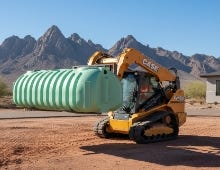
Two-Compartment Septic Tanks
Often called the "Standard Bearer," these tanks are divided by an internal wall. This allows for better separation of solids in the first chamber before the clearer effluent moves to the second. Many modern residential codes now require two compartments to protect the longevity of the leach field.
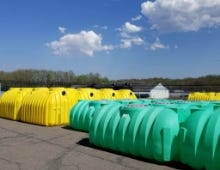
Single-Compartment Septic Tanks
These are ideal for older code requirements, smaller "cabin-style" setups, or for use as a primary settling tank in a larger, multi-tank series.
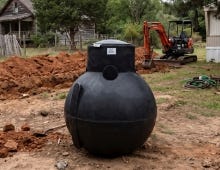
Pump Tanks
In a perfect world, gravity does all the work. But if your leach field is located at a higher elevation than your house, you’ll need a pump tank. These house a specialized effluent pump to "lift" the waste to the field
Note: This setup involves electrical components and float switches that typically require a licensed electrician for safety and compliance.

Multi-Use Underground Tanks
These are versatile "workhorse" tanks. While they can be configured for septic, they are also frequently used for greywater collection or as heavy-duty storage for specialized waste systems.
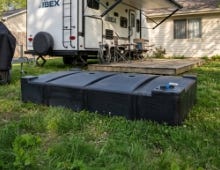
Above Ground Septic Tanks
Perfect for temporary situations—like a job site trailer, a seasonal RV pad, or areas where the water table is so high that burial is impossible. These are designed with a low vertical profile to stay discreet while remaining easily accessible for pumping.
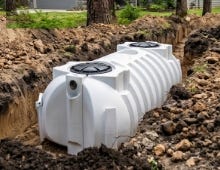
Advanced Treatment Units (ATU)
For homes near lakes, streams, or in areas with poor "perc" soil, an ATU acts like a miniature municipal treatment plant. They use oxygen to break down waste more aggressively.
Safety Note: Due to their mechanical complexity, ATUs almost always require installation and ongoing maintenance contracts with professional certified installers. Click here to register for the installer training certification.
Your Path to a Successful DIY Septic Installation Starts Here
Mastering how to install a septic tank is a significant milestone for any property owner. By opting for a low-profile plastic system, you’ve already bypassed the most difficult hurdles of traditional installations: heavy machinery and deep, dangerous excavations.
Success in DIY septic tank installation ultimately comes down to three things: meticulous planning, adhering to your local septic tank installation permit requirements, and never cutting corners on septic tank bedding. Whether you are setting up a 1,000-gallon septic tank for a primary residence or a small pump tank for an uphill leach field, the "Blueprint" remains the same. Do the dirt work right, level your tank with precision, and your system will provide reliable service for decades.


