


Defending Your Perimeter: The Crucial Role of Water Supply for Wildfire Sprinkler Systems
In the aftermath of recent historic blazes across the Western United States, a haunting question often surfaces in local post-incident reports: "Why was there no water supply for the fire engines?" For many property owners, the answer is a wake-up call regarding the limitations of public infrastructure.
In prone areas, the very conditions that fuel a wildfire, high winds, extreme heat, and lightning, are the same forces that take down the power grid and compromise municipal water pressure. If you are relying on a standard utility connection or an electric well pump to feed your wildfire home defense system, you may find yourself with a dry line exactly when the ember front arrives.
The hard truth is that an external sprinkler system for wildfire defense is nothing more than a paperweight without a dedicated, pressurized water source. To truly harden a property, owners must shift their focus from the "nozzles" to the "source." A robust defense requires a self-contained infrastructure. Specifically, a dedicated wildfire water pump and the right fire suppression water tank setup, that operates independently of the grid. By securing your own water supply, you aren't just protecting your structure; you are providing a critical tool that local fire departments can utilize to save your property when the local hydrants run dry.
Where’s Your Source? Types of Water Supply for Fire Protection
When designing a fire sprinkler system water supply, there are three primary sources to consider, each with distinct advantages and catastrophic failure points. Understanding these types of water supply systems is the first step in ensuring your property isn't left vulnerable.
- Municipal Water Lines: While convenient, city mains are notoriously unreliable during a megafire. Heavy simultaneous demand from hundreds of fire hydrants and home systems often causes a total loss of pressure.
- Private Wells: Most residential wells rely on electric submersible pumps. Because wildfires frequently cause widespread power outages or "Public Safety Power Shutoffs" (PSPS), a well is often the first thing to fail unless backed up by a massive, fire-shielded generator.
- Dedicated On-Site Storage: This is the gold standard for fire suppression. By keeping thousands of gallons of water in a stationary vessel on your property, you eliminate reliance on the grid. Firefighting water tank requirements for insurance and NFPA 22 compliance typically favor this "static" source because it is predictable, accessible, and entirely under the owner's control.
The "Backbone" Setup: Wildfire Water Pump and Tank Requirements
Building an effective wildfire pump and tank setup requires more than just a large container of water; it requires an engineered approach to volume and velocity.
The Fire Water Tank: Choosing Your Reservoir
Depending on your local codes and the scale of your wildfire home defense system, you will likely choose between two materials:
- Polyethylene (Plastic) Tanks: Excellent for cost-effective, corrosion-resistant storage. While poly tanks can melt if a fire is at the doorstep, they are ideal for providing the "wetting down" period before the fire front arrives.
- Bolted Steel Tanks: If you are following strict NFPA 22 fire tank standards for a commercial site, steel is often the requirement. NFPA 22 steel fire protection tanks are designed to withstand higher heat loads and provide the structural integrity needed for commercial-grade protection.
The Water Pump: The Heart of the System
A water storage tank without a pump is just a pond. To feed an external sprinkler system for wildfire defense, you need a high-pressure "transfer" or "fire" pump.
- Why Diesel or Gas? You should almost always opt for a diesel driven fire water pump or a high-quality gasoline engine. In a wildfire scenario, electricity is your enemy. A self-contained engine ensures that your sprinklers keep running even if the neighborhood transformer explodes.
- Performance Metrics: Ensure your pump is rated for the "Total Dynamic Head" (TDH) required to push water to your roof's highest peak while maintaining enough PSI to atomize the water into the ember-extinguishing mist your system requires.
Integration with External Roof Sprinklers
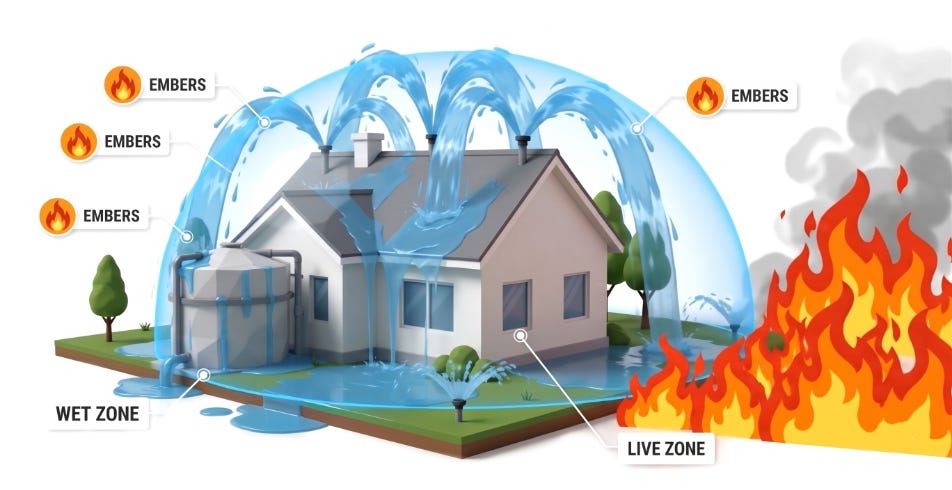
Acquiring the hardware is only half the battle; the true effectiveness of external sprinkler systems for wildfire defense lies in the hydraulics of integration. Most home wildfire protection kits come with specific PSI (pounds per square inch) and GPM (gallons per minute) requirements to ensure the sprinkler heads "throw" the water far enough to create a defensible moisture curtain.
When connecting your dedicated tank and pump to these kits, you must account for "friction loss." If your pump is located 100 feet away from the house or has to push water up two stories, the pressure at the nozzle will be significantly lower than the pressure at the pump discharge.
- The Pressure Match: Always verify that your wildfire pump and tank setup can provide at least 20% more pressure than your sprinkler kit’s minimum requirement. This "safety buffer" ensures that even with long hose runs, your roof stays saturated.
Compliance & Maintenance of Wildfire Sprinkler Systems
In rural or suburban-fringe areas, your water storage is more than just a personal asset, it is a community resource. Most local fire marshals look to NFPA 1142 (Standard on Water Supplies for Suburban and Rural Fire Fighting) as the benchmark for property safety. Following these guidelines ensures that your fire fighting water tank requirements meet insurance standards and, more importantly, that the connections are compatible with fire department equipment.
- Routine Readiness: A system that hasn't been tested is a system that will fail. We recommend a "Dry Season Drill": Start your diesel driven fire water pump once a month and clear your sprinkler nozzles of any debris or mineral buildup.
- Accessibility: Ensure your water storage tank has the proper "Fire Department Connection" (FDC) fittings. If the local engine runs out of water, they can "draft" from your tank to continue the fight.
Securing Your Peace of Mind with Tank Depot
A wildfire is a test of preparation. While wildfire home defense systems like roof sprinklers offer a vital layer of protection, they are purely cosmetic without a guaranteed water source. By investing in a dedicated water supply, comprising a high-capacity storage tank and a reliable, off-grid pump, you take control of your property’s readiness.
Don’t wait for the smoke to appear on the horizon.


