


Is Your Poly Tank Repairable, Or Is It Time To Replace It?
Your water storage tank is leaking, or you have spotted a crack, and your first move is to look for a patch kit. That makes sense. A new water tank costs money, and a repair sounds faster and cheaper.
But the patch kit is the wrong place to start. The real question is not whether you can cover the damage. It is whether the tank should stay in service at all. A tank that holds water in your backyard and a tank that holds acid at a plant are two very different decisions, even if the crack looks the same.
The answer comes down to two things: what your tank is made of, and what it holds. Get those right and the repair or replace call gets a lot clearer. Let us walk through it.
The Material Decides Everything
Not all poly tanks are the same plastic, and that changes everything about repair. There are two main types. Linear polyethylene (sometimes called HDLPE) can, in some cases, be plastic welded by a professional. Crosslinked polyethylene, or XLPE, is different. Its molecules are locked together in a way that does not melt back down. That is what makes XLPE so tough for storing harsh chemicals, but it also means the melt and fill welding tricks you see in online videos do not hold up on it the way people expect.
Here is the safety part that matters most. A patch on a tank holding acid, caustic soda, or sodium hypochlorite (bleach) can create a weak spot right where the chemical tank is under the most stress. If that patch fails, it fails while holding the exact chemical the tank was supposed to contain safely. That is not a risk worth taking to save a few dollars.
So before anything else, find out what your tank is made of. Check the nameplate, your original paperwork, or call the supplier who sold it to you. If you do not know the material, you cannot know if a repair is safe. Not sure how to tell? Our team can help you figure it out.
Sign 1: Crazing And Fine Surface Cracks
Crazing is a web of tiny cracks across the surface of the tank, a bit like a cracked windshield or old paint. It usually comes from years of sun exposure and normal aging. It is easy to look at crazing and think it is only skin deep.
It is not. Crazing is a sign that the plastic has grown stiff and brittle across the whole wall, not just in one spot. Patching one area does nothing for the rest of the storage tank, which is aging the same way.
When you see widespread crazing, you are looking at a poly tank near the end of its life. This is a replace signal, not a patch spot.
Sign 2: A Bulkhead Fitting That Keeps Leaking
A bulkhead fitting is the part that lets a pipe pass through the tank wall. When one starts to leak, the natural move is to tighten it. It stops for a while, then it leaks again. That repeat leak is telling you something. It is often one of three things: the fitting was overtightened, the gasket has failed, or small cracks are spreading out from the fitting where the wall is under stress. Adding more sealant or cranking it tighter can actually make the cracking worse.
Sometimes the fix is a fresh, correctly sized fitting installed the right way. Sometimes the repeat leak is the tank warning you that the wall around it is failing. If you are replacing a fitting, start with the right part. See our bulkhead fittings and tank adapters to match size, thread, and material to your tank.
Sign 3: Chalking, Fading, And Brittleness
Run your hand along the tank. If it comes back with a chalky, powdery residue, or the color has faded from what it used to be, the sun has been at work. UV light breaks down polyethylene over time.
Chalking and fading are not just cosmetic. They mean the surface has changed, and the wall underneath has usually lost strength and flexibility too.
A plastic storage tank that feels brittle, or sounds hard and hollow when you tap it, has aged all the way through. A surface repair on a wall like this sits on a weak base. It is a patch on a problem that is bigger than the patch.
Sign 4: Bulging Or An Out Of Round Tank
A healthy tank holds its shape. If yours is bulging at the bottom, or has gone out of round (no longer a clean circle when you look down at it), something structural is wrong.
Usually it is one of two causes. The liquid storage tank may be holding a liquid heavier than it was built for. Every poly tank has a specific gravity rating, which is just a measure of how heavy a liquid it can safely hold. Store something heavier than the rating and the wall bulges. The other cause is a foundation that is uneven or sinking.
Neither of these is a repair. A bulging tank needs to be replaced, and resized correctly for what you are actually storing. Our team can help you match the tank to your liquid's weight and your site.
Sign 5: Unknown Age And Unknown Chemical History
Sometimes the biggest problem is what you do not know. If you inherited the tank with a property, cannot read the nameplate, or are not sure what the tank held before you got it, you are storing your chemical in a mystery.
You cannot confirm a chemical storage tank is safe for your acid or caustic if you do not know its age or what soaked into its walls in a past life. For anything regulated, unknown history is its own reason to replace. The cost of guessing wrong is far higher than the cost of a known, correctly specified tank.
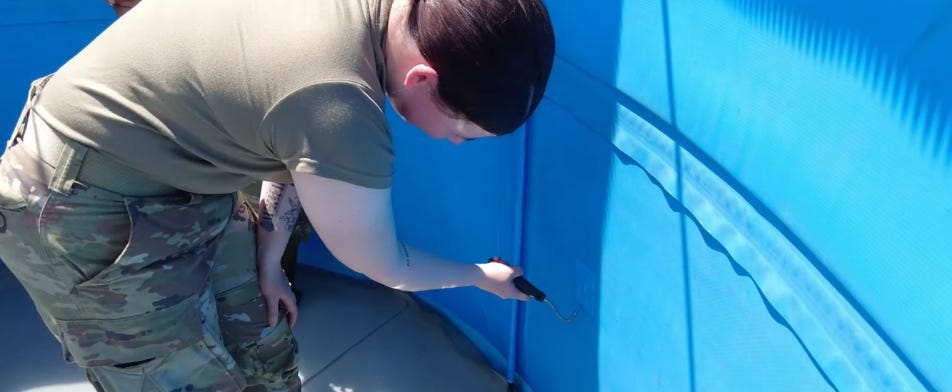
A Different Case: Vertical Concrete Tanks Built To Be Repaired
Everything so far has been about poly, where the material tends to fight the repair. Concrete is the opposite. A concrete water tank is built to be maintained over decades, and surface damage can often be patched and sealed in the field instead of replaced - depending on the concrete tank.
This is worth knowing if you are storing water and want an asset that lasts. Tank Depot is the exclusive US partner for the Deploy OMNI Series, a modern vertical concrete water tank engineered to be repaired on site rather than thrown away. For long term water storage, a repairable concrete tank can make more sense than a poly tank you will eventually replace.
If you are storing water and want a tank built to be maintained instead of replaced, our OMNI Series vertical concrete water tanks are worth a look.
When A Repair Actually Makes Sense
Repair is not always the wrong answer. There is a narrow window where it is reasonable. If you have a small, reachable crack on a newer tank, you know the material is linear polyethylene, you know its full history, and it holds water and not chemicals, that tank may be worth a professional look before you replace it. The key words are small, newer, known material, known history, and water.
Even then, we would point you to a qualified professional to assess it rather than a heat gun and a video. A repair done wrong can fail faster than the original crack. A pro can tell you honestly whether a repair buys you real time, or just delays the inevitable.
When those boxes are checked, a repair can be a smart, budget friendly call. When they are not, read the next section closely.
When Repair Is Off The Table
For some storage tanks, repair is simply not on the table, no matter how small the damage looks. Replace, do not repair, when the tank is:
- In chemical service. Acids, caustics, and sodium hypochlorite belong in a sound, fully rated tank. A patch is a weak point where you can least afford one.
- Doing secondary containment. A containment tank or basin only works if it is whole. A repaired containment wall defeats the purpose.
- Certified for potable water. Many potable tanks carry an NSF 61 listing. A field repair can void that listing, which means the tank is no longer certified for drinking water.
- A DOT or UN marked portable tank. Altering a certified tank, including some repairs, can void the certification mark that makes it legal to transport.
In all of these cases, the safe and compliant move is a new tank, specified correctly the first time.
What To Bring To A Replacement Conversation
If you have decided to replace, a little prep gets you the right storage tank faster. Have these ready when you call:
- The chemical you are storing, and its concentration
- The operating temperature
- The volume you need, in gallons (or liters)
- How you fill and empty the tank
- The footprint and space you have on site
- Whether you need secondary containment
With those answers, our team can match the material, wall type, specific gravity, fittings, and venting to your exact job. That is how you get the right tank the first time, instead of solving the same problem twice.
Get The Right Tank The First Time
Not sure whether to repair or replace? Tell us your chemical, your volume, and your site, and we will help you make the right call, and get you the right poly chemical storage tank if you need one.


