Listen to this article:
The Master Guide to IBC Tote Fittings: Camlocks, Adapters, and Valves
If you have ever bought an IBC tote fitting that looked right, felt right, and still leaked, you already know the problem. The parts are almost standard. ALMOST! Two fittings can both say "2 inch" on the label and still refuse to seal, because "2 inch" is not one measurement. It is four separate things that all have to match: the valve type and size, the thread standard, the camlock style, and the gasket material. This guide walks through each of those four so you can order the right IBC tote adapter the first time. It also covers something most parts pages skip: how swapping a fitting on a certified tote can quietly void its UN transport marking. That last part matters more than the price of any single part.
1. Start with the valve you already have
Before you shop for anything, look at the valve on the bottom of your tote. Most IBC totes ship with a 2 inch (50 mm) discharge valve, though 3 inch (80 mm) shows up on totes built for thick liquids. You will usually see one of three styles. A butterfly valve uses a flat disc that turns inside the flow. A ball valve uses a rotating ball with a hole through it. A cylindrical valve works much like a ball valve with an internal cylinder. The size drives the choice more than most buyers expect. Some manufacturers offer butterfly valves in both 2 inch and 3 inch, but offer ball and cylindrical valves in 2 inch only. So if you are moving a viscous product like syrup or heavy oil and you want the wider 3 inch opening, a butterfly valve may be your only path. We cover the full valve breakdown in our guide to IBC totes. For this guide, the valve matters mostly because everything else bolts onto it.
2. Thread type is where most people go wrong
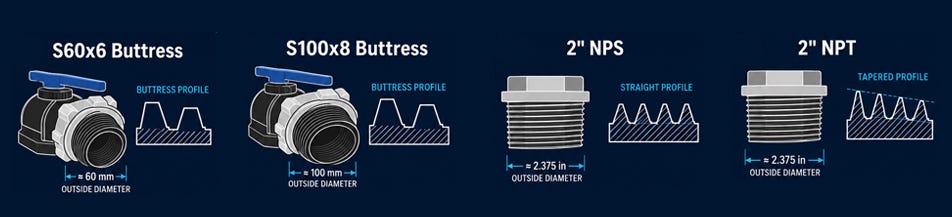
Here is the trap. Two fittings can share the same 2 inch size and still have completely different threads. Thread type is the single most common reason an IBC tote fitting will not seat, and it is easy to miss at the counter. The threads you will run into on IBC totes are:
- Buttress (coarse thread): the wide, chunky thread found on many tote fill ports and bottoms. Sometimes written as S60x6 or similar.
- NPS (National Pipe Straight): a straight thread that keeps the same diameter along its length.
- NPT (National Pipe Taper): looks similar to NPS but the thread tapers, so it wedges tighter as you turn it.
- Metric and BSP: common on imported totes and easy to confuse with the standards above.
The NPS versus NPT mix-up is the expensive one. One manufacturer sells the same 6 inch heavy duty cap in two versions: one with an NPT center thread and one with an NPS center thread. Same cap, same size, one letter of difference. NPT is tapered and NPS is straight, so the two will start threading together and then bind or leak. It does not look wrong when you are holding it, which is exactly why it costs people a return trip.
If your tote has a coarse buttress thread and you need to connect standard pipe, you do not force it. You use an adapter built for the job, like the Banjo TA283 IBC tote adapter, which converts the coarse buttress thread to a standard NPT connection. Match the thread first, then worry about everything else.
3. Camlocks, and what the letters mean
A camlock is a quick connect fitting. Instead of threading a hose on every time, you push two halves together and flip a pair of levers. For any job where you connect and disconnect often, filling from a tanker or emptying to equipment, a camlock saves real time. Camlocks use letters to name the parts. The two you care about for an IBC tote camlock setup are the Type C coupler (the female half with the levers) and the Type E adapter (the male half it locks onto). Match those two and you have a working quick connect. They come in poly, aluminum, and stainless steel, so pick the material to suit your product and how rough the service is.
One shortcut worth knowing: some tote valves already include a camlock front end built in, so you may not need a separate adapter at all. Check your valve before you buy. If you are speccing a new tote, our chemical IBC totes can come camlock ready.
4. The gasket is the part that actually fails
The gasket is a small rubber ring, and it is usually the first thing to leak. It is also where buyers make a quiet mistake: they match the size and thread perfectly, then never check what the gasket is made of. The material has to be compatible with whatever is inside the tote. The common gasket materials you will see are:
- EPDM: the standard, general purpose choice on many totes.
- Viton / FKM: used for more aggressive chemicals.
- PTFE: a high performance option often found on ball valves.
- PE, Santoprene, and ETFE: used on specific valves and adapters.
Watch how easy it is to grab the wrong one. Manufacturers routinely sell the exact same fitting in two gasket versions, an EPDM build and a Viton build, with the same size and thread. Same part number family, different rubber, very different chemical compatibility. The Banjo TA283 adapter, for example, uses a Santoprene gasket chosen for chemical resistance and a tight seal. There is a smart design idea hiding here too. At least one manufacturer builds its butterfly valve gasket from PE on purpose, so the buyer does not have to evaluate compatibility against the product at all. That is the opposite of an afterthought. Gasket choice is a real decision, not a default, and the right answer depends on your exact liquid, its concentration, and its temperature.
5. Vents: the fitting people forget
Try to drain a sealed tote and it will glug, slow to a crawl, and sometimes dent inward. That is vacuum. As liquid leaves, air has to get back in, and a vent is the fitting that lets it. Some products also off gas and need a way to release pressure safely. A vent handles both jobs. Venting fittings range from basic vacuum relief bungs to higher performance degassing systems, and some offer one way airflow while others allow two way airflow for continuous emptying. If your product builds pressure or reacts with air, this is not an optional part. Our guide to chemical tank venting goes deeper on how to size and choose one.
6. Swapping a fitting can void your UN mark
This is the part almost no parts page will tell you. If your tote is certified to carry regulated liquids, it earned that certification as a complete, tested package: a specific bottle, cap, valve, and gasket, tested together. Change one of those components and you can invalidate the certification.
Manufacturer certification language is explicit about this. The certification covers the packaging as documented, and using components other than the ones in the report may render that certification invalid. There is a second wrinkle for rebottled and remanufactured totes: the responsibility for the full UN mark falls on whoever installs the inner receptacle into the cage and valve. In other words, the moment you swap a valve or drill a bulkhead fitting into a certified tote, you may have taken on that responsibility yourself.
This does not mean you can never replace a part. Totes need IBC tote valve replacement all the time, and worn parts should be replaced. It means you replace like with like, keep documentation, and match the tightening torque the manufacturer specified. Published torque figures for one common composite tote run about 100 ft-lbs on the 6 inch fill cap, 18 ft-lbs on the 2 inch plug, and 70 ft-lbs on the valve to the tote body. If you are storing a regulated product, confirm the exact values for your tote and your fittings before you turn a wrench. When you do need parts, start from the right shelf: replacement valves in the correct stubby and full drain styles, or bulkhead fittings when a project genuinely calls for one.
Why 60+ Northeastern PA food and beverage producers rely on IBC totes
Northeastern Pennsylvania runs on bulk liquid. More than 60 food and beverage companies operate within about 50 miles of Scranton, from a Coca-Cola operation to the region's well known snack and pretzel producers. For all of them, IBC totes move syrups, brines, oils, and washdown fluids at a scale that drums cannot touch.
Here is the fittings angle that catches food plants off guard: on a food grade tote, the fittings have to be food contact rated too, not just the bottle. A food safe inner container with a non food valve or gasket is not a food safe system. Manufacturers make this easy to check with a simple visual cue, a green lid that signals a food configuration, paired with valve and gasket materials that meet CFR 21 food contact requirements. If you run a product for people to eat or drink, every wetted part in the flow path has to clear that bar.
Tank Depot stocks food grade IBC totes for storage and transportation, and the matching fittings through our Scranton branch and ships across the region. If you are not sure whether your current setup is truly food safe end to end, that is exactly the kind of question our team answers before you buy.
Send us your valve style, thread type, and what you are storing, and we will match the exact adapter, camlock, valve, or gasket to your tote and your product. No guesswork, no wrong returns. Looking for new, reconditioned, or rebottled IBC totes? We’ve got you covered.