


A Master Guide to Tanks and Booster Pumps for Smart Microgreens
If you’ve ever spent four hours of a Saturday morning hunched over a rack with a 2-gallon watering can, you know the "Hobbyist Wall." It’s that invisible ceiling where your labor costs start to eat your margins alive, and your back starts to protest the vertical farm dream.
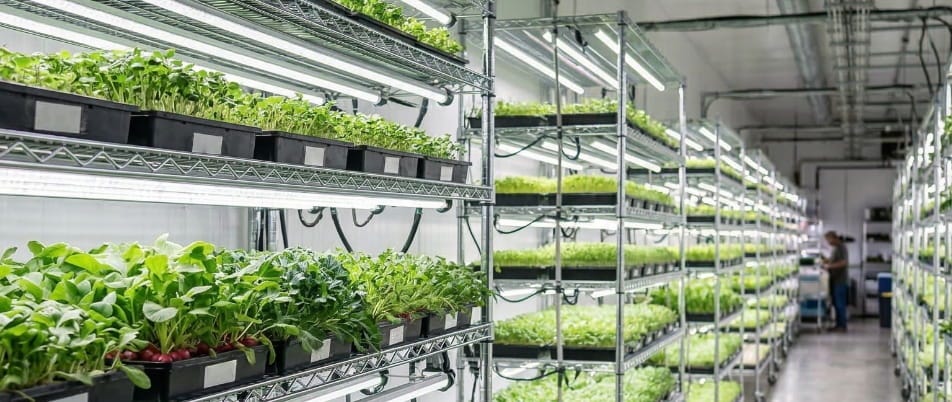
In 2026, scaling a microgreens operation isn’t just about adding more racks; it’s about mastering the "heart and lungs" of your facility. That is, automated watering systems for microgreens.
When you move from a few trays to a high-density vertical setup, the physics of water changes. Gravity is no longer your friend. To ensure that the cilantro on the top rack gets the same saturation as the pea shoots on the bottom, you need a system that can fight friction and elevation without breaking a sweat. This guide focuses on the two most critical (and often misunderstood) components of that system: The Nutrient Reservoir, that is the your water tank, and the High-Pressure Booster Pump.
We’re moving past "on-off" timers and toward sophisticated microgreens irrigation design. Whether you are looking at submersible vs. external pumps or trying to calculate the perfect nutrient reservoir sizing for a three-day weekend away from the farm, getting these specs right is the difference between a bountiful harvest and a dried-out disaster.
Why Do I Need a Booster Pump for Microgreens?
Perhaps you’re wondering, "Can’t I just hook up to the main water line and use a timer?" In a small-scale setup, maybe. But as you add tiers, you encounter the "Pressure Gap." Standard residential or commercial water pressure is often inconsistent, and when forced through a complex microgreens irrigation design with dozens of emitters, that pressure drops significantly by the time it reaches the top shelf.
This is where high-pressure booster pumps become the MVP of your grow room. Unlike a standard utility pump that just moves water, a booster pump is engineered to "stack" pressure, ensuring that every tray, regardless of its height, receives the exact same flow rate.
The Magic of Constant Pressure
For the modern professional, the goal isn't just movement; it's stability. Utilizing constant pressure pumps equipped with a Variable Frequency Drive (VFD) for hydroponics allows the system to be "smart."
Instead of the pump running at 100% capacity and potentially blowing out your fittings or popping off your pressure-compensated drippers, a VFD pump (like the DAB ESYBOX or Walrus TQI series) senses the demand. If only one rack is watering, the pump sips power and maintains a gentle flow. When the entire farm kicks on, it ramps up instantly to maintain a steady PSI. This prevents the "Pipe Burst" scenarios that haunt growers using oversized, non-regulated hardware.
Overcoming Vertical Resistance
Every foot of elevation requires the pump to work harder. Without a dedicated booster, your automated watering systems for microgreens will suffer from uneven saturation, where the bottom trays are waterlogged and the top trays are wilting. By integrating a pump designed for head height calculations, you neutralize gravity and ensure your automated bottom watering system delivers nutrients with surgical precision.
Selecting the Reservoir: Tank Orientation & Materials
Your microgreen’s tank is more than just a bucket; it’s the command center for your crop’s nutrition. In a high-turnover microgreens environment, your nutrient reservoir sizing and tank geometry dictate how often you’re mixing nutrients and how easy it is to keep the system sterile.
Vertical Storage Tanks: The Space-Saving King
In most urban or indoor farms, floor space is the most expensive commodity. Vertical storage tanks are the industry standard for automated watering systems for microgreens because they offer the highest volume per square foot. However, it’s not just about footprint. A tall, narrow column of water provides a slight "static head" advantage for your pump, making the initial suction easier for high-pressure booster pumps.
Transportable and Leg Tanks: The Mixing Advantage
If your microgreens irrigation design requires heavy agitation or frequent "batch" mixing of nutrients, transportable water tanks (specifically horizontal leg tanks) are often the superior choice.
- The Sump Advantage: Many of these tanks feature a sloped bottom or "sump," allowing for 100% drainage. This is critical for preventing the buildup of old nutrient salts at the bottom of the reservoir.
- Low Profile: If your booster pump is a multistage centrifugal pump (like the Walrus TPH), a horizontal leg tank allows the pump to sit at a similar level to the water, reducing the "suction lift" required.
The Pro Choice: Cone Bottom Tanks
However, if we’re being 100% transparent: Cone bottom tanks are the ultimate solution for nutrient mixing. * Total Drainage: Unlike leg tanks, which might have small "dead zones," a cone bottom tank funnels every drop toward the center. This is critical for preventing the buildup of old nutrient salts and "bio-slime" that can clog pressure-compensated drippers.
- Vortex Mixing: When you are pH-balancing or "brewing" a large batch of nutrients, the conical shape allows for better circular agitation, ensuring a perfectly homogenous solution before it ever hits your high-pressure booster pumps.
- The Trade-off: Conical mixing tanks require a specialized stand and more vertical clearance. If you have the height, choose the cone.
Material Safety: Why Food-Grade HDPE?
Because microgreens are a "raw-eat" crop with a fast growth cycle, chemical leaching is a major risk. Every water tank we recommend for this application is made from high-density polyethylene (HDPE). This material is UV-stabilized (to prevent algae growth) and BPA-free. When choosing your hydroponic water tank, consider the "Mixing vs. Delivery" strategy. Many micro-growers use one transportable water tank for the initial nutrient "brewing" and pH balancing, and a larger vertical water tank for the actual delivery to the racks. This ensures that the water being pushed by your constant pressure pumps is always perfectly stabilized.
How Do I Size My Tank for a Microgreens Rack?
Determining your nutrient reservoir sizing isn't just about "guessing big." A nutrient tank that is too small leads to nutrient fluctuations and pump dry-runs, while a tank that is too large can lead to stagnant water and "bio-slime" buildup.
To find the "Goldilocks zone" for your automated watering systems for microgreens, use this three-step calculation:
- The Consumption Baseline: On average, a standard 10 X 20 tray of microgreens requires roughly 0.5 to 1 gallon of water per week, depending on the crop density and room humidity.
- The Delivery Volume: If you are using automated bottom watering, you need enough volume to flood your flood-and-drain trays to a depth of roughly 0.5 inches across your entire farm simultaneously.
- The Safety Buffer: You should always maintain a 20% "Dead Zone" at the bottom of the tank. This ensures your submersible vs. external pumps never suck in air, which can cause cavitation and motor burnout.
The Formula: (Number of Trays × Daily Water Use) + (Total System Pipe Volume) + 20% Reserve = Your Minimum Tank Capacity.
For a 50-tray rack system, a 100-gallon vertical water tank is usually the sweet spot, allowing for a 3- to 4-day buffer. This sizing ensures your high-pressure booster pumps always have a consistent "flooded suction" head, meaning the pump doesn't have to work to "pull" the water—it’s fed by the weight of the water in the tank itself.
Precision Plumbing for Microgreens and Hydroponics: Integrating Solenoids and IoT
Once your nutrient dosing tank and pump are in place, the "intelligence" of your microgreens irrigation design comes down to how you distribute that pressure. In a professional 2026 setup, we’ve moved past manual ball valves.
The Role of IoT-Enabled Solenoid Valves in Hydroponic Farming
By using IoT-enabled solenoid valves, you can segment your farm into zones. This is vital because radishes and sunflowers have very different thirst levels. These valves act as the gatekeepers; when your controller sends a signal, the solenoid opens, and your constant pressure pumps instantly ramp up to meet the demand.
Protecting Your Hardware
High-pressure systems are prone to a concept known as "Water Hammer". Water Hammer refers to a shockwave that occurs when water flow is stopped abruptly. To prevent this, we recommend:
- Slow-Closing Solenoids: To protect your PVC joints.
- Backflow Prevention: A mandatory inclusion for any system connected to a municipal line to prevent nutrient-rich water from siphoning back into the main supply.
- Pressure-Compensated Drippers: These ensure that whether a tray is 2 feet or 12 feet from the pump, it receives exactly 2.0 gallons per hour (GPH).
Submersible vs. External Pumps: Which Layout Fits Your Grow Room?
When finalizing your microgreens irrigation design, the physical placement of your pump is just as important as its horsepower. The debate between submersible vs. external pumps usually comes down to three factors: heat management, maintenance access, and floor space.
Submersible Pumps: The Internal Workhorse
Submersible pumps, like the automatic bottom suction models from Dublin Pump Company, are designed to sit directly inside your vertical water tank.
- Pros: They are virtually silent and take up zero additional floor space. Because they are "cooled" by the water surrounding them, they are highly efficient for short, high-volume bursts.
- Cons: That cooling process transfers motor heat directly into your nutrient solution. In a microgreens setup, keeping your water below 70 °F/21 °C is vital to prevent root rot pathogens like Pythium. If your grow room runs warm, an internal pump might push your reservoir into the "danger zone."
External Multistage Pumps: The Professional Standard for Microgreens
For larger commercial operations, an external multistage centrifugal pump (like the Walrus TPH series) is often the preferred choice for automated watering systems for microgreens.
- Pros: These pumps stay cool by venting heat into the air, not your water. They are significantly easier to service because you don't have to "fish" them out of a 200-gallon tank.
- Cons: They require a dedicated footprint next to your tank and involve slightly more complex "suction side" plumbing.
The Verdict: If you are running a compact, climate-controlled boutique farm, a submersible pump with automated bottom watering capabilities is a clean, easy win. If you are scaling to a warehouse with hundreds of racks, the reliability and temperature stability of an external booster pump are worth the extra plumbing.
Maintenance: Keeping the Flow Consistent
An automated system is a "set and forget" asset—until a single clogged emitter ruins a $40 tray of Wasabi Arugula. To keep your constant pressure pumps running at peak efficiency, you need a proactive maintenance schedule.
Scrubbing the System
Bio-films and nutrient salts are the natural enemies of pressure-compensated drippers.
- Bi-Weekly: Wipe down the interior of your vertical water tank to prevent algae buildup.
- Monthly: Flush your lines with a mild food-grade citric acid solution to dissolve mineral deposits.
- Quarterly: Inspect the intake screen of your pump. If you're using high-pressure booster pumps, even a small piece of debris can cause cavitation, leading to pitted impellers and a noisy, inefficient motor.
Checking the "Pulse"
Modern IoT-enabled solenoid valves and VFD controllers often provide pressure data. Keep an eye on your baseline PSI; a slow drop in pressure over several weeks usually indicates that your filters are clogging or your pump’s mechanical seal is beginning to wear. Addressing these small issues early prevents the "catastrophic fail" that usually happens in the middle of a harvest cycle.
The ROI of Precision Irrigation in Indoor Farming
As we gear towards 2030, the difference between a profitable microgreens farm and a struggling one often comes down to the efficiency of your infrastructure. Transitioning to automated watering systems for microgreens is more than just a convenience, it is a strategic move to stabilize your yields and reclaim your time.
By pairing the correct nutrient reservoir sizing with a high-performance high-pressure booster pump, you eliminate the human error of under-watering and the physiological stress of uneven pressure. Whether you choose the compact efficiency of submersible vs. external pumps, the key is to build a system that can scale. Invest in a constant pressure pump and a high-quality food-grade tank from Tank Depot today, and you’ll find that the system pays for itself in labor savings and crop consistency before the next quarter is out.


