Calculating Your Rainwater Harvest: How Much Rainwater Can Your Roof Catch?
Water is rapidly becoming one of our most precious managed resources. Whether you are a homeowner looking to slash municipal utility bills and sustain an organic garden, or a commercial facilities manager striving to meet strict municipal stormwater compliance regulations and LEED certifications, your roof is sitting on an untapped asset. Every time a storm front rolls through, thousands of gallons of pure, soft water cascade down your gutters and wash away into municipal storm systems.
But how much water can you actually capture, store, and utilize?
The answer isn't a guessing game—it is a precise science. To successfully transition from a passive property manager to an active water harvester, you need to understand the exact mechanics of how to calculate rainwater collection from roof systems. Sizing your system incorrectly carries high stakes: install a storage tank that is too small, and you will watch thousands of gallons of valuable, harvestable water overflow into your foundation; buy an asset that is too large, and you waste capital on unnecessary industrial capacity.
To take the guesswork out of your design process, you must accurately calculate your property's precise geographic supply metrics and balance them against your daily consumption habits.
Calculate Your Dynamic Yield in Real-Time
Ready to bypass the manual math and see your facility's real-world harvest capacity instantly? Use our interactive, site-specific Tank Depot Rainwater Harvesting Calculator to input your footprint and view your optimized storage volume recommendations in under 60 seconds.
Is It Legal to Catch Rainwater on Your Property?
Before diving deep into technical flow rates and storage calculations, it is critical to confirm the regulatory landscape of your specific region. A common misconception is that catching rain is universally restricted or entirely illegal across the United States. In reality, rainwater harvesting is completely legal in all 50 states, though several regions enforce specific capacity thresholds, plumbing code requirements, and water rights compliance rules. For instance, arid Western states operating under historic "Prior Appropriation" doctrines may limit your total residential storage volumes, while Central and Eastern states focus heavily on public health, plumbing certifications, and cross-contamination prevention. To view your specific state's permitted storage guidelines, engineering mandates, or regional tax incentives, review The 2026 Guide to Rainwater Harvesting in the USA: Laws, Benefits, and Expert Design before finalizing your hardware footprint.
The Core Formula: How to Calculate Rainwater Collection from a Roof
To master water independence, you must first understand the fundamental physics of your roof. Many property owners mistakenly assume that the pitch, slant, or total surface area of their roofing shingles dictates how much water falls into their gutters. In reality, gravity works vertically. The true volume of water you can capture depends entirely on your roof's flat, horizontal footprint—known scientifically as the catchment area.
To accurately calculate roof rainwater runoff, water engineers rely on a standardized mathematical formula. This equation translates raw surface area and regional rainfall depths into real-world volumetric gallons.
The Rainwater Harvesting Calculation Formula
Harvest Potential (Gal) = Catchment Area (Sq. Ft.) X Rainfall (Inches) X 0.623 X Runoff Coefficient
   [ Catchment Area ]   ×   [ Rainfall Depth ]   ×   [ 0.623 Constant ]   ×   [ Runoff Coefficient ]
     (Square Feet)              (Inches)             (Gallons/SqFt/Inch)           (Material Efficiency)
                                        │
                                        ▼
                         === TOTAL HARVEST POTENTIAL ===
Explaining the Math: Why the Formula Works
To customize this formula for your specific home or commercial facility, let's break down exactly what each variable means and why it matters to your overall system design:
- Catchment Area (Sq. Ft.): This is the flat, two-dimensional overhead footprint of the roof area feeding into your gutter system. To find this number, simply measure the length and width of the building's exterior walls plus any eave overhangs. Do not calculate the actual sloped surface area of the roof; a steep roof and a flat roof with the exact same foundation footprint will catch the same volume of vertical rainfall.
- Rainfall (Inches): This represents the depth of rain recorded over a specific time frame (e.g., a single storm event, a calendar month, or an entire year). To calculate your seasonal baseline, you can pull average precipitation figures from local meteorological databases.
- The 0.623 Conversion Constant: This is the mathematical bridge that converts dimensional space into liquid volume. One inch of water covering a flat surface of exactly one square foot equals precisely 0.6233 gallons of water. This constant remains completely fixed regardless of your location or setup.
- The Runoff Coefficient (Cr): No rainwater harvesting system is 100% efficient. As water moves across your roof toward your downpipes, a portion of it is lost to evaporation, absorbed by porous materials, or splashed over the sides of the gutters. The runoff coefficient is a decimal between 0 and 1 that accounts for this inevitable loss based on your specific roofing material.
Material Breakdown: How Your Roof Impacts Rainwater Yield
Choosing the right roofing material can dramatically alter how much water successfully makes it into your holding assets. When you use a rainwater collection calculator, you must adjust the runoff coefficient to match your structural reality:
|
Roofing Material |
Runoff Coefficient (Cr) |
Efficiency / Water Loss Explanation |
|
Pre-painted Metal / Steel |
0.90 - 0.95 |
Highly Efficient: Slick, non-porous surfaces offer minimal friction and zero absorption, making metal the gold standard for maximum collection yield. |
|
Concrete / Clay Tiles |
0.80 - 0.85 |
Moderately Efficient: While smooth, tiles feature contoured shapes and seams that can trap small amounts of water, resulting in minor evaporative loss. |
|
Asphalt Shingles |
0.70 - 0.75 |
Low Efficiency: Rough, highly textured, and slightly porous composite materials trap water easily and introduce more particulate debris into your first-flush diverters. |
|
Flat Tar & Gravel Roofs |
0.60 - 0.70 |
Poor Efficiency: Commonly found on older commercial structures, the gravel substrate acts as a sponge, retaining significant moisture and slowing down flow rates. |
By pairing your structural footprint with your roof's material efficiency coefficient, you can easily calculate rainwater runoff from a roof before spending a single dollar on storage infrastructure.
Choosing the Right Asset: Sizing Your Rainwater Tank
Selecting a water storage asset based on a guess or a gut feeling is one of the most expensive mistakes a property manager can make. If you under-size your storage array, you miss out on free water and let valuable resources escape down the property line during heavy storms. If you over-size your configuration, you invest capital in massive industrial containment volumes that may never fill.
To break this cycle, you must look at system design through a professional engineering lens.
The Scientific Method to Rainwater Tank Sizing
To establish a highly functional closed-loop water system, you must balance two conflicting forces: Supply and Demand.
    [ TOTAL SUPPLY ]                     [ TOTAL DEMAND ]
  Rainfall x Roof Footprint            Family Size x Daily Use
         │                                      │
         ▼                                      ▼
         ───────────────────┬───────────────────
                            │
                            ▼
               === OPTIMAL TANK CAPACITY ===
A properly integrated system uses a precise mathematical balance. Your Supply is dictated by your physical environment—your roof's square footage and local meteorology.
Your Demand is governed by your consumption habits—how many people occupy the property and what the captured water is being used for.
By understanding how these two metrics intersect, you can easily deploy an accurate rainwater storage tank calculation that fits your site's exact needs.
Calculating Local Rainfall Frequency, Volume, and Runoff Intensity
The first half of your calculation centers around environmental supply. To find your regional capacity, you must analyze both long-term historical averages and immediate, short-term storm intensity profiles.
To execute how to calculate rainwater harvesting tank size configurations effectively, look up your ZIP code’s average annual precipitation using a localized climate database. This gives you a macro-level baseline of what your property can expect to collect across a 12-month calendar. However, looking only at yearly averages is dangerous; you must also evaluate how heavily it rains during severe weather events using a stormwater drainage calculator.
The "One-Hour Downpour" Scenario
To visualize why runoff intensity matters, let’s look at a concrete operational example. Imagine a standard residential property with a 1,500 square foot roof footprint built with efficient pre-painted metal panels (Cr = 0.90). If a sudden, heavy storm front drops exactly 1 inch of rain within a single hour, we can map out the volume using our baseline equation:
1,500 Sq. Ft X 1 Inch X 0.623 X 0.90 = 841.05 Gallons
This single, intense hour of weather yields roughly 841 gallons of raw water. If your property is only equipped with a standard 500-gallon or 800-gallon holding tank, your storage asset will hit maximum capacity and begin overflowing into your foundation in less than 60 minutes.
For areas prone to intense, brief summer storms followed by weeks of dry weather, checking a rainwater tank volume calculator helps you scale up your storage capacity to safely capture these sudden, high-volume deluges.
Factoring in Family Size and Water Consumption
The second half of our engineering balance is your property's real-world water consumption. Your storage volume must be large enough to handle your daily demand without running completely dry between rain events.
First, determine the application of your harvested water:
- Outdoor Irrigation Only: Your demand is seasonal. It depends on garden square footage, crop types, and local evaporation rates during dry months.
- Whole-House Non-Potable Indoor Use: Your demand is consistent year-round. This includes toilet flushing, washing machine supply, and indoor cooling systems.
To calculate your indoor baseline, use the standardized Daily Household Demand Formula:
Daily Household Demand (Gal) = Number of Residents X Daily Per Capita Non-Potable Use (Gal)
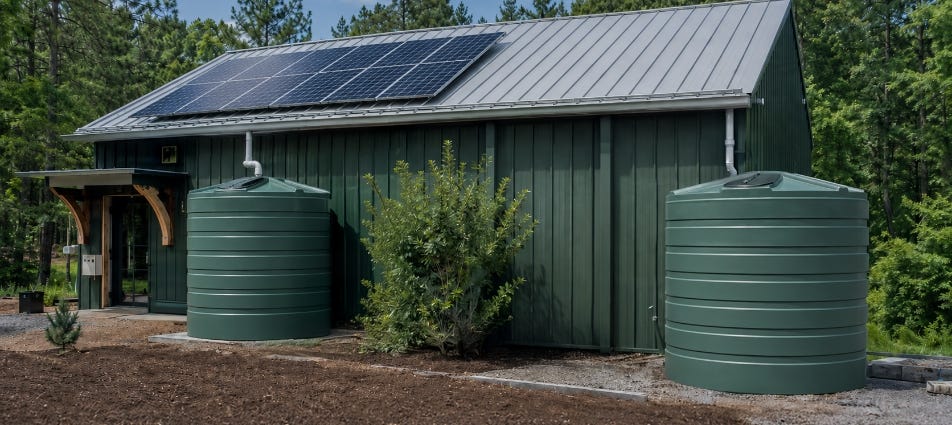
Standard Engineering Baseline: In an average American household, a single resident consumes roughly 20 to 30 gallons of water per day strictly for non-potable indoor tasks (such as toilet flushing and laundry). For a family of four, this translates to an indoor non-potable demand of 80 to 120 gallons every single day. If space allows it, you could think along the lines of interconnecting multiple rainwater catchment tanks to satisfy your demand and comfortably hold available supply.
Balancing Dry Periods
Your final rainwater harvesting tank sizing must bridge the gap during dry spells. If your region typically experiences a 20-day stretch without a single drop of rain during the summer, a family of four consuming 100 gallons per day will require a baseline reserve of at least 2,000 gallons (100 Gal/Day X 20 Days) of stored water to remain fully self-sufficient.
By applying this precise framework, you ensure your residential or commercial rainwater harvesting tank size calculator logic accounts for both intense supply spikes and prolonged dry stretches.
Maximizing Your Sustainable Rainwater Storage
Transitioning to an efficient rainwater harvesting setup is one of the smartest operational improvements you can make for your property. However, true sustainability relies entirely on structural accuracy. By utilizing a data-driven rainwater harvesting calculator and balancing your regional storm profiles against your real-world consumption demand, you eliminate the costly guesswork often associated with fluid storage management.
Accurate sizing does more than just protect your building from structural erosion and foundation damage caused by unmanaged overflow. It directly saves you money on initial asset procurement while maximizing your long-term return on investment (ROI). You won't waste capital purchasing industrial containment volume you can't fill, nor will you limit your self-sufficiency with an under-sized reservoir.
No matter what your site metrics reveal, a successful setup requires heavy-duty, UV-stabilized, and structurally sound storage infrastructure to keep your water secure.
Ready to Build Your Water Independence?
Explore Tank Depot’s industry-leading inventory to find the exact containment system for your property:

Perfect for tight residential setbacks and suburban pathways.
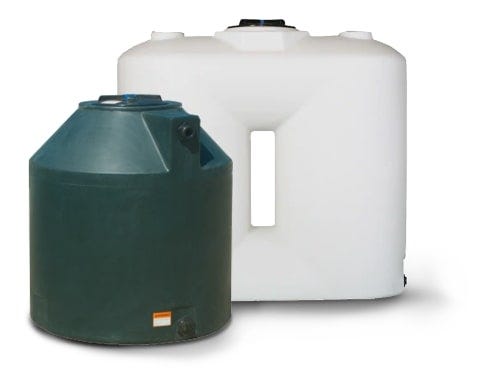
Engineered for maximum capacity, longevity, and simple maintenance.

The ultimate choice for large-scale commercial and residential water storage.