


Case Study: Overcoming Liquid Surge with Custom Baffled Tanks
The Midnight Slosh: When a 12-Pound Payload Turns into a Pendulum
Meet Jim. He manages fleet logistics for a multi-state agricultural distributor. For months, Jim’s team faced an invisible, white-knuckle liability on the highway. Every time his drivers hauled a partial load of liquid ammonium polyphosphate, a heavy fertilizer weighing a brutal 11.6 pounds per gallon, the trucks became terrifyingly unpredictable.
It wasn't just standard water sloshing. Because of the high specific gravity of the payload, the dynamic forces inside the liquid storage tank were massive.
Drivers reported that during routine highway braking, the fluid cargo would build momentum, rushing forward with enough kinetic force to override the truck's anti-lock braking systems. It felt like an iron pendulum swinging inside the shell, pushing the vehicles long past their safe stopping markers.
Worse, when cornering on steep rural exits, the dense liquid would climb the inner walls. This abruptly shifted the vehicle's center of gravity and caused the truck chassis to groan under the strain.
Jim realized his liquid transport setups were an accident waiting to happen. He needed a engineered solution before a routine delivery turned into a highway rollover statistic. That is when he called his strategy partners at Tank Depot.
The Physics of Fluid Momentum: Breaking Down the Surge
To solve Jim’s stability crisis, we have to look at the fluid dynamics of a moving payload. When a truck carries solid cargo, the mass is locked in place. Liquid is a completely different beast. Because fluid is highly malleable, it deforms and surges in response to every braking, acceleration, and steering input.
This volatile energy transfer is governed by the classic momentum equation:
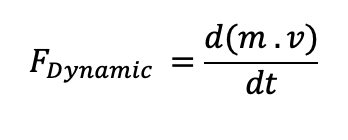
This equation proves that dynamic force changes based on velocity over time. Because liquid moves freely, the dynamic force exerted by a shifting fluid payload is time-dependent. When you are hauling high-density chemical solutions, that force frequently punches way above the impact forces generated by solid cargo of the exact same weight.
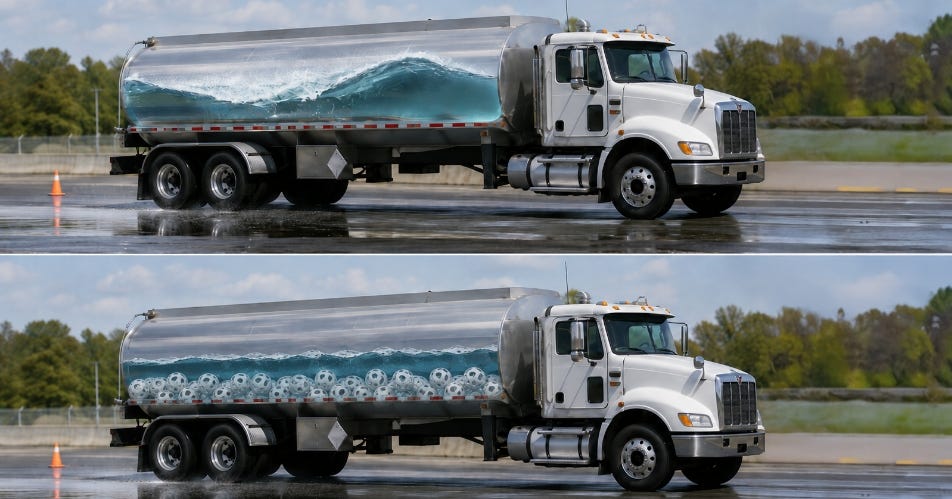
When Jim's drivers tapped the brakes, the liquid's momentum drove it forward in a massive subterranean wave. It would slam against the front bulkheads. This forward wave generates intense, localized fluid pressures against the hauling tank structure. It transfers a severe longitudinal force directly to the truck's chassis, straining the vehicle suspension and stretching out your stopping distances.
The hazard spikes even higher when cornering. Lateral sloshing forces the liquid to climb the sidewalls, shifting the entire vehicle’s center of gravity both sideways and upward. This sudden displacement overtaxes your tires, axles, and suspension components, creating an immediate rollover risk.
Sloshing behaves at its worst in a partially filled tank, especially a half-full load. A half-empty tank gives the liquid a much longer path to accelerate. The fluid builds up maximum speed and kinetic energy before it hits the tank walls. When a liquid transportation tank is completely full, the fluid is physically confined, making surge forces negligible. But because modern fleet operations must frequently haul partial loads, mastering liquid surge control is absolutely vital to your fleet's daily road safety.

The Anatomy of Stability: Internal Tank Baffles vs. Free-Floating Dampeners
For decades, the standard way to reduce liquid surge was simple: weld or bolt large, solid walls inside the tank structure. These traditional internal walls—known as a fixed internal baffle system—work by having a dividing wall in the tank to cut down on the internal wave effect of sloshing
While this sounds great on paper, static barriers come with severe engineering drawbacks and hidden operational costs.
When a heavy truck is transporting liquid cargo, thousands of pounds of fluid smash into these rigid metal or plastic partitions every single time the driver hits the brakes or turns a corner. Because fixed baffles are completely rigid, they cannot bend or absorb that energy. Instead, they take the direct force of the liquid's momentum and concentrate all that brutal kinetic stress right onto their anchoring points.
● Weld Fatigue and Cracking: In structural steel stainless steel or aluminum tanks, this relentless pounding creates massive cyclic stress. Over time, the joints where the baffles meet the outer tank shell begin to flex, fatigue, and crack. This leads to expensive structural repairs and hazardous leaks.
● Poly Tank Vulnerabilities: The issue is even trickier in modern poly tanks. Rotational-molded polyethylene tanks are designed to flex naturally under loads. Forcing a rigid internal divider into a flexible poly tank causes severe stress fractures along the tank walls, dramatically shortening the operational lifespan of your valuable assets.
● The Sanitization Nightmare: From a daily maintenance perspective, fixed internal walls create hard-to-reach structural pockets and blind spots. This makes inspecting, scrubbing, and properly sanitizing the tank interior incredibly difficult. If you need to repurpose the tank to haul a different fluid, trapped chemical residue behind those bulkheads poses a massive risk of cross-contamination.
The Drop-In Alternative: A Flexible, Free-Floating Matrix
To solve these persistent engineering headaches, modern mobile fluid transport fabrication has taken a massive leap forward. Instead of fighting the fluid with rigid walls, advanced fleets are switching to a dynamic, free-floating dampening approach.
Rather than modifying the tank structure, operators can drop modular, specialized dampening units—such as Enduraplas Baffle Balls or Liquid Surge Control SurgeBusters—directly through standard tank manways and lids. Once inside, these hollow structures float and roll freely, automatically distributing themselves to form a flexible, energy-absorbing matrix throughout the payload.
These innovative liquid transport baffled tanks don't try to stop the liquid's movement completely. Instead, they cleverly break up the wave patterns. As the liquid tries to slosh, it is forced to travel through thousands of tiny flow-restriction ports built into the floating spheres or interlocking paddles. This restriction instantly throttles the fluid's velocity, breaking a single, violent wave into tiny, disorganized currents and safely converting destructive kinetic energy into harmless heat through fluid friction.
To help you compare your options, here is how traditional fixed systems stack up against modern free-floating solutions across critical performance metrics:
|
Evaluation Parameter |
Built-In Rigid Baffles |
Free-Floating Dampening Surgebuster Systems |
|
Installation & Fleet Retrofitting |
Requires permanent mechanical alterations, high-heat welding, or expensive, specialized tank molds. |
Fast drop-in installation requiring absolutely zero tank modifications, structural cutting, or special tools. |
|
Structural Stress Dispersion |
Concentrates thousands of pounds of dynamic kinetic energy onto specific weld joints and tank walls. |
Disperses impact forces evenly throughout the entire fluid volume, protecting the outer tank shell. |
|
Material & Shell Compatibility |
Strictly restricted to matching materials (metal-on-metal or complex plastic molding). |
Universally compatible with all high-density poly, fiberglass, stainless steel, and aluminum tanks. |
|
Maintenance & Fleet Repurposing |
Highly difficult to clean, inspect, or sanitize due to hard-to-reach physical compartments and tight corners. |
Easily fished out through the tank manway and hosed down for rapid, hassle-free tank cleaning and chemical swaps. |
|
Operational Lifespan |
Subject to localized weld fatigue, stress cracking, and permanent structural deformation over time. |
Highly durable, rust-proof, chemical-resistant plastic structures built to withstand high-impact forces for years. |
By upgrading to a free-floating baffle ball matrix setup, fleet managers achieve a seamless balance of safety and efficiency. You eliminate the dangerous vehicle handling caused by fluid sloshing while completely protecting the physical structural integrity of your transport tanks.
Technical Breakdown: Selecting Your Surge Suppression System
Material & Food-Grade Considerations: Industrial vs. Potable Applications
When it comes to picking the right surge suppression equipment, a one-size-fits-all approach simply doesn't work. Your choice between a rigid physical barrier and a modular system comes down to a clear understanding of your payload's chemical properties and your industry's specific regulatory requirements.
Our inventory at Tank Depot features high-performance options tailored to two distinct profiles: heavy-duty industrial fluid transfer and certified food-grade transport.
For food-grade applications, including fresh drinking water or liquid ingredients, physical compatibility is strictly regulated. Enduraplas Baffle Balls are manufactured from highly durable, food-grade polyethylene. This dynamic choice ensures your transportable water tank remains free of contaminants while preserving the absolute purity of your cargo.
Conversely, industrial applications moving agricultural chemicals, wastewater, or lubricants require an incredibly rugged structure. Liquid Surge Control SurgeBusters are built from a tough, high-performance polymer blend designed to handle demanding industrial liquids without breaking down over time. Note that while these are perfect for heavier liquids, these are also used for drinking water transportation.
Regardless of the system you pick, a foundational rule applies to your entire setup: the tank shell must match the weight of your payload. When hauling highly corrosive chemicals or dense fertilizers, your transport tank must feature a certified specific gravity rating of 1.9 SG or higher. This ensures the tank walls remain structurally secure against high-impact surge forces.
The 7-Second Retrofit: Instant Safety and Efficiency
One of the biggest key benefits of our modular systems is how easy they are to deploy. Traditional baffle systems force your fleet into retirement for days while specialized technicians cut, bolt, or weld brackets inside your tank.
Our free-floating solutions eliminate that entire headache. They don't require permanent alterations, structural drilling, or a single bolt.
For example, the Enduraplas assembly process is incredibly straightforward. You align the two matching halves, press them together with a quick, firm, hands-on motion, and give them a simple "click & turn" twist. This locks the integrated structural clips, creating a rigid, hollow sphere in exactly seven seconds.
From there, you simply drop the assembled units directly through your tank’s existing manway lid or hatch. They distribute themselves naturally throughout your payload, rolling and floating freely to provide immediate wave mitigation.
To help you choose the right model from our lineup, here is a breakdown of the specific sizes, dimensions, and structural options available on our category page:
The Fleet Manager’s Guide to Lid Clearance, Displacement, Liquid Surge and Baffle Sizing
|
Manufacturer |
Product Description & Setup |
Opening Size Fit |
Key Specs & Dimensions |
Primary Application |
|
Liquid Surge Control |
4" SurgeBuster (Case of 10) |
Fits 4" to 7" openings |
• Length: 7" |
Small industrial tanks, agricultural spray lines, and specialized process storage. |
|
Liquid Surge Control |
7" SurgeBuster (10 or 25 Pack) |
Fits 8" to 15" lids |
• Length: 36" |
Mid-sized water tankers, agricultural sprayers, and waste storage bins. |
|
Liquid Surge Control |
15" SurgeBuster (10 or 25 Pack) |
Fits 16"+ manways |
• Length: 22" |
Heavy-duty commercial haulers, bulk chemical transport, and emergency fire tenders. |
|
Enduraplas |
Small Baffle Ball |
Fits 8" lids |
• Diameter: 7.5" |
Mid-sized farm sprayers, small water trucks, and mobile pressure washers. |
|
Enduraplas |
Large Baffle Ball |
Fits 16" lids |
• Diameter: 15" |
Large potable water haulers, civil dust-suppression trucks, and industrial mixing vessels. |
By dropping the correct size into your fleet, you protect your investment, lower your maintenance costs, and maximize your transport safety without sacrificing a single drop of productivity on the road.
Precision Math: Surgebuster & Baffle Balls Sizing Formulas and Density Adjustments
The Basic Volumetric Setup: Achieving Total Wave Disruption
To completely eliminate dangerous sloshing, your transport tank must be filled with a mathematically precise quantity of dampening units. Leaving too much open space allows the liquid payload to build up destructive momentum across unbaffled sections.
Calculating your baseline setup is incredibly easy. For the Enduraplas Baffle Balls, your target count relies on a direct volumetric ratio based on the total rated capacity of your water tank:
● The 7.5" Model (EP-AVB195): Requires 50 balls for every 100 gallons of total tank capacity (or 0.5 balls per gallon). This ensures you have one small ball managing every 2 gallons of fluid space.
● The 15" Model (EP-AVB355): Requires 10 balls for every 100 gallons of total tank capacity (or 0.1 balls per gallon). This provides one large ball for every 10 gallons of fluid space.
Mathematically, we represent these counts using simple baseline formulas:
NAVB195 = ⌈ 0.5 .Vtank⌉
NAVB355 = ⌈0.1 .Vtank⌉
(Where  is your total tank capacity/volume in gallons, and the ceiling brackets (⌈…⌉) simply mean we round our final answer up to the nearest whole integer).
For example, if Jim is retrofitting a 1,000-gallon tank with the larger 15" Baffle Balls, the math is straightforward:
1000 x 0.1 = 100 Baffle Balls
The Heavy Payload Constraint: Density-Adjusted Calculations
While the volumetric formulas above work perfectly for standard water hauling , things change dramatically when your fleet moves into heavy chemical solutions, liquid fertilizers, or specialized industrial slurries.
Because dense liquids have significantly more mass per gallon, their shifting kinetic energy is amplified. A 1,000-gallon load of heavy agricultural chemical can weigh up to 12,000 lbs—exerting far more violent surge forces against your truck's chassis than standard water payload.
To safely counteract these elevated dynamic forces, the total number of SurgeBusters inside your tank must be adjusted upward based on the weight per gallon of the heaviest liquid you transport. Additionally, your industrial poly tank shell must be explicitly rated for a high specific gravity:
G ≥ 1.9
This certified rating ensures your liquid storage tank walls possess the structural thickness required to handle both the dense chemical payload and the focused dampening resistance of the baffle matrix.
Density-Adjusted Sizing Chart: Dynamic Baffle Counts for Liquid Transport
To protect your tank shell and ensure predictable vehicle handling during transit, use this density-adjusted configuration matrix. It maps out exactly how many dynamic internal units you need to deploy based on your total rated tank capacity and the exact weight profile of your cargo.
|
Rated Tank Capacity (Gallons) |
Standard Payloads(Water <8.34 lbs/gal) |
Medium Payloads(Chemicals 8.34–10.0 lbs/gal) Use: 7.5” or 15” Mixed Matrix |
Heavy Payloads(Fertilizers 10.0–12.0 lbs/gal) Use: 15” Baffle Balls (AVB355) |
|
100 |
50 units (7.5” Size) |
50 units (7.5” Size) |
10 units (15” Size) |
|
300 |
150 units (7.5” Size) |
150 units (7.5” Size) |
30 units (15” Size) |
|
500 |
250 units (7.5” Size) |
250 units (7.5” Size) |
50 units (15” Size) |
|
1,000 |
500 units (7.5” Size) |
500 units (7.5” Size) |
100 units (15” Size) |
If your transport fleet frequently handles mixed payloads, always calculate your unit counts using the Heavy Payloads column. Running a slightly higher density configuration with a water load is completely safe and increases your stability, but running a water-only configuration with a heavy fertilizer load will under-dampen the tank and compromise your vehicle handling on the road.
The Offloading & Freezing Toolkit: Seasonal Upkeep and Ground Safety
Yard Operations and Delivery Day Safety
Optimizing your fleet for transport safety begins long before your new equipment ever touches the highway. It starts right in your yard on delivery day.
When you order bulk packs of liquid transport baffled tanks components—like our 25-pack configurations of the 15-inch Liquid Surge Control SurgeBusters—the shipment arrives as a heavy, industrial-sized freight load. Because these commercial systems are built to withstand rugged field conditions, they are packaged in large, high-volume crates.
It is incredibly important for fleet managers to plan their yard logistics ahead of time. Our largest modular setups ship directly on dedicated freight carriers. Because of their footprint, standard liftgate service is not available for shipping crates or product dimensions exceeding 83 inches.
Operational Safety Rule: Your yard team is completely responsible for offloading the delivery vehicle. To ensure a smooth, injury-free delivery day, make sure your receiving bay has a forklift, tractor, or heavy offloading equipment ready to handle the freight when the truck rolls in.
Winterization and Freezing Climate Maintenance
If your fleet operates in regions that drop below freezing, managing your surge suppression systems during the winter shifts is a critical step in preserving your equipment's operational lifespan.
While both the high-density polyethylene Enduraplas Baffle Balls and the advanced polymer SurgeBusters are completely rust-proof and chemical-resistant, freezing water introduces a massive physical hazard: expansion.
If a truck is parked in freezing temperatures with a partial water load, ice will begin to solidify directly around and inside the hollow frames or interlocking disc paddles of your floating matrix. As water turns to ice, it expands with incredible physical force. This traps the modular structures in a solid ice block, subjecting the structural ribs to unwanted mechanical strain and potential deformation.
To maintain peak safety and efficiency, we highly recommend a proactive seasonal maintenance routine:
● Fish Out Before the Freeze: For winter storage or deep tank sanitization, easily fish the free-floating units out through the main tank manway or hatch using a simple hook tool.
● The Rapid Clean: Line the units up in your wash bay and give them a quick hose-off with a power washer to blast away any residual sediment or film.
● Dry Storage Prep: Store the dry units in a designated holding bin or outdoor yard rack for the winter. This leaves your tank empty, dry, and completely safe from ice-induced stress cracks.
By integrating these simple ground-handling and winterization workflows into your regular fleet schedule, you protect your initial investment and ensure your internal tank baffles are clean, rigid, and ready to reduce liquid surge the moment spring field operations kick back into gear.
Meeting Fleet Safety and Liquid Surge Control Regulatory Frameworks
Municipal & Fire Service Compliance: Navigating NFPA and USFS Rules
Integrating proper surge mitigation is not just a smart choice for day-to-day operations—for many of Tank Depot's municipal, industrial, and emergency services clients, it is a strict legal requirement. Operating large, mobile water supply apparatus like city water tenders or wildland firefighting trucks means managing extreme shifts in fluid momentum under high-stress driving conditions.
For instance, a standard 3,000-gallon emergency water tender hauls over 25,000 lbs of dynamic, sloshing water payload. If a driver has to slam on the brakes while rushing to a fire line, an unbaffled tank can easily cause a jackknife or a catastrophic rollover accident.
To protect first responders, the National Fire Protection Association (NFPA) enforces rigid structural design rules. Under NFPA 1901 (Standard for Automotive Fire Apparatus) and NFPA 1906 (Standard for Wildland Fire Apparatus), emergency tanks are required to feature a heavy-duty internal baffling system to break up fluid waves. While engineers historically relied on permanently welded or molded internal swash partitions, these rigid walls are highly vulnerable to stress cracks along their weld lines over years of intense field service.
Fortunately, federal and state agencies have modernized their procurement rules to embrace more reliable technology. The United States Forest Service (USFS) maintains a strict inspection standard for tactical water tenders deployed to wildland fire incidents. Under the official USFS Tactical Water Tender Incident Checklist (Section D.2.1.2), transport tanks must utilize longitudinal and transverse baffling systems where the parallel internal wall spacing does not exceed 52 inches.
Crucially, the USFS explicitly permits the use of an approved "Free Floating Baffle System (Baffle Balls)" as a certified alternative to permanent partitions. As long as the transport operator can provide manufacturer data sheets proving the floating matrix provides sufficient dynamic vehicle stability, municipal fleets can confidently pass inspection using drop-in dampeners instead of tearing apart their tanks for custom fabrication.
Expanding Beyond Emergency Water: Industrial Fluid Lines and Power Applications
While fire safety guidelines focus primarily on water transport, industrial and commercial fleets must apply these exact same surge mitigation principles to a wide range of heavy fluids.
Modern mobile fluid transport fabrication systems regularly manage complex payloads—including high-viscosity lubricants, petroleum fuels, and heavy agricultural chemicals. When hauling dense liquids in transport setups equipped with specialized pump rooms or custom auxiliary equipment, unchecked fluid sloshing does more than just threaten vehicle handling; it sends destructive hydraulic shockwaves through your entire line infrastructure.
Uncontrolled surge forces strain delicate fittings, accelerate wear on inline valves, and can even cause localized foaming and aeration inside your hydraulic fluid reservoirs. By deploying a free-floating baffle matrix, you create a comprehensive dampening shield. This shield absorbs the payload's kinetic energy before it reaches your external plumbing, protecting the intricate fluid lines that feed your truck's downstream hydraulic machinery and power distribution systems.
The Results: Enhanced Fleet Safety and Operational Lifespan
The Proven Outcome: How Jim Transformed His Fleet
By working with Tank Depot to completely retrofit his liquid cargo fleet, Jim turned his white-knuckle highway problem into a masterclass in operational efficiency and transport safety. Instead of dealing with costly, permanent tank modifications or structural vehicle downtime, Jim's yard team easily executed the drop-in deployment strategy right in their own service bays.
The real-world results over the following months spoke volumes:
● Eliminated Structural Damage: By breaking up the fluid's physical momentum before it could hammer the outer shell, the floating matrix completely stopped the cyclic fatigue that causes structural leaks and dynamic stress cracks along tank walls and weld joints.
● Massive Braking Improvements: Thanks to the superior surge suppression and slosh reduction of the interlocking designs, Jim's drivers noticed an immediate difference on the highway. Independent safety testing has shown that these modular systems can actually reduce vehicle braking distances by up to 46%, giving drivers a massive safety buffer during emergency stops.
● Total Rollover Protection: Because the matrix dampens lateral shifting, the liquid payload can no longer climb the tank sidewalls during sharp turns. This keeps the truck’s center of gravity perfectly balanced, completely eliminating the threat of a sudden, slosh-induced vehicle rollover.
For Jim, the key benefits went beyond simple road safety. His fleet maintenance costs plummeted, his truck components lasted longer, and his drivers finally had the absolute confidence they needed to handle any route safely.
Ready to Secure Your Fleet? Connect with Tank Depot Today
Don't let uncontrolled liquid sloshing compromise your drivers' safety or chew through your corporate maintenance budget. Whether you are hauling fresh drinking water across rough construction sites, moving heavy agricultural chemicals, or managing industrial wastewater fleets, Tank Depot has a high-performance solution ready to ship to your yard.
● Browse Our Catalog: Head straight over to our dedicated Baffle Balls & Surge Busters Category Page to check real-time regional stock, review exact pricing, and select the perfect layout size for your fleet.
● Explore Sizing Metrics: Look over our technical dimension liquid surge control charts to match your specific tank lid openings (from compact 4-inch ports up to standard 16-inch industrial manways).
● Get an Expert Volume Setup: Need a custom density-adjusted volumetric calculation for heavy chemical payloads? Contact our specialized Tank Depot engineering team directly at (866) 926-5603 for an accurate, volume-discounted commercial freight quote today!


