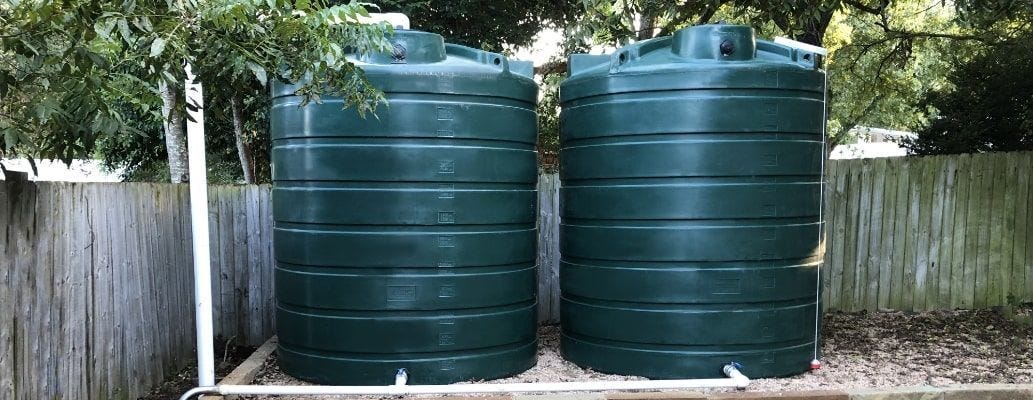
Rainwater harvesting has come a long way from the plain industrial barrel in the corner of the yard. Today you can capture thousands of gallons of clean roof runoff with systems that slot into high-end landscaping, tuck along a narrow side yard, or handle heavy agricultural loads. With droughts and water restrictions pressuring municipal supplies across much of the country, a well-chosen tank pays off in lower bills, reliable irrigation, and a backup reserve when you need it most.
Whether you want to trim your water bill, keep a garden green through drought restrictions, or build an off-grid reserve, the right tank style matters. Here is our guide to the nine best types of decorative and residential rainwater harvesting tanks, plus a bonus look at Tank Depot's Omni Series, an eco-friendly aboveground concrete tank that delivers industrial structural mass and thermal insulation without the excavation.
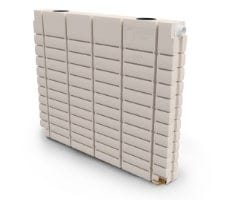
For suburban lots, urban properties, or homes with a narrow side-yard walkway where a round bulk tank would block the path or breach setback rules, slimline tanks are the answer. Molded from food-grade, UV-stabilized polyethylene, they carry an ultra-compact footprint, often under 25 inches (64 cm) deep and some as narrow as about 11 inches (28 cm), so they sit flush against an exterior wall right beneath the downspout. You get high-capacity storage without giving up yard space.
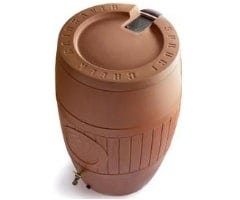
If looks come first, decorative rain barrels styled as Mediterranean terracotta urns, granite pillars, or oak whiskey barrels double as patio features. Many include an integrated planter well on top for flowers or herbs, and they come fitted with brass spigots, overflow hoses, and child-proof debris screens. Most run 50 to 150 gallons, a natural fit for residential garden landscapes.
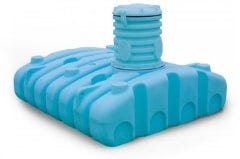
When aboveground space is tight or HOA rules prohibit visible storage, an underground cistern is the ultimate hidden solution. Seamless polyethylene cisterns are engineered with heavy-duty ribbed walls to handle dynamic soil burial loads and high groundwater tables, and placed below the frost line they protect stored water from freezing while leaving 100% of your surface landscape intact. For how buried poly stacks up against concrete, see our guide to polyethylene vs concrete underground tanks.
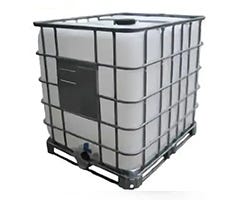
For DIY-minded homeowners and small operations that want capacity on a budget, intermediate bulk containers (IBC totes) are a rugged, no-frills way to store rainwater. Each caged 275 or 330 gallon IBC tote sits in a reinforced steel frame, stacks easily, and takes well to modification, so tinkerers can add first-flush inlets, spigots, mesh screens, and overflow links with basic fittings. They are a practical entry point for garden irrigation, washdown, or an emergency reserve, and several totes can be manifolded together as your needs grow.
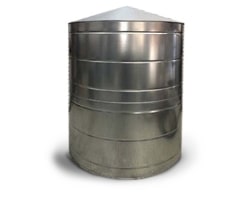
Corrugated galvanized steel rainwater tanks pair rustic farmhouse charm with industrial-grade durability, a favorite for homesteads, wineries, and commercial estates. An internal food-grade, NSF-certified poly liner keeps stored water off the metal, while the steel shell delivers structural strength, heat tolerance, and decades of reliable outdoor performance. For fire protection, steel tanks can be built to NFPA 22 standards, with custom sizes available well beyond a million gallons.
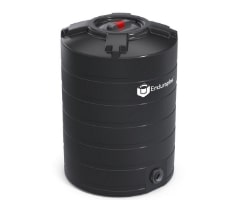
When raw storage capacity per dollar is the goal, vertical poly water tanks remain the industry standard, and polyethylene is the most common material for aboveground rainwater cisterns. Dark green and black tanks block sunlight to prevent internal algae growth, and capacities run from as low as 20 gallons up to 15,000 gallons, with larger vertical poly tanks reaching 20,000 gallons. Set on a flat pad near a barn or outbuilding, they deliver unmatched storage efficiency.
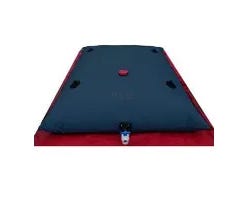
For temporary sites, seasonal agricultural needs, or crawlspaces where a rigid tank will not fit through the access door, flexible bladder water tanks are a low-profile alternative. Made from heavy-duty elastomeric coated fabric, they lie flat when empty and expand as rainwater fills the unit, so they are easy to transport and deploy in tight spaces.
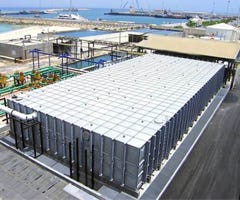
When a project needs serious capacity, modular fiberglass (FRP) panel tanks are built to scale. Assembled on-site from pre-fabricated glass-reinforced panels, they range from a few hundred gallons up to 2.5 million gallons, which makes them a workhorse for municipal, commercial, and remote-site water storage, fire reserves, and large rainwater systems. The sectional design ships flat, installs fast, and can be expanded or relocated as demand changes, all while resisting corrosion and UV. Explore our modular fiberglass tanks for large-scale collection.
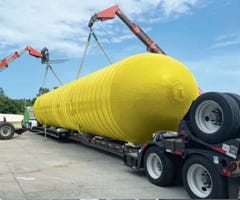
For commercial developments, parking lots, and municipal sites that must manage peak runoff, underground fiberglass (FRP) stormwater tanks are the heavy-duty answer. Buried out of sight, these corrosion-resistant tanks handle stormwater detention and retention alongside rainwater harvesting, with capacities from 1,000 to 60,000 gallons and compliance with AWWA D120, NSF/ANSI 61, NFPA 22, and UL-1316 for demanding municipal and commercial projects. High-flow inlets and overflow control tame peak stormwater while banking water for irrigation, fire suppression, or washdown use. See our full line of underground fiberglass tanks.
Calculating Your Roof Catchment Yield for Rainwater Collection Systems
Before you pick a size, estimate how much water your roof can actually harvest. Rainwater collection follows a simple, reliable rule:
Collection Volume (gallons) = Roof Area (square feet) × Rainfall (inches) × 0.623
At the theoretical maximum, 1 inch of rain on a 1,000-square-foot roof yields about 623 gallons. To estimate your own annual potential:
- Measure the square footage of your roof footprint (length × width of the covered building footprint).
- Multiply by your region's average annual rainfall in inches.
- Multiply by 0.623.
After gutter screens and first-flush losses, plan on capturing roughly 550 to 600 gallons per inch of rainfall rather than the full 623. To size your system precisely, use Tank Depot's interactive rainwater harvesting calculator.
What Materials Are Best for Decorative and Eco-Friendly Rainwater Harvesting Tanks?
The construction material shapes durability, water quality, installation ease, and environmental impact. The main options:
- Polyethylene Plastic: Lightweight, UV-stabilized, and available in food-grade, FDA-compliant resin, poly is the most widely used material thanks to its low cost and easy installation. Decorative barrels and slimline tanks rely on it for safety and longevity.
- Concrete: Underground concrete offers exceptional durability and temperature stability and can be built to standards like those from the American Rainwater Catchment Systems Association (ARCSA). It suits large-volume and commercial systems, and Tank Depot's aboveground Omni Series brings those concrete benefits without the excavation.
- Fiberglass (FRP): Glass-reinforced panels deliver a high strength-to-weight ratio, corrosion resistance, and dimensional stability, from a few hundred gallons up to millions. FRP suits large aboveground modular tanks and buried commercial stormwater systems.
- Galvanized Steel with Protective Coatings: Coated steel delivers structural strength and a long service life for heavy-duty systems, though it needs periodic maintenance to guard against rust.
Installation Types and Their Effects on Rainwater Harvesting Tank Performance
How you install a tank affects accessibility, space use, and maintenance.
- Above-Ground Installation: Simplest to install and maintain, with clear visibility of water levels and easy access for inspection and repairs. Most decorative and slimline tanks use this approach.
- Underground Installation: Frees up surface space for landscaping or agriculture and benefits from natural temperature regulation that improves water quality, but it requires professional setup and good soil drainage.
Practical Installation Tips for Optimal Rainwater Collection Systems
Protect your system at the inlet. Pair the tank with first-flush water diverters to channel away the first, dirtiest runoff, and add stainless steel gutter leaf eaters and screens to block debris. For the fundamentals, review our Rainwater Harvesting 101 guide, and check the US state rainwater harvesting laws guide before you install. For industry design standards, reference the American Rainwater Catchment Systems Association (ARCSA) standards and the U.S. Department of Energy rainwater harvesting guidelines.
Latest Innovations in Smart Rainwater Harvesting Tanks
Smart features are making rainwater systems easier to run and monitor:
- IoT-Enabled Sensors: Real-time monitoring of water level, quality, and usage to optimize how you draw down the tank.
- Automated Filtration Systems: Keep water consistently clean for irrigation and landscaping.
- Mobile App Integration: Remote monitoring and control for added convenience and efficiency.
Many decorative tanks also offer customizable colors, finishes, and shapes, along with built-in pumps, so the system fits your property's style as well as its function.
Bonus Innovation: Omni Series Deployable Vertical Concrete Tanks
Polyethylene and galvanized steel cover most residential installations, but large commercial, agricultural, and fire-prone properties often want the structural mass and thermal insulation of concrete. Traditionally that meant expensive subterranean digging, heavy crane equipment, and poured-in-place labor prone to micro-fissures. Tank Depot's Omni Series deployable concrete rainwater tanks change that:
- Eco-Friendly Low-Carbon Design: An advanced sustainable mix sharply lowers embodied carbon compared with poured-in-place concrete structures.
- Aboveground Deployability: The tanks deploy directly on a level pad, eliminating heavy excavation expenses, soil-pressure risks, and water-table buoyancy issues.
- Thermal & Fire Durability: Built to withstand wildfire exposure and extreme ambient heat, the concrete's thermal mass keeps stored rainwater cool and suppresses microbial growth without continuous electrical cooling.
- ARCSA & Potable Compliance: Engineered to comply with ARCSA design standards and NSF potable drinking water guidelines for high-capacity rainwater harvesting.
Expert Assistance & Consultation
Not sure which rainwater tank style or pre-filtration setup best fits your property layout? Contact our rainwater harvesting specialists today for personalized guidance on system sizing, state compliance, and pre-filtration accessories.