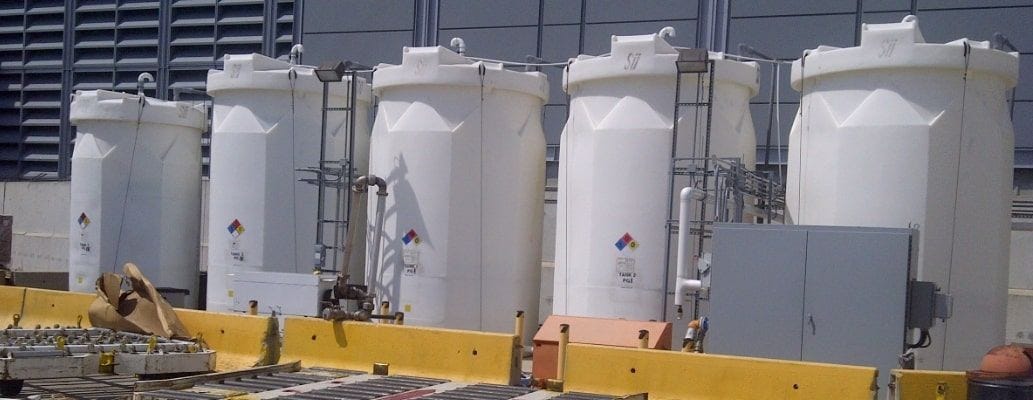
Why HDLPE Is the Recommended Option for Sodium Hypochlorite and Sulfuric Acid Tanks
Quick answer: HDLPE (high density linear polyethylene) is the plastic tank recommended for sodium hypochlorite (bleach) and sulfuric acid. In six month soak tests by Snyder Industries, one of Tank Depot's manufacturing partners, HDLPE kept its full toughness in both chemicals. XLPE (cross-linked polyethylene) lost more than half its toughness in bleach and almost all of it in sulfuric acid. HDLPE can also be welded for repairs, recycled, and approved for drinking water use. XLPE can't.
People ask us this all the time: which plastic tank is best for bleach and sulfuric acid? You may have heard that cross-linked polyethylene (XLPE) is the "tougher" plastic. For a lot of chemicals, that's fair. For these two, the answer is different.
At Tank Depot, we sell both HDLPE and XLPE chemical tanks, so we have no reason to push one over the other. We go with the data and time-proven results. The testing from Snyder Industries points to one clear winner for bleach and sulfuric acid: HDLPE.
This guide explains why, in plain English. No chemistry degree needed. If you're brand new to chemical tanks, our Chemical Containment Tanks 101 guide is a good place to start.
What Is HDLPE, in Plain English?
HDLPE stands for High Density Linear Polyethylene. You'll also see it called HDPE. It's in the same plastic family as a milk jug, but made much thicker and stronger for industrial tanks.
"Linear" means the plastic's tiny chains line up side by side, like dry spaghetti in a box. They pack in tight, which makes a dense wall that chemicals have a hard time getting through.
XLPE stands for Cross-Linked Polyethylene. While the tank is being molded, an additive ties those chains together, like knotting the spaghetti into a net.
Here's the easiest way to picture the difference:
- HDLPE is like chocolate. You can melt it and reshape it. That's why an HDLPE tank can be heat welded if it ever gets damaged.
- XLPE is like a baked cake. Once it's baked, you can't un-bake it. An XLPE tank can't be welded or recycled.
Neither plastic is "bad." They're built differently, and that difference matters a lot when a harsh chemical is pressing on the tank wall every single day.
What does ASTM D1998 mean?
ASTM D1998 is the rulebook for upright polyethylene chemical storage tanks. It sets how thick the walls must be, how the tank is tested, and how much force the wall has to handle. Think of it as the building code for poly chemical tanks. It covers both plastics: Type I is cross-linked (XLPE) and Type II is linear (HDLPE). Every tank we recommend for bleach and sulfuric acid is built to ASTM D1998.
HDLPE vs XLPE: Side by Side Comparison
Here's how the two plastics stack up, using figures published by Snyder Industries:
|
Feature |
HDLPE |
XLPE |
|
How it's made |
Chains sit side by side (thermoplastic) |
Chains tied together (thermoset) |
|
Toughness after 6 months in 16.5% bleach* |
400 ft-lb (542 J) Result: Retention |
160 ft-lb (217 J) Result: Degradation |
|
Toughness after 6 months in 98% sulfuric acid* |
400 ft-lb (542 J) with resin #88000046 |
3.4 ft-lb (4.6 J) |
|
Tensile strength (how hard it is to pull apart) |
2,800 to 3,220 psi (19.3 to 22.2 MPa) |
2,700 to 2,900 psi (18.6 to 20.0 MPa) |
|
Can be heat welded for repairs |
Yes |
No |
|
Recyclable |
Yes |
No |
|
NSF / FDA acceptable |
Yes |
No |
|
Heat tolerance |
Good |
Slightly higher |
|
Where it shines |
Bleach and sulfuric acid |
Some polymers and surfactants |
|
Recommended for bleach and sulfuric acid |
Yes |
No |
*Impact strength measured at -40°F (-40°C) after soaking. Higher numbers mean a tougher tank. Source: Snyder Industries testing with the University of Nebraska and resin producers.
Why HDLPE Is the Standard for Sodium Hypochlorite (Bleach)
Sodium hypochlorite is the chemical name for bleach. Water treatment plants use it to kill germs in drinking water and wastewater. Industrial bleach is much stronger than the bottle under your sink, usually around 12.5% to 15%.
Bleach is an oxidizer. What does that mean?
An oxidizer slowly breaks down other materials. Rust on a bike chain is oxidation. Bleach does something similar to plastic. Over time, the wrong plastic turns brittle, like an old garden hose left out in the sun.
Snyder tested this. They soaked HDLPE and XLPE samples in 16.5% bleach for six months, then hit them in a freezing cold impact test. HDLPE held strong at 400 ft-lb (542 J). XLPE dropped to 160 ft-lb (217 J), less than half. A well known plastics reference, the Compass Chemical Resistance Guide for Plastics, rates XLPE for bleach as "not as good as HDPE."
Why tank color matters for bleach
Sunlight is bad news for bleach. UV rays break it down, so it loses strength before you ever use it. Heat does the same thing.
Some tanks are made black to block sunlight. That stops UV, but a black tank soaks up heat like a dark car seat in July. Hot bleach breaks down faster, and the heat is hard on the tank too.
So Snyder developed HDLPE resin #88000059, an opaque white plastic. Opaque means light can't pass through. White means it bounces sunlight away. The result blocks UV and stays cooler. Snyder calls it the Bleach Protection System, available in double wall storage tanks up to 12,500 gallons (47,300 L) and on non-caged IBC totes up to 550 gallons (2,080 L).
Here's which HDLPE setup Snyder recommends, based on where your bleach tank sits:
|
Where the tank sits |
Recommended HDLPE setup |
|
Indoors, very little sunlight |
Natural color HDLPE, 1.9 SG, built to ASTM D1998 |
|
Outdoors |
Opaque white HDLPE resin #88000059, 1.9 SG, built to ASTM D1998 |
|
Outdoors, with insulation |
Natural HDLPE, 1.9 SG, with 1 inch (2.5 cm) sprayed polyurethane foam and mastic coating |
Keep metals and salt out of the tank
Bleach often carries tiny amounts of metals like copper and iron. Those metals speed up oxidation, which wears on the tank. Salt can also build up at the bottom and hold oxygen right against the tank wall.
Two simple habits help. First, use a full drain outlet, like Snyder's titanium SUMO fitting, so the tank empties all the way. Second, flush the tank every six months. Buying good quality bleach with low metal content helps too.
Browse our sodium hypochlorite tanks, including the 1500 gallon HDLPE double wall opaque tank built for outdoor bleach storage.
Why HDLPE Is the Standard for Sulfuric Acid
Sulfuric acid is used to adjust pH in water treatment, make fertilizer, and run many factory processes. At 93% to 98% strength, it's one of the hardest liquids a plastic tank can hold, for two reasons.
Reason 1: It's very heavy
Water weighs 8.34 pounds per gallon (1.0 kg per liter). Concentrated sulfuric acid weighs about 15.3 pounds per gallon (1.84 kg per liter). That's nearly double. All that weight pushes on the bottom of the tank wall, all day, every day.
That's where specific gravity (SG) comes in. SG compares a liquid's weight to water. Water is 1.0. Concentrated sulfuric acid is about 1.84. A tank with a 1.9 SG rating has walls thick enough to hold a liquid up to 1.9 times heavier than water, or about 15.83 pounds per gallon (1.9 kg per liter). That makes a 1.9 SG tank the right match for concentrated sulfuric acid.
Reason 2: It attacks the wrong plastic fast
Snyder soaked samples in 98% sulfuric acid for six months. HDLPE resin #88000046 kept its full toughness at 400 ft-lb (542 J), the same as fiberglass that never touched acid. XLPE fell to just 3.4 ft-lb (4.6 J). That's less than 1% of the HDLPE result. In plain terms, the XLPE turned brittle. HDLPE #88000046 was formulated specifically to resist concentrated sulfuric acid. That's why the resin number matters. "HDLPE, 1.9 SG" alone isn't a complete spec for this chemical.
The recommended sulfuric acid setup
|
Part |
Snyder recommendation (sulfuric acid up to 98%, room temperature) |
|
Tank material |
HDLPE resin #88000046, natural color |
|
Wall rating |
1.9 SG, built to ASTM D1998 |
|
Fittings |
CPVC |
|
Gaskets |
Viton |
|
Bolts |
Hastelloy |
|
Warranty |
Full 3 year Snyder warranty at ambient (room) temperature |
Safety first: Never add water to concentrated sulfuric acid inside a tank. The mix gets extremely hot, very fast, and can spray acid. Keep water out of the tank, and keep stored acid below 100°F (38°C).
See an example: our 6000 gallon HDLPE sulfuric acid tank, built to ASTM D1998.
What About XLPE Tanks With a Linear Liner?
Some tank makers try to fix XLPE's weak spot by adding a thin inner layer of linear plastic. It sounds like the best of both worlds, but it brings its own problems:
- The layers can peel apart. Linear plastic and cross-linked plastic don't bond for good. Every time the tank fills and empties, the wall flexes. Over time, the liner can separate. This is called delamination.
- Fittings can cut through the liner. To install fittings, the inside wall is often ground smooth or drilled. That can strip away the liner right where leaks like to start.
- No repairs. The outer XLPE shell can't be welded, so a damaged tank usually has to be replaced.
Snyder's approach is simpler and more efficient: build the whole tank from one solid layer of HDLPE.
"But Isn't XLPE Better at Resisting Cracks?"
You may see XLPE sold as having better stress crack resistance. That claim usually comes from a lab test called ASTM D1693. Here's the catch: that test uses only one chemical, a soap like substance called Igepal. It tells you nothing about how a plastic holds up against bleach or sulfuric acid.
Snyder also notes that XLPE resin makers changed their recipes years ago, and today's XLPE is no longer better than HDLPE at resisting cracks. For bleach and sulfuric acid, the test that matters is how the plastic handles that exact chemical over time. HDLPE wins that test.
When XLPE Is Still the Right Choice
To be fair, XLPE is a great material for the right job. Snyder prefers XLPE for storing certain polymers and surfactants, and XLPE can take a little more heat. That's why no single plastic is best for every chemical.
The right choice always comes down to three things: the chemical, its strength (concentration), and the temperature. Our Chemical Storage Tanks: A Compatibility Guide walks through how to match a tank to your chemical.
Quick Checklist: How to Spec an HDLPE Tank for Bleach or Sulfuric Acid
- Name the chemical and its strength, for example 12.5% bleach or 93% sulfuric acid.
- Know your temperature range and whether the tank sits indoors or outdoors.
- Ask for HDLPE built to ASTM D1998 with a 1.9 SG rating.
- Ask for the right resin: #88000059 opaque white for outdoor bleach, #88000046 for sulfuric acid.
- Match fittings, gaskets, and bolts to the chemical. They're different for bleach and sulfuric acid.
- If the chemical treats drinking water, confirm the tank's NSF/ANSI 61 listing. Our NSF 61 compliance guide explains what that label means.
- Plan for spills. A double wall chemical tank catches a leak inside a second outer tank, with no concrete dike needed.
The Bottom Line
For sodium hypochlorite and sulfuric acid, HDLPE isn't just a good option. It's the material Snyder recommends after years of lab testing and field experience. It stays tough in both chemicals, it can be repaired, and it meets drinking water standards. XLPE still has its place, just not holding these two chemicals.
Talk to a Tank Depot Chemical Tank Expert
Not sure which tank fits your chemical, strength, and site? Call our team at (866) 721-6281, Monday to Friday, 7am to 7pm CST, or request a custom chemical tank quote. You can also browse all our polyethylene storage tanks.