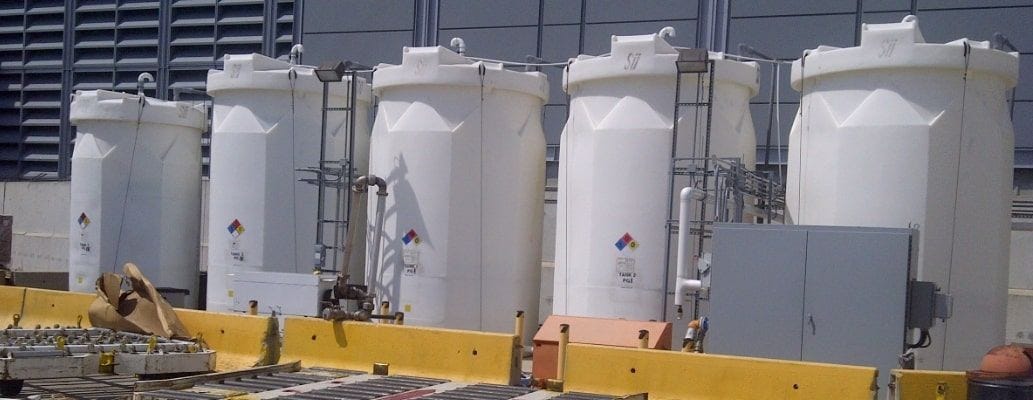
The Industrial Guide to Chemical Tank Venting: Managing Pressure and Safety
A tank vent looks like a small part, and it is easy to ignore. But chemical tank venting is one of the most important safety features on any storage tank you own. Get it right, and your tank runs safely for years. Get it wrong, and the tank can burst open or cave in on itself in seconds. This guide covers how venting works, the main types of vents, and how to choose the right one, all in plain language.
When a Chemical Tank Cannot Breathe, It Fails
Every tank that holds liquid has to move air in and out. When you add liquid, air has to leave, and when you draw liquid off, air has to flow back in to take its place. If a tank cannot do this, pressure builds up inside or a vacuum forms, and both of those are dangerous. Especially in the case of storing sensitive chemicals.
Too much pressure makes a tank swell and rupture, while a vacuum does the opposite and lets the outside air crush the tank inward. People often forget the vacuum side, because they assume a vent is only there to let pressure out. But the air around us presses in at about 14.7 psi (1.01 bar), everywhere and all the time, so the crushing risk is just as real, and often worse.
Here is how bad it gets. A steel rail car built from thick plated steel has been collapsed like an empty soda can by vacuum alone, and lighter plastic totes cave in the moment a pump pulls liquid out faster than air can flow back. Thin-walled tanks are especially weak against vacuum, so the damage can show up in seconds. A good reason to consider higher quality resins, thicker walled vertical chemicals tanks, or units with in-built secondary containment.
How Chemical Tank Venting Works
The simplest way to picture chemical tank venting is to think of the tank breathing, like a pair of lungs. Four everyday things make a tank breathe:
- Filling it. Liquid pushes air out.
- Emptying it. Air has to flow back in.
- Daytime heat. Warm vapor expands and needs to escape.
- Nighttime cooling. Cool vapor shrinks and pulls air in.
A good vent handles all four, while keeping harmful vapor from leaking out the rest of the time.
Normal venting vs emergency venting
A venting system really does two jobs.
Normal venting covers everyday life: routine filling, emptying, and the daily swing between warm days and cool nights. These are small, steady flows.
Emergency venting is for rare, violent events. The main one is an outside fire. Heat from a fire can boil the liquid inside and create a huge surge of vapor very fast. That surge needs a much larger escape path than normal venting can give. A tank set up only for normal venting can still fail in a fire, which is why emergency venting is planned on its own.
The Main Types of Tank Vents
Not all vents are the same. The right one depends on what you store and how you use the tank. Here are the main types, from simplest to most protective.
|
Vent type |
How it works |
Best for |
|
Open vent (gooseneck or pipe) |
Stays open all the time. Air moves freely in and out. |
Water and other non-hazardous liquids only. |
|
Pressure vacuum relief vent |
Stays closed. Opens only when pressure or vacuum hits a set point. Protects both directions. |
The safe baseline for most chemical storage. |
|
Conservation vent |
A pressure vacuum relief vent that also holds vapor and product in during normal use. |
Chemicals that give off costly or harmful vapors. |
|
Emergency vent (hatch or large relief vent) |
Opens wide for a big surge, such as a fire. |
A backup on top of your normal vent. |
An open vent is cheap, but it lets vapors flow straight out, so it is a poor choice for anything hazardous. For most chemicals, a pressure vacuum relief vent is the safe baseline. It stays shut until it is needed, then relieves pressure or vacuum before the tank is harmed. A conservation vent adds one more benefit: it holds your product and vapors inside, which cuts loss and helps you meet clean-air rules. A quick note on flame arrestors: these are not vents themselves, but add-on devices that stop a flame from traveling back into a tank full of flammable vapor. If you store flammable liquids, ask your supplier whether you need one.
|
What you get on a Tank Depot tank Our chemical storage tanks come standard with an 18-inch (457 mm) vented manway, which covers normal venting for most setups. When your application needs more, you can add a U-vent or a mushroom vent for extra capacity. The right choice depends on your chemical, your fill method, and how fast you load the tank, and our team can help you match it. |
How Tank Vent Sizing Works
A vent that is too small is almost as risky as no vent at all. Tank vent sizing is about making sure the vent can move air fast enough to keep the tank inside its safe range.
Sizing a chemical tank vent
Four things decide the right size:
- How fast you fill and empty. Faster flow needs a bigger vent.
- What you store. Some chemicals give off vapor easily and need more venting.
- Your tank's limits. Every tank has a design pressure and a design vacuum, the most it can safely take.
- The vent's own capacity. Each vent can only move so much air at a given pressure.
The goal is easy to state: the vent must move the required air before the tank reaches its limit. Doing that math well takes care, and it is easy to get wrong.
One point catches many buyers off guard. How you fill the tank changes the size you need. If you fill from a tanker truck using air pressure, which is common for bulk chemical delivery, you push air in fast. That kind of fill can need a much larger vent than the old rule of thumb of one size up from the fill line.
Standards give you the framework. API 2000 is the main standard for venting storage tanks. NFPA 30 covers flammable and combustible liquids. ASTM D-1998 covers polyethylene tanks. You do not need to memorize these. You need a tank and vent built to meet the ones that apply.
The honest advice: do not guess at vent size. Work it out with your tank supplier, who can match the vent to your chemical, your fill method, and your tank. That is exactly the kind of help our team gives on every chemical storage tank we deliver.
Match the Vent to Your Chemical
The vent has to survive the chemical, just like the tank does. A vent made of the wrong material will corrode, weaken, and fail. Vents come in many materials, from stainless steel to PVC, and the right one depends on what you store.
Some chemicals are harder on equipment than others. Sodium hypochlorite (bleach) and strong acids give off gas and attack materials over time. They often need an engineered venting setup, not an off-the-shelf part. If you store aggressive chemicals like these, treat venting as part of the tank design from the start.
Keep Your Vents Working
A vent only protects you if it stays clear, and over time vents get blocked. Bird nests, insects, dust, and ice can all seal a vent shut, and a vent that has been painted over or frozen closed is just as bad as no vent at all. Either way, a blocked vent turns your tank back into a sealed container, with every risk that brings.
Put vents on a regular inspection schedule. Check that screens are clear, that nothing has built up, and that the vent still moves freely. It is a small task that prevents a very large problem.
The Bottom Line
Chemical tank venting is not a small accessory. It is what keeps your tank alive. A chemical storage tank that cannot breathe will either burst from pressure or collapse from vacuum, and both are dangerous and expensive. The fix is straightforward: the right type of vent, sized correctly, made of the right material, and kept clear.
At Tank Depot, we help you match the tank and the venting to your chemical and your site, so you get storage that is safe from day one. Browse our industrial storage tanks.