Submersible vs Surface Pumps: Which Belongs on Your Tank?
Two pumps can move the same water from the same tank and still be completely different tools. The difference is where the pump sits. A submersible pump goes inside the tank, down in the liquid. A surface pump sits outside it and pulls the liquid up. That one choice drives almost everything else: whether the pump stays primed, how easy it is to service, how far it can lift, and whether it survives a freeze. Here is how to decide.

Inside The Tank
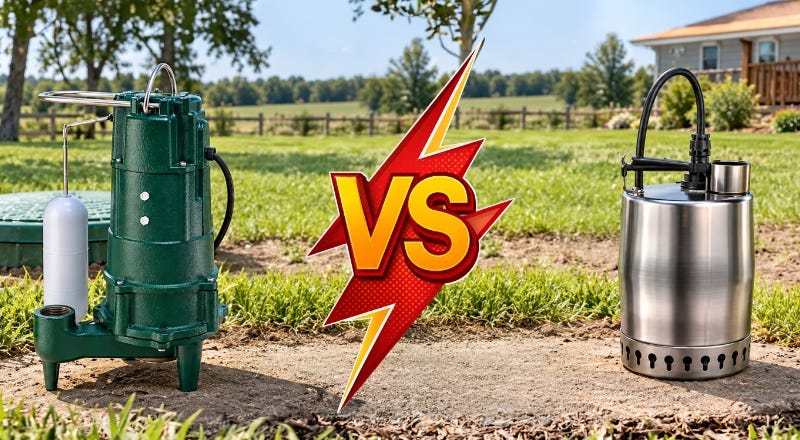
A submersible pump sits down in the liquid it moves. Because it is already underwater, it is always primed and ready, it runs quietly, and the surrounding liquid keeps it cool and protected from freezing. It also takes up no space outside the tank. That makes submersibles the natural choice for cisterns, underground tanks, deep basins, and any tank where a pump would otherwise have to lift liquid a long way up. Shop our submersible water pumps.
There is one rule: a submersible has to stay covered. Run it dry and you can damage it, so the intake needs to stay below the liquid line. The trade-off is service, since inspecting or repairing a submersible means pulling it out of the tank first.
For a cistern or rainwater tank, an all-in-one submersible like the Grundfos SBA 3-45 shows what this looks like: it drops into the tank, starts and stops on its own, and moves up to 25 gallons per minute [95 L/min] at up to 147 feet [45 m] of head, quietly, with a fine strainer keeping grit out.
Outside The Tank
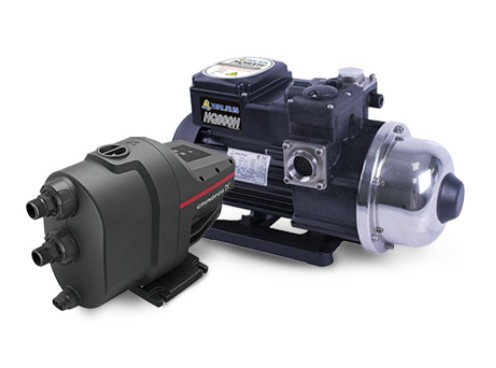
A surface pump sits outside the tank, on a pad or in a pump house, and draws liquid up through a suction line. Because it is out in the open, it is easy to reach, easy to service, and easy to move from one tank to another. Centrifugal, jet, and booster pumps are all surface pumps. Explore our tank and cistern water pumps, including booster pumps and jet pumps.
The catch is priming. A surface pump has to fill its suction line with liquid before it can move anything. A self-priming pump does this itself; a standard one has to be primed by hand. And because it sits exposed, a surface pump needs freeze protection in cold climates and runs louder than a submersible.
A self-priming surface booster like the Grundfos SCALA1 3-45 is the type case: mounted above the tank, it can pull water up from as far as 26 feet [8 m] below it, prime itself, then hold steady household pressure at up to 22 gallons per minute [83 L/min].
The Limit Nobody Mentions: Suction Lift
Here is the physics that decides a lot of these calls. A surface pump does not really suck water up. It lowers the pressure at its inlet and lets the atmosphere push the water up for it. That puts a hard ceiling on how high it can lift from an open tank, around 25 feet [7.6 m] in theory and less in the real world. Even a strong self-priming booster like the Grundfos SCALA1 3-45 tops out near 26 feet [8 m] of lift. If your liquid sits farther below the pump than that, no surface pump will pull it up reliably, and a submersible is the answer.
Note however, a submersible has no suction-lift limit at all. Because it sits in the liquid and pushes rather than pulls, its reach is set by its rated head, not by suction. That is the real case for going submersible on a deep or buried tank: a surface pump physically cannot reach the water, and a submersible can.
Size It Before You Choose: Flow and Head
Before you can choose any pump, you need two numbers, and they are the same whether the pump sits inside or outside the tank. The first is peak flow. Add up the flow rates of everything that might run at the same time, every fixture, sprinkler zone, and appliance, and total them in gallons per minute. That simultaneous total, not the size of your tank, is the flow the pump has to hit.
The second is total dynamic head (TDH): the vertical lift, plus pipe friction, plus the pressure you want at the tap. To turn tap pressure into feet of head, multiply PSI by about 2.31, then add your lift and friction. That lift figure does double duty here, because it is the same number that tells you whether a surface pump can reach your water at all. For the full walkthrough, see the Pump Selection Guide.
The quick version
|
|
Submersible pump |
Surface pump |
|
Where it sits |
Inside the tank, in the liquid |
Outside the tank |
|
Priming |
Always primed |
Must prime, or be self-priming |
|
Best for |
Cisterns, underground and deep tanks, wells |
Above-ground tanks, easy access |
|
Service access |
Pull it from the tank |
Reach it in place |
|
Noise and freeze |
Quiet, protected below liquid |
Louder, needs freeze protection |
|
Lift limit |
Not limited by suction lift |
Capped near 25 ft of suction lift |
Match The Pump To The Tank
This is where your tank makes the decision for you. A buried or tall cistern, a deep underground water tank, or a well points to a submersible. An above-ground tank you can stand next to points to a surface pump you can service without pulling anything. For rainwater collection tanks, a submersible inside the cistern paired with a booster for pressure is a common, reliable setup, and our Rainwater Calculator helps you size the flow. Buying the tank and pump together means the two are matched from the start, and you could potentially get a discounted rate.
Match The Liquid and The Site
Two more factors can settle the choice. First, the liquid. Clean water and rainwater suit either pump. Graywater, or anything carrying solids or debris, changes the rules and usually points to a submersible built for the job.
If you are moving wastewater rather than clean water, that is a different pump family: see our effluent vs grinder pumps guide.
Second, the site. In a freezing climate a submersible below the liquid line is naturally protected, while an exposed surface pump and its suction line need freeze protection. Near a home or occupied space, a submersible runs quieter. And check your power: a fixed site with reliable electricity suits either pump, while a remote or off-grid tank leans toward a solar or engine-driven option.
The short version
Decide where the pump can sit. If the liquid is below reach, buried, or deep, go submersible for a pump that stays primed and out of sight. If the tank is above ground and you want easy service, go surface, and choose self-priming if it has to lift from below. Let the tank, not the brochure, make the call.
Talk to a Pump Expert
Not sure whether to go submersible or surface for your tank? Our team matches pumps to tanks every day. Call (866) 926-5603, Monday to Friday, 7am to 7pm CST, or Contact Us online.
Related: start with the Pump Selection Guide, or for wastewater specifically, see effluent vs grinder pumps.