


You do not have a pump problem. You have a liquid, a tank, and a job that cannot wait on the wrong pump. A unit that is fine for clean water will stall on effluent, corrode on fertilizer, or burn out holding pressure it was never sized for. The cost shows up later as a failed seal, a flooded pad, or a line down during your busiest week.
This guide flips the usual order. Instead of starting with a pump category and hoping it fits, start with what you are moving and where it is stored. That is the fastest route to a pump that runs for years, and it is where Tank Depot is built to help, because we carry the tank and the pump together.
Work through it in four steps: the liquid, the flow and head, where the pump sits, and the materials it is made of. Get those right and the model almost picks itself.
Start with the liquid, not the pump
Every reliable pump choice starts with one question: what is in the tank? Clean or potable water, chemicals or liquid fertilizer, fuel and oil, and wastewater each demand different wetted materials, seals, and impellers. Naming the liquid rules out the wrong pumps before you compare a single number, so it is always step one.
STEP 1 / NAME THE LIQUID
Four liquids, four pump paths
Water
For moving and pressurizing clean or potable water from a storage tank, the best water pumps are submersible pumps, centrifugal pumps, jet pumps, booster pumps, and constant pressure pumps. Draw from a cistern or underground tank with a submersible unit. Hold steady building or household pressure with a booster or constant pressure system. Run irrigation or livestock lines from a surface centrifugal or jet pump. For remote sites with no power, solar pumps move water without a meter running.
Pair these with your rainwater tanks and other water storage. Sizing a rainwater system? Our Rainwater Calculator gets you to a starting flow figure fast.
Chemicals and Liquid Fertilizer
Moving acids, bleach, liquid NPK fertilizer, or other process chemicals is a materials problem first and a flow problem second. Air operated pneumatic pumps and poly transfer pumps are common fits because their wetted parts can be matched to the chemical. The wrong elastomer or housing will swell, crack, or contaminate the batch.
While we do not currently carry chemical and liquid fertilizer pumps in our inventory, expanding into this sector is actively on our roadmap. As we work behind the scenes to develop this product line, our team remains ready to assist you with your broader industrial needs. For inquiries regarding our available chemical storage solutions, please feel free to fill out our custom quote form.
Do not guess on compatibility. Check the liquid against our Chemical Compatibility resource, then match the pump body and seals to it. Store the chemical in the right vessel too, whether that is our vertical chemical storage tanks or chemical IBC totes.
Fuel, Oil, and DEF
For diesel, gasoline, waste oil, and diesel exhaust fluid (DEF), reach for fuel transfer pumps built for the fuel and the voltage you have on hand, including 12 volt units for truck mounted and mobile setups. DEF needs its own dedicated pump and lines, because it will not tolerate contamination from fuel or the wrong metals.
Match the pump to your fuel and oil tanks or portable DEF tanks.
Effluent and Septic
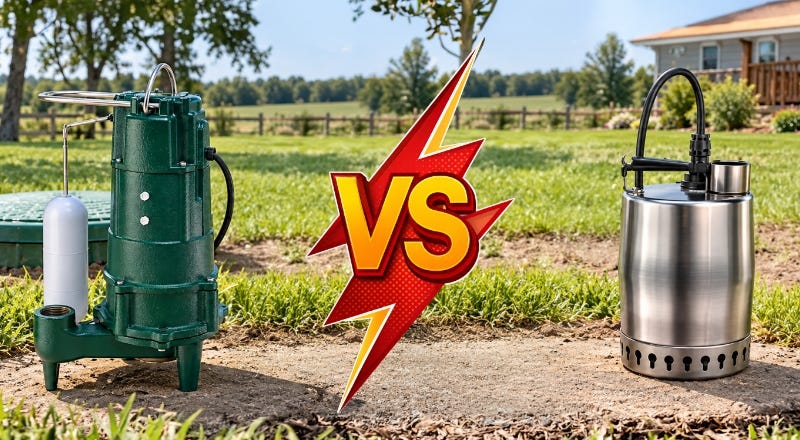
Wastewater is about solids, not just flow. Filtered effluent from a septic tank moves fine on a submersible effluent pump. Raw waste with solids needs a grinder pump that can cut and pass them without clogging. Sizing the pump to the solids it will actually see is what keeps a system from backing up.
Pair these with your septic pump tanks, effluent filters, and the rest of our septic pumps range.
Every pump we carry, matched to the job
If you already know your liquid, this is the short way to the right family of pump. Each row points to a real Tank Depot line, so you can go straight from the job to the products that do it.
|
Pump Type |
Best For |
Where it Sits |
Representative Tank Depot Line |
|
Submersible well pump |
Drawing water up from a drilled well or borehole |
Inside the well |
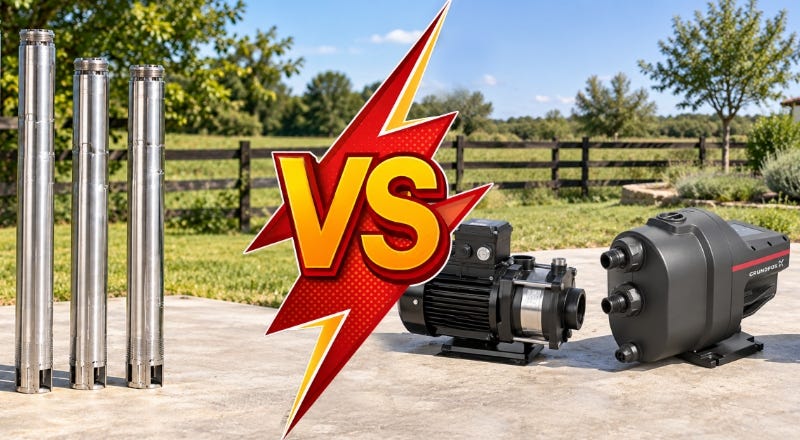
Grundfos SQ, Dublin Strom 3-inch |
|
Submersible cistern or tank pump |
Clean water from a cistern, rainwater or ground tank |
Inside the tank |
Grundfos SBA (floating intake), Dublin bottom-suction cistern |
|
Booster or constant pressure pump |
Holding steady household, irrigation or building pressure |
Surface, self-priming |
Grundfos SCALA1 and SCALA2, DAB E.SYBOX |
|
Jet pump |
Shallow-well or above-tank draw by suction |
Surface |
Grundfos JP |
|
Centrifugal or transfer pump |
Moving water or thin liquids between tanks |
Surface |
Walrus TPH, Banjo poly |
|
Solar pump |
Off-grid water from a well or tank |
Submersible |
Dublin Puremint |
|
Fuel, oil and DEF transfer pump |
Moving diesel, gasoline, waste oil or DEF |
Surface or inline |
Fuel transfer pumps, including 12 volt units |
|
Effluent pump |
Settled septic effluent out to a drain field |
Inside the pump tank |
Zoeller Mighty-Mate, Polylok |
|
Sewage pump |
Raw waste, short lift to a gravity sewer |
Inside a basin |
Zoeller 267, Polylok CPSE |
|
Grinder pump |
Grinding waste and pumping it under pressure |
Inside a basin |
Zoeller Shark 818/820, Grundfos SEG |
STEP 2 / SIZE FLOW AND HEAD
Size it right: GPM and total dynamic head
Two numbers decide whether a pump can actually do the job: flow rate, measured in gallons per minute (GPM, or liters per minute in metric), and total dynamic head (TDH), the total resistance the pump must overcome, measured in feet (meters). TDH is not just how high you are lifting the liquid. It adds the vertical lift, the pressure you need at the outlet, and the friction from every foot of pipe, elbow, and fitting in between.
A pump that is too small never reaches your target pressure. A pump that is oversized runs off its efficiency point, wastes energy, and wears out seals and bearings early. Right sized beats oversized every time.
Get to a starting figure with our Rainwater Calculator for rainharvesting systems and our Conversion Charts and Formulas for the rest, then confirm against the manufacturer performance curve before you buy.
For the underlying math, the Engineering ToolBox pump head and horsepower reference lays out the formulas, and the Hydraulic Institute, the industry standards body, explains why running a pump near its efficiency point is what protects it over the long run.
STEP 3 / MATCH THE MATERIALS
Match the material to the liquid
A pump is only as compatible as its wetted parts, the surfaces that touch the liquid: the housing, impeller, seals, and elastomers. Clean water is forgiving. Chemicals, fertilizer, and DEF are not. The same pump body that lasts for years on water can fail in weeks on the wrong chemical. Before you commit, check both the liquid and concentration against compatible construction materials.
STEP 4 / CHOOSE PUMP LOCATION
Submersible or surface: where the pump sits
Where the pump sits matters as much as what it moves. A submersible pump drops inside the tank or well, stays primed, runs quietly, and is protected from freezing. A surface pump sits outside the tank and pulls the liquid up, which makes it easy to service but means it has to prime and lift.
If a surface pump has to draw from a tank below it, you want a self priming pump so it can pull the liquid up on its own without hand priming every time. For above ground storage in cold climates, factor in freeze protection. For occupied buildings, factor in noise.
Power source is part of this call. Fixed sites run best on electric pumps, while remote or off-grid ground leans on solar or engine-driven units. If you are weighing electric against an engine for wildfire or grid-down readiness, our guide to gas vs electric water pumps for fire defense works out the nitty gritties.
This is the question generic pump guides skip, and it is the one that depends most on your tank. It is also why buying the tank and the pump from one place saves you the mismatch.
Buy the tank and the pump as one system
Most pump guides are written by pump sellers who never ask what tank you are using. We start there. Tank Depot carries the storage tank and the pump that fits it, from rainwater cisterns to chemical totes to septic systems, so the two are matched before they ship instead of after something leaks.
It also tends to be cheaper. Ask our product specialists concerning bundling your tanks and pumps, so you are not sourcing two halves of a system from two vendors and hoping they line up.
The short version
- Name the liquid
- Size the flow and head
- Decide where the pump sits
- Match the materials
Do that in order and the right pump is usually the obvious one. When it is not, that is what our team is for.
Talk to a Pump Expert
Not sure which pump fits your tank and your liquid? Our team sizes and matches pumps every day. Call (866) 926-5603, Monday to Friday, 7am to 7pm CST, or Contact Us online and we will help you get it right the first time.
FREQUENTLY ASKED QUESTIONS


