


The Best Car Wash Water Reclamation System for Sustainable Operations
For modern car wash owners, a successful operation isn't just about a sparkling clean car; it's about smart business management. In an era of rising utility costs and growing environmental concerns, the excessive water consumption of a traditional car wash can quickly erode profit margins. The solution is a robust car wash water recycling system, which allows you to capture, filter, and reuse water, dramatically cutting costs and creating a more sustainable business. For instance, a commercial car wash equipped with recycling systems requires approximately 30 to 45 gallons of water per vehicle, whereas a single hand wash can use up to 140 gallons or more.
Investing in the best liquid storage tank type for your car wash reclamation system is a critical decision that directly impacts your bottom line and environmental footprint. This is more complex than selecting a simple water tank, as reclaimed water can contain chemicals, soaps, and sediments that increase its specific gravity, requiring a more durable material.
This guide will provide an in-depth review of the different tank types, helping you make the most informed decision for your business.
| Best For | Commercial car washes, truck washes, high-volume vehicle cleaning facilities, and industrial operations seeking to reduce car wash water usage. |
| Key Strengths | Water conservation, reduced utility costs, compliance with environmental regulations, durability to handle higher-specific-gravity water, and long-term profitability. |
| Primary Certifications | NSF/ANSI, IAPMO, and ASTM certifications for material and structural integrity. |
| Shipping Options | Nationwide delivery, local pickup, and freight consolidation for large orders. |
| Warranty | Varies by manufacturer, typically covering materials and workmanship. |
The Stamp of Approval: Navigating Certifications & Standards
In the competitive world of commercial car washes, a tank is far more than a simple storage container; it's a critical component of a compliant business. Reclaiming water is a legal and ethical imperative that can also lead to significant profit. For this reason, selecting a tank that is properly certified is the first step toward safeguarding your investment and your reputation.
Certifications provide an independent guarantee that your commercial tank is structurally sound, capable of handling specific wastewater compositions, and will not risk environmental contamination. This is especially vital for a car wash water recycling system, which often operates under unique regulatory scrutiny.

NSF & IAPMO: The Plumbing & Health Foundation
Before a tank can even be considered for a car wash system, it must meet foundational public health and plumbing standards. NSF International sets rigorous criteria for public health, ensuring a tank's materials are safe and non-leaching so they won't contaminate the reclaimed water or the surrounding soil.
IAPMO, with its focus on plumbing and mechanical codes, provides certification that a tank’s design and fittings are compatible with standard plumbing systems, a crucial detail for ensuring a seamless and compliant connection within your facility. While not specific to car wash reclamation, these certifications are the bedrock of any reliable water system.

ASTM International: The Backbone of Structural Integrity
While ASTM International provides respected technical standards—such as ASTM D1998 for polyethylene vertical tanks—these are often best practices rather than regulatory requirements in the car wash industry. ASTM specs can validate a tank’s ability to handle the higher specific gravity of reclaimed water, which typically contains detergents, oils, dirt, and solids. However, in practice, many jurisdictions and operators do not require ASTM-certified tanks for car wash reclamation.
Instead, choosing a tank rated for high specific gravity (1.5 SG or greater) is generally sufficient to ensure structural durability under real-world conditions. It's less about the stamp and more about the specs—tanks should be engineered for the weight and chemistry of reclaimed washwater, even if formal ASTM labeling isn’t mandated.
Unique State Regulations: Adding a Layer of Security
While federal guidelines from the U.S. EPA provide a broad framework, most specific car wash wastewater management regulations are enforced at the state and municipal levels, with some jurisdictions having particularly stringent requirements. For example, states like California and Texas have strict mandates due to persistent water scarcity. In California, the Water Code requires any business discharging wastewater to file a Report of Waste Discharge with the Regional Water Quality Control Board, and the local plumbing code may reference specific certifications and require permits for a reclamation system. Similarly, in Texas, the TCEQ (Texas Commission on Environmental Quality) has detailed rules on managing washwater and requires commercial car washes to obtain permits and use specific equipment, like grit traps, with strict guidelines on waste disposal by licensed transporters.
Other examples include:
- Virginia, Oklahoma, and Arizona have general permits specific to vehicle wash water that may require documented storage capacity or flow control measures.
- Municipal sewer authorities frequently enforce pretreatment standards, requiring tanks to be configured for sedimentation, oil separation, and effluent monitoring.
Compliance with these frameworks determines whether your system is legally viable—not just functional.
Operator Certification: A Hidden Requirement in Complex Systems
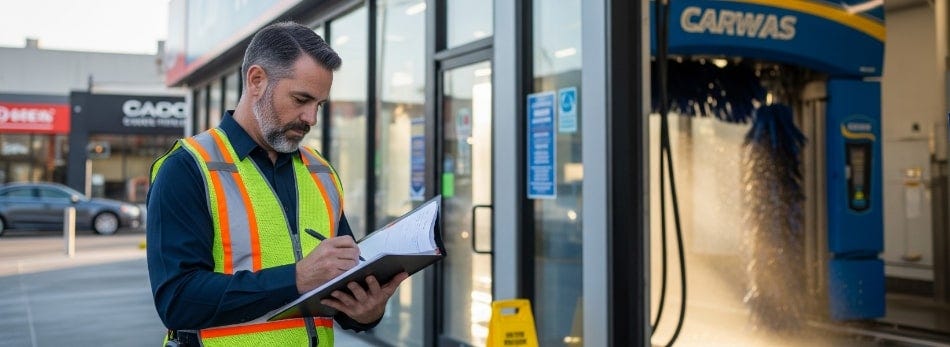
In many states, wastewater reclamation systems—especially those using advanced treatment like chemical dosing, filtration, or biological processing—fall under operator licensing regulations. That means your staff may need to hold a Wastewater Treatment Operator Certification or equivalent license to legally operate or oversee the system.
- New York’s DEC requires Grades 1–4 certified operators depending on system complexity.
- North Carolina’s Water Pollution Control System Operators Commission licenses operators statewide.
- California’s WWOCP enforces operator standards for facilities using reclaimed or treated water in any capacity.
This requirement is often overlooked but critical—failing to meet operator licensing obligations can jeopardize your compliance status even if your hardware meets all other specifications.
Voluntary Certification & BMP Programs: A Competitive Advantage for Car Wash Operators
Beyond mandatory codes, many local utilities and environmental agencies promote Best Management Practices (BMPs) for car wash water reuse and pollutant control. Some offer rebates, public certifications, or marketing perks to car washes that go above and beyond.
For example:
- Colorado Springs Utilities offers a Car Wash Certification program for businesses that meet water-efficiency and pollution-prevention benchmarks.
- The U.S. EPA publishes national BMPs for vehicle washing, which, while not enforceable by law, are widely adopted by regulators as reference standards—and often used in local permitting or inspection.
Participating in these programs enhances not just compliance, but also public trust, branding, and sustainability credentials.
Why Shop at Tank Depot?
Ultimately, navigating compliance requires a proactive approach. This is why it is so important to work with a supplier who understands the complexities of these systems. They can help you select a tank that not only has the right certifications but is also specifically rated for the unique characteristics of the fluid it will contain, providing peace of mind and protecting your business for the long haul.
Competitive Comparison: Which One Stands Out?
Choosing the right reclamation tank is a strategic decision that goes beyond a simple purchase; it's an investment in your car wash's operational efficiency and long-term profitability. The choice of material and orientation can directly impact your business, from your initial installation costs and available space to the system's resilience and maintenance needs. To help you make an informed decision, this comparison breaks down the key features of the most viable tank solutions for high-volume car wash applications.
| Feature | Vertical Storage Tanks | Underground Water Tanks | Fiberglass Below-Ground Tanks |
| Primary Use | High-capacity, above-ground storage of fluids with higher specific gravity. | High-volume, below-ground storage to conserve space. | Long-term, below-ground containment of corrosive fluids. |
| Material Strength | High-density polyethylene (HDPE) with a high specific gravity rating (1.5+). | Rotationally molded polyethylene. | High-strength fiberglass reinforced polymer (FRP). |
| Best for | Sites with available land and a need for easy inspection and maintenance. | Urban or limited-space sites where land conservation is a priority. | High-volume car washes using chemicals that can degrade other materials. |
| How it Works | Water from the wash bay is routed to a series of vertical tanks for settling, filtration, and reuse. The high SG rating handles the weight of the reclaimed water. | Reclaimed water is piped to the below-ground tank, where the constant soil temperature helps keep water stable before it is filtered and reused. | Waste from the wash bay settles in the underground tank, with the fiberglass material resisting degradation from chemicals before the fluid is processed and reused. |
| Durability & Longevity | Highly durable and impact-resistant. UV-stabilized for above-ground use. Lifespan of 20+ years. | Extremely durable and built to withstand the pressures of being buried underground. Lifespan of 20+ years. | Exceptional structural strength, rigidity, and superior resistance to corrosion from a wide range of chemicals. Lifespan of 30+ years. |
| Key Strengths | Visibility for easy level monitoring and inspection, with no costly excavation for maintenance. | Keeps tanks off-site and out of view, maximizing above-ground space for operations. | Unmatched chemical resistance and structural integrity, making it ideal for highly aggressive chemicals. |
| Installation | Easiest and least costly to install as they are placed above ground on a level concrete pad. | Requires excavation and proper bedding, but the process is simpler than concrete. | Lightweight and less costly to transport and install than concrete, but requires careful bedding and backfilling. |
| Long-Term Cost | Lower installation and maintenance costs; higher operational costs if the system requires a larger footprint. | Low operational costs; higher initial installation cost due to excavation. | Highest upfront cost, but offers the lowest long-term maintenance due to superior durability and resistance to corrosion. |
This comparison shows that the best tank for your car wash will be based on various factors. A vertical storage tank is an excellent choice for a facility with room to spare, prioritizing easy inspection. For a business with limited space, a durable underground water tank is a practical and efficient solution. Finally, for an operation that uses aggressive cleaning agents, a robust fiberglass below-ground storage tank is a strategic investment that offers unparalleled resistance and longevity.
The Right Tank for Your Wash: Application-Specific Performance
The best water reclamation tanks for car washes isn’t a one-size-fits-all solution; it is an engineered system designed to handle the specific flow patterns and operational demands of your business. While every car wash aims to conserve water, a high-volume tunnel wash faces entirely different performance challenges than a self-service bay.
Understanding these differences is crucial to selecting a tank that can perform reliably under pressure and ensure your business remains profitable and compliant for the long term.
High-Volume Automatic & Tunnel Washes
These operations are the titans of the industry, capable of washing dozens of cars an hour. They generate immense, rapid surges of wastewater in a single, concentrated stream. For these applications, the reclamation system must have both the capacity to manage peak loads and the structural integrity to withstand a constant flow of water, often containing a high concentration of detergents and solids.
This is where fiberglass below-ground tanks and large-capacity underground water tanks excel. Their robust construction and massive storage volume are purpose-built to handle these peak events, allowing for a seamless transition from wash bay to reclamation, ensuring the system never gets overwhelmed or backs up, which could lead to costly downtime.
Self-Service & In-Bay Automatic Washes
In contrast to tunnel washes, self-service and in-bay automatic systems have more sporadic and unpredictable usage patterns. While each bay’s flow may be intermittent, the combined volume from multiple bays can still be significant, especially on a busy weekend. For these setups, the key is to have a flexible, scalable, and easy-to-maintain system.
Vertical storage tanks are a perfect fit here. They can be installed individually or in series to match the system’s specific volume needs. Their above-ground placement makes them incredibly easy to install and inspect, and their high specific gravity rating ensures they can safely store the reclaimed water. The accessibility of these car wash water filtration tanks also simplifies routine maintenance, which is essential for a system with many distributed collection points.
Beyond the Tank: A Guide to Installation & Essential Components
A reclamation system's performance is determined by the quality of its tanks, the precision of its installation, and the effectiveness of its supporting components. For a car wash operator, this is a specialized construction job that requires an understanding of fluid dynamics, local plumbing codes, and the unique properties of reclaimed water. It goes far beyond simply dropping a tank in the ground; it’s a meticulous process that ensures your system operates at peak efficiency for years to come.
Navigating the Installation Process
The installation process for a reclamation system varies significantly depending on the tank type, but each requires a professional, calculated approach.
Vertical Storage Tanks (Above-Ground)
These are the most straightforward and cheapest upfront to install. Because they're placed above ground, the process only requires preparing a level, compacted concrete pad. Their simple installation saves significant labor and excavation costs, making them popular for facilities with available space. The main constraint is that they consume valuable site real estate.
Underground Water & Fiberglass Tanks (Below-Ground)
Installation for these systems is far more complex and involves a higher initial investment. The process requires extensive excavation, careful site preparation, and the creation of a proper bedding layer (sand or pea gravel) for the tank.
While more involved, this method conserves valuable surface space.
Fiberglass Reinforced Plastic (FRP) tanks have the highest initial cost of the underground options, however, their superior durability often translates to the lowest long-term maintenance costs.
Essential Accessories for a Complete System
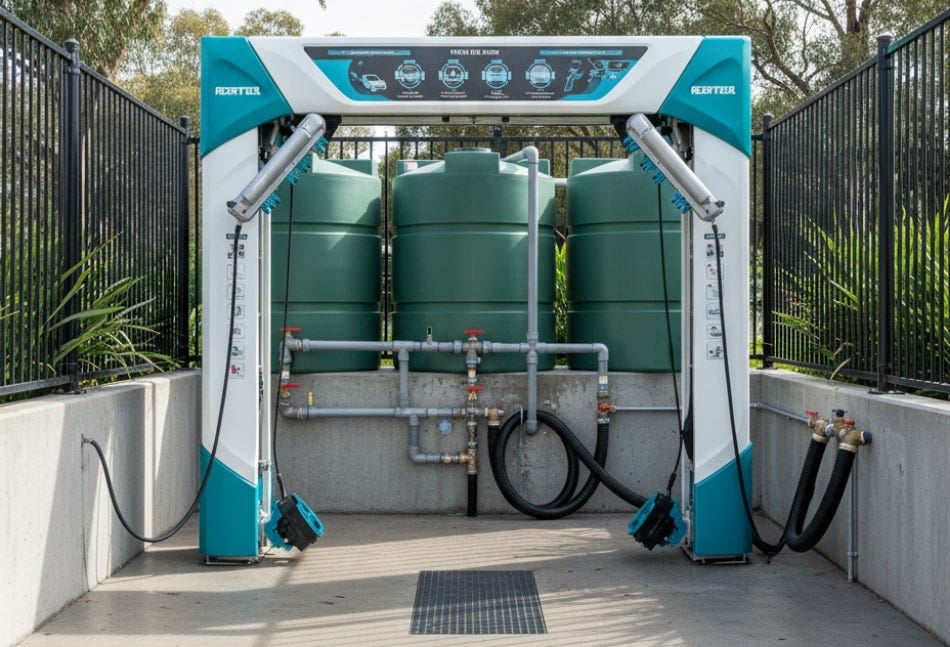
A tank is just one part of a complete car wash reclamation system. The right accessories are crucial for ensuring the system is easy to maintain, compliant, and efficient.
- Grit and Silt Traps: These are often the first point of contact for wastewater. They are designed to capture heavy solids like sand, gravel, and mud before they enter the main reclamation tanks, preventing premature system failure and expensive maintenance. They have the same working mechanism as strainer baskets for rainwater tanks.
- Oil-Water Separators: This is a critical component for any car wash. These separators use gravity to separate oils, grease, and other lighter-than-water substances from the wash water before it is sent on for further treatment and storage.
NB: It is important to note that both grit traps and oil-water separators are frequently mandatory under municipal and state discharge permits.
- Pumps & Filters: These are the heart of the reclamation system, working in tandem to move water between tanks and ensure it is clean enough to be reused. High-performance specialty filters remove remaining suspended solids and particulates, ensuring the water is clean enough to be recycled without clogging nozzles or leaving residue on vehicles.
- Level Sensors & Alarms: For any reclamation system, an alarm is a critical safety and operational feature. A float switch inside the tank triggers an audible and visual alarm when the water level reaches a predetermined point, alerting the owner to a potential overflow or system issue before it becomes a major problem.
The Tank Depot Customization Edge
For a commercial car wash, an off-the-shelf tank may not always be the perfect fit. Site-specific challenges like a difficult-to-access location, a unique plumbing layout, or the need to maximize storage in a confined space often demand a more tailored solution. While many suppliers offer a standard product line, Tank Depot's core differentiator is its ability to provide custom-molded and fabricated solutions.
This unique capability ensures that even the most difficult projects can find a compliant and effective solution. We solve complex liquid storage problems by offering precision inlet/outlet placement, custom dimensions, and specialized fittings, all designed to create a purpose-built system that fits your exact needs and provides peace of mind.
NB: Custom options are only available for specific brands.
Final Verdict: Securing Your Car Wash's Future with the Ultimate Choice
Your car wash's water reclamation system is a fundamental piece of your operational infrastructure. The right tank ensures you remain profitable and free from costly failures, whether it’s for a high-volume tunnel wash or a self-service bay.
For conserving valuable space, a high-capacity underground tank is a reliable solution. When aggressive chemicals are a factor, a robust fiberglass below-ground tank offers an unparalleled solution for long-term containment.
Tank Depot isn't just a supplier; we are your partner in building a resilient and profitable water management system. We offer a comprehensive product line, a profound understanding of certifications, and the ability to provide custom-fabricated solutions for a successful installation from start to finish.


