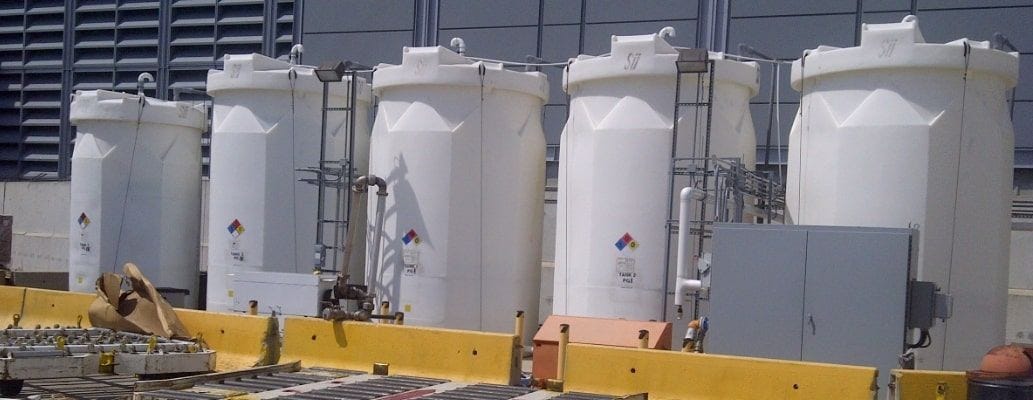
The Definitive Engineer’s Blueprint for Secondary Containment Poly Storage Tanks
Let’s be honest—managing bulk chemical storage comes with an unyielding layer of regulatory responsibility. For decades, the standard industrial path to environmental safety compliance was a predictable one: procure a single-walled tank, mix several bags of concrete, and erect a massive, space-hogging external secondary containment dike or open basin around it.
But in modern facility operations, relying on legacy concrete structures is a permanent, high-maintenance liability. Concrete is inherently porous; it cracks under continuous thermal expansion, requires ongoing applications of expensive anti-corrosive epoxy coatings, and transforms into an open rain-collection pond after every major storm. When a chemical spill or localized breach interacts with trapped rainwater, your facility is instantly saddled with expensive chemical testing, infrastructure degradation, and recurring hazardous waste dewatering fees.
There is a much smarter, pre-engineered alternative. Welcome to the modern era of fluid logistics: the rotationally molded double wall plastic tank.
By nesting a high-performance primary vessel inside an integrated, interlocking outer protective shell, this complete "tank-within-a-tank" system delivers verifiable secondary containment systems natively. It eliminates the need for external open bunds, saves valuable plant floor space, and cuts your total upfront procurement and installation costs by an average of 35%.
To fully understand why these advanced polymer systems are rapidly replacing legacy containment dikes, we must look past the seamless outer walls and evaluate the raw, submittal-grade anatomy of a factory-certified dual wall tank.
The Anatomy of an Industrial Dual Containment Tank System
Every high-performance polyethylene secondary containment tank we engineer is a masterclass in rotational molding structural design. By analyzing the certified manufacturing submittals and product documents from top-tier builders like Snyder Industries, we can map out the precise components that make these systems structurally uncompromised.
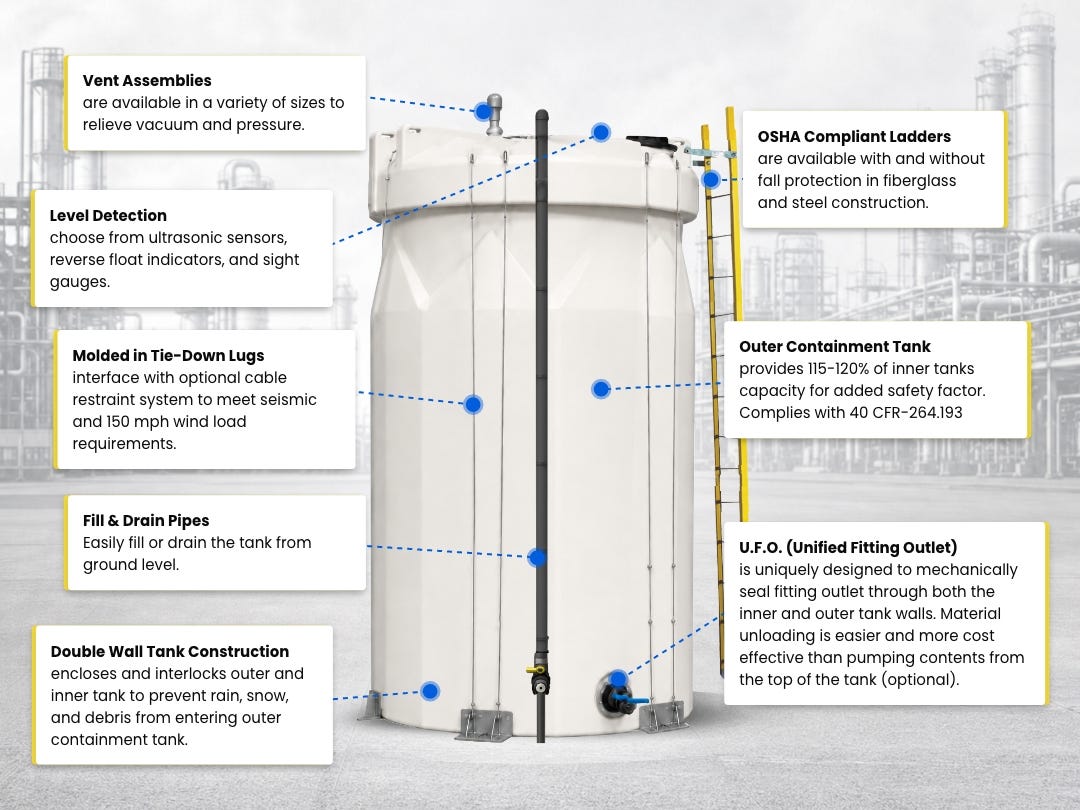
The Cylindrical Inner Primary Tank
The core of the storage solution is the standalone inner primary vessel. Rotationally molded as a single, seamless piece of high-grade virgin polymer, these tanks are designed with a tapered, stratiform wall thickness that matches or exceeds rigorous ASTM D1998 upright storage tank variables. Because the part is molded without welded seams or stress focal points, it handles extreme internal hydrostatic head pressures flawlessly.
The Blended-Form Octagonal Outer Secondary Tank
Enveloping the primary core is a heavy-duty, blended-form outer secondary containment shell. This outer barrier is completely freestanding and engineered without the aid of secondary internal spacer blocks, which can shift during transit and cause structural stress cracks. It acts as an impermeable shield that completely isolates the inner tank from physical impacts and weathering elements.
The 1/2" Deep Integrated Pump Recess Platform
On smaller configuration units and commercial mini-bulk delivery stations, the top head features an integrally molded, recessed heavy-duty platform. Sized with a flat surface area and rated to support direct mechanical loads up to 225 lbs, this deck allows facility engineers to securely direct-mount chemical feed metering pumps, manifold loops, and piping attachments directly over the tank boundary without structural deflection.
Threaded Vented Access Manways
To facilitate safe internal maintenance and visual tank diagnostics, the top heads are equipped with specialized, heavy-gauge polyethylene manway assemblies. These configurations are precisely scaled to the volumetric capacity of the asset:
● Day Tanks & Mini-Bulk Units: Fitted with compact 6" threaded enclosures or 14" access rings featuring an 11- " clean clear access opening.
● Bulk Storage Giants: Built with an industrial standard 18" threaded manway ring enclosing a 15" clean access port, up to heavy-duty 24" bolted, airtight configurations for volatile chemical containment.
Integrated Lifting and Tie-Down Lugs
Erection and site placement of a multi-ton industrial asset requires built-in rigging protection. Advanced poly double wall chemical storage tanks feature a minimum of 3 to 8 heavy-duty lifting and tie-down lugs integrally molded directly into the top dome geometry at 90-degree principal centerlines. These reinforced connection points allow empty primary and secondary units to be hoisted, transported, and aligned as a single unitized system, interfacing directly with certified high-wind and seismic cable restraint networks without creating structural point-load vulnerabilities.
Understanding The Mechanics of Patented Interlocking Tank-in-a-Tank Construction
When you look at a heavy-duty polymer dual wall tank sitting in an industrial yard, it’s easy to see it as just a massive plastic structure. But underneath that clean, seamless exterior is a brilliant matrix of structural physics and fluid dynamics.
Relying on a single-walled tank paired with an open concrete basin means your facility is exposed to continuous environmental and mechanical stress. At Tank Depot, we believe in a better engineering path. Let’s break down the patented mechanics—including Snyder Industries Patent No. 6,474,496—that show how an integrated double wall plastic tank delivers absolute fluid isolation.
The Anti-Rotation Keyway System
In a standard chemical processing line or municipal water treatment plant, your wastewater storage tank is subjected to severe physical forces. When high-volume chemical feed pumps kick on, the sudden torque sends kinetic shockwaves through your process piping, manifolds, and tank connections.
If you are using a basic, non-integrated containment system, that structural torque can cause the primary inner vessel to shift or twist slightly inside its basin. The result? Misaligned nozzles, sheared gaskets, and unpreventable, dangerous leaks at your primary connection points.
How We Solve It:
Our advanced double wall tanks completely eliminate this structural vulnerability through an integrally molded Anti-Rotation Keyway System. During the rotational molding process, interlocking geometric recessed channels are molded directly into the top head and sidewall walls of both the inner primary tank and the outer secondary containment shell.
When nested together, these molded-in keyways physically lock the two tanks into a single, unyielding unitized system. This physical barrier completely prevents any axial rotation or structural shifting, ensuring your heavy-duty process piping remains flawlessly aligned under the most extreme industrial pumping loads.
Atmospheric Shielding & Debris Isolation
For facilities utilizing traditional open concrete basins or secondary dikes for outdoor chemical storage, the weather is a constant operational enemy. Open dikes act as massive rain-collection ponds, capturing everything from torrential rainwater and winter snow to mud, dust, sand, and windblown debris.
This accumulation introduces a severe physical risk to your operation:
● The Debris Problem: Blowing leaves, bird droppings, and industrial dust settle into the open containment area, creating a wet, acidic sludge at the base of your tank.
● The Operational Drain: This sludge buries the lowest vertical-to-floor seams of your storage system, trapping moisture against critical joint paths and accelerating localized environmental degradation.
How We Solve It:
Our poly dual-containment systems feature a unique interlocking dome geometry designed for total atmospheric isolation. The upper dome of the primary inner tank is precision-engineered to completely overlap and interlock with the vertical sidewall of the outer secondary containment tank.
This creates a fully enclosed, interlocking protective canopy. Rainwater, blowing sand, mud, and debris hit the sloped top dome and are shed completely down the exterior of the outer shell. The interstitial space between the two walls remains 100% dry, clean, and free from external matter, protecting your chemical purity and extending the structural lifespan of the entire asset.
Eliminating the Rainfall Overflow Risk
Under strict EPA SPCC 40 CFR Part 112 regulations, a secondary containment structure must maintain continuous volumetric capacity to handle a catastrophic primary vessel release during a heavy rainfall event.
For legacy open concrete dikes, this presents an ongoing regulatory headache. If an open dike fills up with several inches of stormwater after a major storm, its effective containment capacity is compromised. Plant personnel must immediately take action:
● The Testing Cost: Before that captured rainwater can be legally discharged into municipal storm sewers, your team must manually inspect and test the water for chemical contamination.
● The Wastewater Bill: If a small leak or valve drip has introduced industrial chemicals into the trapped rainwater, that entire volume is now classified as hazardous wastewater. Your business is forced to pay exorbitant, recurring industrial dewatering and hazardous treatment fees just to empty the basin.
The Double-Wall Advantage:
Because our integrated double wall storage tanks feature a completely enclosed, self-contained design, rainwater can never enter or accumulate in the outer secondary tank. Your 115% to 120% volumetric containment safety factor is fully protected and preserved every single second of the year, regardless of local weather conditions.
Navigating Regulatory Thresholds and True SPCC Compliance Benchmarks
When we audit an industrial fluid facility, the conversation almost always centers around compliance codes. Navigating the rigid frameworks of federal EPA Spill Prevention, Control, and Countermeasure (SPCC) rule 40 CFR Part 112 and 40 CFR 264.193 can feel like a moving target for procurement teams.
For decades, the standard approach to satisfying these containment mandates was strictly volumetric: if you store a specific volume of a hazardous substance or industrial chemical, you build an external concrete basin or open dike sized to hold 110% of that static fluid capacity.
However, forensic engineering and real-world failure data show that traditional, open secondary basins suffer from a massive flaw. They calculate risk as a static equation, completely ignoring the dynamic fluid physics that occur during a catastrophic structural failure.
Let's demystify these federal environmental regulations and evaluate the hydrodynamic surge risks that make integrated, poly double wall tanks the only modern choice for true site safety.
The Hydrodynamic Surge Risk: Why Concrete Basins Fail
A primary engineering pitfall of traditional single-wall aboveground storage tanks (ASTs) paired with external concrete dikes is the assumption that a structural breach behaves like a gradual leak.
It does not. When a single-walled vessel suffers a plastic collapse, a structural weld failure, or a sudden brittle fracture along its vertical seams under load, the fluid release is instantaneous and highly pressurized.
The potential energy stored within a full chemical storage tank is calculated based on its hydrostatic head pressure (P):
P = ρgh
Where:
● is the density of the stored chemical compound (such as dense, heavy liquids like wastewater, sodium hydroxide, or liquid fertilizer solutions matching heavy-duty 1.9 Specific Gravity ratings).
● g represents gravitational acceleration (9.81 m/s2).
● h is the total vertical fluid column height.
For a dense chemical like a urea ammonium nitrate fertilizer solution () filled to an industrial height of 27 feet, the static pressure exerted against the bottom shell course is approximately 105 kPa (15.2 psi). This hydrostatic load exerts a massive, continuous circumferential tensile force—known as hoop stress ()—acting directly on the tank wall structure:
()
Where represents the tank radius and is the engineered wall thickness.
The moment a localized material flaw, stress riser, or corrosion pit compromises a single-walled tank shell under this load, that potential energy instantly converts into kinetic energy. The fluid release does not pool gently inside a concrete basin; it manifests as a high-velocity, catastrophic hydrodynamic surge wave.
This dynamic liquid wave possesses immense momentum. As documented in major industrial infrastructure failures like the Allied Terminals collapse, the wave front moves with enough physical force to easily climb, overtop, and smash past standard vertical concrete dike walls. Earthen and concrete secondary dikes are sized for static volumes, meaning they are structurally incapable of absorbing the kinetic momentum of a pressurized hydraulic surge.
The 115% to 120% Volumetric Safety Factor: Self-Contained Energy Mitigation
This hydrodynamic pitfall is exactly why progressive facilities are shifting away from single-wall configurations and deploying factory-certified, poly double wall storage tanks.
An integrated two wall plastic tank neutralizes the threat of kinetic wave generation through its nested, interlocking shell engineering. Because the secondary containment vessel completely envelops the primary inner container, the structural void or interstitial space between the two walls is highly confined.
   [ CATASTROPHIC INTERNAL SEAM SPLIT ]
                  |
                  v
   [ Pressurized Primary Fluid Release ] ---> [ Hydrostatic Head Pressure Discharges ]
                  |
                  v
   [ High-Velocity Hydrodynamic Surge ] ---> [ STRIKES INTEGRAL OUTER SHELL IMMEDIATELY ]
                  |
                  v
   [ Dynamic Kinetic Energy Absorbed ]  ---> [ Pressure Equalizes Safely Inside Void ]
                  |
                  v
   [ 115% - 120% Containment Preserved ] ---> [ ZERO Environmental Leakage | Site Protected ]
When an internal primary split or wall penetration occurs, the pressurized chemical cannot build multi-directional momentum or form a massive, uncontained wave front. Instead, the fluid immediately discharges into the narrow interstitial zone, making direct contact with the inner wall of the secondary containment shell.
The structural outer shell acts as an immediate kinetic energy absorber, trapping the pressure and dampening the dynamic force of the release. The fluid equalizes safely within the secure boundaries of the unitized system, preventing the cascading facility damage or community evacuations associated with overtopped concrete basins.
Furthermore, we engineer our dual wall tank systems to far exceed base regulatory baselines. While federal mandates require standard volumetric capacity, our outer protective containment shells are precision-molded to hold a minimum of 115% to 120% of the inner primary tank's volumetric capacity.
By upgrading to an over-engineered poly double wall containment tank, your facility achieves instant, uncompromised regulatory equivalency under EPA SPCC criteria and 40 CFR 264.193 guidelines. You secure absolute peace of mind, safeguard your personnel, and eliminate the risk of environmental remediation liabilities—all without a single bag of concrete on site.
Fluid Dynamics at the Base Outflow: The Gravity Bottom Discharge
Engineering a secure entry point at the top of a primary vessel is relatively straightforward, but managing bottom drainage on an industrial chemical line introduces entirely different physical demands. Traditional, open secondary containment dikes force facilities into a legacy operational hassle: drawing hazardous liquids out over the top lip of the tank. Relying on top-draw priming tubes, foot valves, and suction pumps introduces continuous energy drains, mechanical maintenance overhead, and the constant risk of vapor lock or siphoning failures.
The smarter engineering path requires a bottom-discharge configuration, but drilling through a double-walled system traditionally compromised the secondary containment boundary. To solve this, advanced double-wall systems utilize high-strength, flexible compression fittings engineered as a bottom sidewall transition seal.
This transition is anchored by the patented U.F.O. (Unified Fitting Outlet). Mechanically engineered under Snyder Industries Patent No. 6,474,496, the U.F.O. works by compressing heavy-duty internal and external structural flanges seamlessly through both the inner primary tank wall and the outer secondary containment shell simultaneously.
   [PRIMARY INNER WALL]                   [OUTER SECONDARY WALL]
           |                                        |
           |     +----------------------------+     |
           |     |  Heavy-Duty PVC/PP Flange  |     |
           |     +----------------------------+     |
===========|=====|============================|=====|=========== [BORE LINE]
  Chemical |     |  Continuous Fluid Passage  |     | Discharge Piping
  Outflow  |     |  (EPDM or Viton Sealing)   |     | (Gravity Drain)
===========|=====|============================|=====|=========== [BORE LINE]
           |     +----------------------------+     |
           |     | Mechanical Isolation Sleeve|     |
           |     +----------------------------+     |
           |                                        |
           |<----------- INTERSTITIAL ------------->|
                         VOID SPACE
By deploying a synchronized double-gasket arrangement—utilizing 40-50 durometer EPDM or 60-70 durometer Viton® seals based on chemical compatibility—the fitting creates a leak-proof conduit. This design permits high-efficiency gravity drainage directly from the lowest point of the inner tank while completely maintaining the structural integrity of the outer environmental containment envelope.
Thermoplastic Materials Selection and Lifecycle Economics
When procurement teams evaluate industrial double wall chemical storage tanks, they often fall into the price vs. project capital value paradox. Looking strictly at an upfront equipment invoice can give buyers "sticker shock," as an integrated double wall plastic tank commands a higher initial price than a bare, single-walled vessel.
However, a comprehensive total cost of ownership (TCO) analysis quickly exposes the hidden expenses of the single-wall route. A single-walled tank cannot legally operate without secondary isolation under EPA 40 CFR 264.193 codes. Building an external concrete dike or containment basin from scratch requires:
● Professional engineering design and site permitting
● Structural excavation and rebar reinforcement
● Pouring specialized, low-porosity concrete mix
● Applying anti-corrosive epoxy barrier coatings
This civil engineering process frequently doubles or triples the total initial installation cost, turning a seemingly cheap single-wall tank into a massive capital expense.
The other option would be to rely on external plastic IBC containment basins and spill pallets.
+-------------------------------------------------------------------------+
| FIVE-YEAR LIFECYCLE ECONOMIC MATRIX                                     |
+------------------------------------+------------------------------------+
| SINGLE-WALL AST + CONCRETE DIKE    | INTEGRATED POLY DOUBLE-WALL AST    |
+------------------------------------+------------------------------------+
| High Initial Construction Costs    | 35% Lower Procurement & Setup Costs|
| (Permitting, Excavation, Concrete) | (Factory-Assembled & Site-Ready)   |
+------------------------------------+------------------------------------+
| Continuous Maintenance Overhead    | Minimal Operational Burden         |
| (Rainwater Testing & Dewatering)   | (Automated Interstitial Sensors)   |
+------------------------------------+------------------------------------+
| High Risk Spill Liabilities        | Zero Environmental Leakage Risk    |
| (Hydrodynamic Overtopping Surge)   | (Breaches Captured in Interstice)  |
+------------------------------------+------------------------------------+
By contrast, purchasing an integrated poly dual wall tank delivers a major 35% procurement win. Because these systems are shipped fully assembled directly from factory molding floors on standard flatbeds, field assembly costs are virtually eliminated.
Furthermore, the compact footprint of an all-in-one double wall storage tank conserves premium facility floor space, while the completely enclosed, interlocking dome design eliminates ongoing stormwater testing, rainwater log bookkeeping, and hazardous waste disposal liabilities.
The New Standard in Chemical Logistics
By integrating advanced fluid physics with factory-certified craftsmanship, double-wall polymer technology has fundamentally rewritten the rules of industrial risk management. Choosing an all-in-one dual containment system isn't just about avoiding regulatory fines. It’s about protecting your workforce, streamlining your facility's footprint, and securing your bottom line.
Traditional concrete dikes and open basins represent a legacy era of high-maintenance liabilities, continuous dewatering costs, and hidden corrosion traps. Modern industrial processing demands a smarter, cleaner, and completely self-contained architecture.
At Tank Depot, we have spent decades partnering with the nation's premier manufacturers to deliver elite, site-ready poly storage solutions. From compact 35-gallon chemical day tanks to massive 12,500-gallon bulk units, we provide the exact engineering blueprints, material science, and automated tracking instrumentation required to eliminate risk entirely.
Let's make sure your facility is designed for today’s strict compliance standards. Request a free customized double wall tank quote or consult with our specialized industrial sales team to secure your uncompromised storage architecture at Tank Depot