


Comparing Electric Water Pumps and Gas Water Pumps for Emergency Fire Fighting
If you manage a ranch, a facility, or acreage in a fire-prone county, you almost certainly already own water pumps. They run your daily supply, your irrigation, and your livestock water without a second thought. Here is the uncomfortable part. The one moment you would need them most, an advancing fire, is the exact moment they are most likely to be dead, because a wildfire tends to take the power grid with it. That is what the gas vs electric water pump question is really about. It is not a horsepower contest. It is a decision about what still runs when the power is out, and how you move stored water onto a roof, a fence line, or a firebreak when every second counts. Use the table below as a quick read, then we will work through each job.
|
Your situation |
Reach for |
Why |
|
Everyday supply, irrigation, livestock water |
Electric |
Automatic, quiet, low cost to run while power is up |
|
Pre-wetting roof and landscape before a fire, grid still up |
Electric |
Fine while power holds, and it can run on a timer |
|
Filling or drawing a reserve off-grid |
Solar / DC electric |
Grid-independent but low flow, a supply tool, not a defense tool |
|
Active defense during the fire, grid down |
Gas / engine-driven |
Runs without the grid, portable, high pressure to throw water |
|
Remote ground with no power (back pasture, fence lines) |
Gas / engine-driven |
Deploys anywhere a truck or UTV can reach |
|
Code-required fixed sprinkler system |
Engineered fixed pump |
NFPA-rated and spec'd to the tank, not a portable unit |
The short version: it is rarely gas or electric. It is the right pump for each phase, backed by water you have already stored.
Two pumps, two jobs
An electric pump and an engine-driven pump are built for opposite halves of the same problem, so comparing them on price or horsepower alone misses the point. Line up what each one is actually for:
What electric pumps own
- Everyday water supply and pressure boosting for the property
- Pre-wetting the roof, walls, and landscape in the days and hours before a fire front, while the grid is still up
- Automated, quiet, low-cost duty that can run unattended on a timer or pressure switch
- Off-grid supply when paired with solar, though at low flow
What gas and engine-driven pumps own
- The grid-down window, which is the heart of an active wildfire
- Remote and unpowered ground where there is nothing to plug into
- Portability, so you can carry the pump to the threat instead of routing the threat to the pump
- High pressure and volume to throw water far and atomize it into an ember-stopping mist
Why the grid decides a gas vs electric water pump fight
Here is the failure point that catches people out.
High winds, downed lines, and Public Safety Power Shutoffs routinely cut electricity across whole communities before the flame front even arrives. A private well on an electric submersible pump, or a booster feeding a sprinkler line, is often the first thing to go dark. Without a large, fire-shielded generator, an electric pump becomes a piece of idle hardware at the exact moment you need water on the roof.
This is not a new position for us. Our companion guide on securing your water supply for wildfire sprinkler systems makes the same case: in a wildfire, electricity is the first utility to fail, so your active defense has to run without it. That is the single biggest reason the answer for the fire itself leans toward an engine.
The electric water pump's real job: proactive defense
None of this makes electric pumps optional. It makes them a preparation tool rather than a fire-front tool. Everything you do before the emergency is electric territory, and doing it well is what keeps a fire small in the first place.
For daily supply and pressure boosting, our constant-pressure and booster lineup covers the range. The Grundfos SCALA1 is a self-priming booster that can lift water from about 26 ft [8 m] below the pump, which makes it a natural fit for drawing off a ground-level rainwater or storage tank. The DAB E.SYBOX MINI 3 and E.SYBOX MAX handle single homes up through commercial buildings, and the high-volume Walrus TPH three-phase pumps move serious water for larger sites.
There is even an off-grid electric option worth understanding, because it shows exactly where the line sits. A Puremint solar pump runs on its own panels with no grid at all, so it survives an outage. But it delivers on the order of 7 to 9 GPM [26 to 34 L/min], built to fill a tank or a trough over time, not to throw a pressurized stream at a roofline. It is a supply pump that happens to be grid-independent, which is a different thing from a defense pump.
This is also where storage and supply meet. If your reserve is fed by harvested rainwater, our guide on residential fire prevention with rainwater harvesting walks through sizing that loop. You can browse the full electric pump range here.
The gas water pump's real job: active, off-grid defense
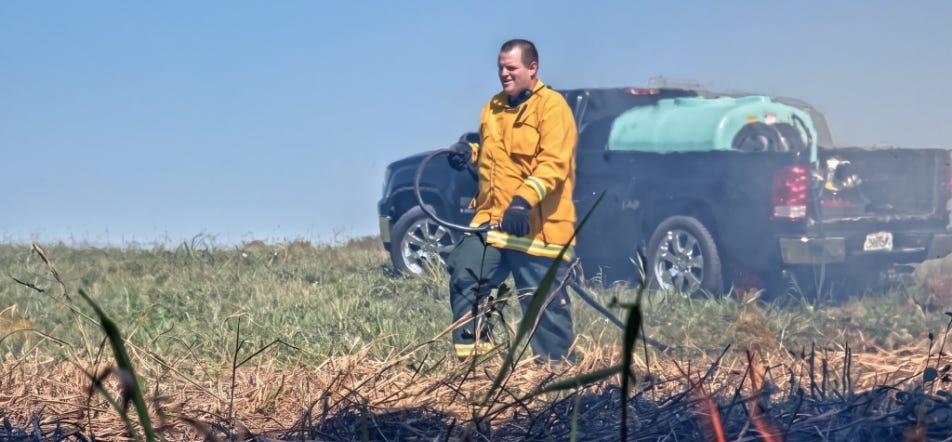
When the power is out and municipal lines lose pressure, an engine-driven pump is your last active line of defense. It runs on its own fuel, independent of every utility, and it goes wherever a truck, trailer, or UTV can carry it. That mobility lets you set up a defensive line in the field instead of hoping a fixed system reaches far enough.
In our catalog, the engine-driven capability lives in the Tank Depot Enduraplas Fire Ranger series. Each unit pairs a Honda GX160 5.5 HP [4.1 kW] engine with a self-priming centrifugal pump on a skid. Rather than trickling water, the Fire Ranger moves roughly 120 GPM [454 L/min] at 100 psi [6.9 bar], with about 35 ft [10.7 m] of vertical spray and 40 ft [12.2 m] horizontal. That vertical reach is the number that matters most for a homeowner, because it is enough to wet a typical roofline ahead of an ember shower.
Because the pump is self-priming, it does not have to rely only on its own onboard tank. It can draw from an external source through a suction hose, which is what turns a single skid into a full system. More on that next.
The unit itself carries an integrated hose reel of about 100 ft [30 m] with an adjustable fire nozzle, plus fork points and tie-down slots so it loads into a truck bed in minutes.
The system that actually works: engine pump plus stored reserve
A high-output pump is only as useful as the water behind it. A rooftop sprinkler run can pull 20 to 60 GPM, and to cover the roughly two-hour window of an ember front you need a meaningful reserve on hand. Most guidance lands at 3,000 to 5,000 gallons [11,000 to 19,000 L] of dedicated on-site water for a defended property.
So the setup that holds up is simple to describe: a large stored reserve, and a self-priming engine pump that draws from it and delivers it where it is needed. The reserve is the foundation. The mobile pump is the tool that puts that water on the roof, the outbuildings, the brush line, or a firebreak, reaching the parts of a property a fixed system never touches.
One important distinction, so nobody over-reads this. A portable engine pump is active, hands-on defense. It is not an engineered fixed fire pump on a code-required sprinkler system. If your site is governed by NFPA rules for a sprinkler or hydrant system, that system is fed by a pump spec'd to the installation, and the storage tank is the piece we engineer into it. The Fire Ranger works alongside that, it does not replace it.
For the reserve itself, match the tank to the property:
- Poly fire suppression tanks (about 1,100 to 20,000 gallons [4,200 to 76,000 L]) for rural and residential sites that do not require NFPA compliance.
- Fiberglass tanks for commercial sites needing corrosion resistance and NFPA 22 or AWWA D120 conformance.
- Steel NFPA 22 fire tanks for code-driven, municipal, and industrial reserves at large volume.
Our guide to the best water storage tanks for fire protection compares those materials in detail, and this overview covers why a dedicated reserve matters in the first place.
Matching the pump to your property
Commercial and agricultural sites
A working ranch or facility already runs electric pumps for daily supply, so the gap is almost always the deployable engine unit. The Fire Ranger 250 and 400 fill that gap, drawing from a fiberglass or steel reserve sized to the operation. The dual-use case makes the purchase easier to justify between fire seasons: the same unit handles dust suppression on roads and lots, equipment washdown, and general water transfer, so it earns its keep year-round rather than sitting idle.
Rural homeowners
Same logic, smaller scale. The Fire Ranger 250 leads here, drawing from a poly reserve or a harvested-rainwater tank, using its vertical reach to wet a roofline before embers land. We stock the 250 and 400; smaller Fire Ranger sizes are available by request if a lighter unit fits your property better. Pair any of it with defensible space around the home and the tank, and you have a real, grid-independent defense rather than a sprinkler kit waiting on power that will not be there.
The numbers, side by side
A note on the Foam Ranger pump option
|
|
Electric (everyday + pre-wet) |
Gas / engine (active defense) |
|
Example |
Grundfos SCALA1, DAB E.SYBOX, Walrus TPH |
Tank Depot Enduraplas Fire Ranger 250 / 400 |
|
Power source |
115V / 230V grid (or solar DC, low flow) |
Honda GX160 5.5 HP [4.1 kW] gasoline |
|
Typical flow |
3 to 76 GPM depending on model |
~120 GPM [454 L/min] |
|
Typical pressure |
Constant pressure, ~72 to 145 psi |
~100 psi [6.9 bar] |
|
Reach |
Plumbed to fixtures / sprinkler lines |
~35 ft [10.7 m] vertical, 40 ft [12.2 m] horizontal |
|
Mobility |
Fixed installation |
Skid-mounted, portable |
|
Best use |
Daily supply, pre-event hydration |
Grid-down active fire defense |
For high-risk commercial and land-management use, the Tank Depot Enduraplas Foam Ranger series adds Class A or Class B suppression foam capability on top of the same skid-and-engine concept. Foam can blanket a structure and cut oxygen and heat transfer more effectively than water alone. This is a specialist tool rather than the default choice, and the specific foam class and performance claims need sign-off before we position it, so we are keeping the mention brief here and may give it a dedicated piece later.
Staging it right: a fire-season checklist
Owning the hardware is half the job. Staging it so it works under pressure is the other half.
- Secure the reserve. Keep a baseline of at least 3,000 to 5,000 gallons on site, and make sure the tank has the right fire department connection and drafting fittings so crews can draw from it. Our wildfire supply guide covers those fittings.
- Clear defensible space. Keep about 30 ft [9 m] clear around the tank and pump, free of brush, dry weeds, and debris, so the equipment survives radiant heat and crews can reach it.
- Run a dry-season drill. Engines seize if they sit. Start the unit once a month through fire season, check fuel, and flush the hose so it starts on the first pull when it matters.
Match the pump to the job, not one pump to everything
The gas vs electric water pump decision is not either-or. Electric pumps keep your property supplied and let you pre-wet it while the grid holds. An engine-driven pump like the Fire Ranger takes over the moment the power drops, drawing from a stored reserve to put water exactly where the fire is. Build both into a layered plan and back them with enough stored water, and you control your own readiness instead of gambling on infrastructure that fails first in a fire.
Start by browsing all Tank Depot pumps, size your reserve with our fire tank guides, or call an expert at (866) 926-5603 to build the setup around your property.


