

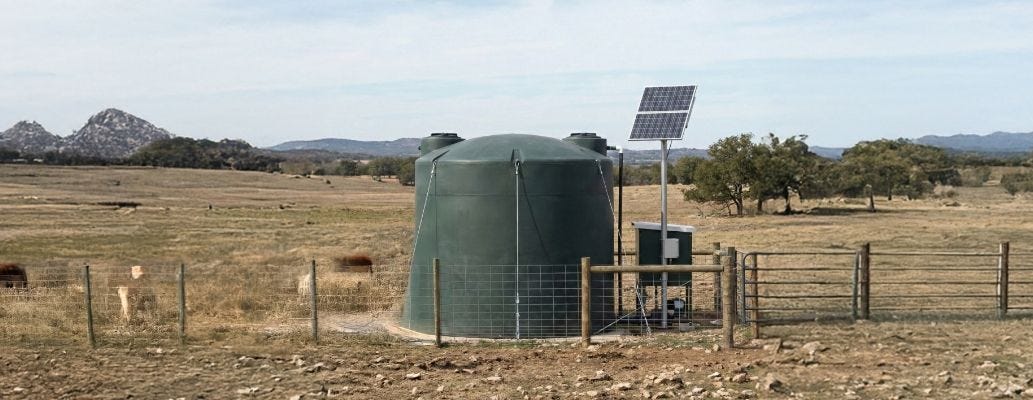
5,000 Gallon Water Storage Tanks: The Ultimate Guide to Bulk Summer Water Storage
In an era of shifting climates and increasing demand on aging infrastructure, "water security" has moved from a luxury to a necessity. Whether you are managing a 50-head cattle ranch, drought-proofing a residential landscape, or securing a fire-suppression reserve, the 5,000-gallon water tank represents the "Goldilocks" of bulk storage: large enough to provide months of autonomy, yet manageable enough for standard freight and site installation.
As of 2026, over half of the United States faces intensified seasonal water shortages. However, the strategies for managing bulk water remain constant. This guide breaks down the engineering, logistics, and selection process to help you secure a reliable water future for the next decade and beyond.
Why 5,000 Gallons of Water Storage?
When planning for water security, the primary question is: How long will this last?
According to the EPA, a typical family of four consumes approximately 400 gallons of water per day, with 70% of that (280 gallons) dedicated to indoor use.
During a summer drought or well failure, households often shift to "conservation mode" by addressing high-consumption areas like toilets (which account for 27% of indoor use) and laundry (which can consume 50 gallons per load in older machines).
- The 40-Day Safety Net: By adopting high-efficiency habits, such as using WaterSense labeled fixtures or eliminating leaks that can waste 200 gallons daily, a family of four can realistically reduce indoor consumption to roughly 125 gallons per day. At this rate, a 5,000-gallon tank provides a 40-day safety net. This is the critical "buffer zone" needed to survive peak summer demand, well recovery periods, or delivery lead times for bulk water hauling.
- The Freight Efficiency Threshold: Logistics is a major cost driver for large tanks. A 5,000-gallon unit is strategically sized to fit on standard 53-foot trailers. It represents the maximum volume that can typically be delivered without the added expense of "Super Load" escort vehicles or specialized wide-load permits, ensuring your cost-per-gallon of storage remains optimized.
- The Rainwater Harvest "Sweet Spot": For those augmenting their supply through collection, the math is undeniable. A 2,000 sq. ft. roof shedding just 1 inch of rain yields 1,246 gallons of water. A 5,000-gallon Enduraplas tank is perfectly calibrated to capture the yield of a massive 4-inch "summer gusher" storm. This allows you to store a month’s worth of water from a single weather event, rather than watching excess overflow go to waste.
Comparative Engineering: Finding Your Footprint
While the capacity is the same, the physical dimensions of a 5,000-gallon tank vary significantly between models. This is often the deciding factor for customers with overhead height restrictions (trees/rooflines) or narrow access points (gates/fences).
Below is a comparison of our top-tier 5,000-gallon vertical tanks from industry giants like Enduraplas to help you determine which "footprint" fits your installation site.
5,000 Gallon Tanks Dimensional Comparison
| Tank Model/Style | Diameter | Total Height | Material | Best For |
| Slim Profile (e.g., Norwesco) | 102" | 152" | HDPE | Narrow spaces; maximizing vertical height. |
| Low Profile (e.g., Bushman) | 129" | 96" | LLDPE | High-wind areas; blending into landscapes. |
| Enhanced Security (e.g. Enduraplas) | 110" | 150" | Poly | Max liquid security with S.G up to 1.5 and integrated tie-down lugs and up to 10 year warranty. |
| Heavy Duty (e.g., DuraCast) | 102" | 157" | Poly | Higher specific gravity (1.2); extreme durability. |
| Standard Industrial (Snyder) | 102" | 155" | HDLPE | Indoor/Outdoor industrial bulk handling. |
Site Prep 101 for Your Bulk Water Tank: The 40,000 lb Engineering Challenge
When empty, a 5,000-gallon vertical poly water tank is surprisingly manageable, weighing between 700 and 900 lbs. However, once filled to capacity with potable water, the physics change dramatically. Water weighs approximately 8.34 lbs per gallon, bringing the total weight of a full tank to over 42,000 lbs, roughly the same as a fully loaded semi-truck.
Foundation Option A: Reinforced Concrete (The Gold Standard)
For permanent installations and industrial bulk water storage, a reinforced concrete pad is the superior choice. Check out how this Enduraplas tank performs in this durability test to understand why a strong base is mandatory when the tank is full.
- Specifications: The pad should be a minimum of 4 inches thick (6 inches for higher specific gravity liquids). It must be reinforced with rebar or fiber mesh and poured over a compacted sub-base.
- Size: The pad must be level and at least 6 to 12 inches wider than the diameter of the 5,000-gallon water tank.
- Benefit: Eliminates the risk of "point loading" and uneven settling, ensuring the storage tank's seamless, one-piece construction remains stress-free.
Foundation Option B: Compacted Crusher Dust (The Economical Choice)
A common alternative for residential and bulk agricultural water tanks is a "crusher dust" or "fines" base.
- Specifications: This is not simple gravel or sand. It must be a 6-inch deep layer of 1/4” minus crushed stone (fines) that is mechanically compacted until it is as hard as asphalt.
- The "3-Foot Rule": To prevent erosion around the edges (which can lead to the tank "undermining"), the base should extend 3 feet beyond the tank's footprint on all sides.
- Risk Factor: Avoid using pea gravel or large river rocks, as these can shift under the tank's weight and cause the floor to bulge or puncture.
Comparing Foundation Pads for Bulk Water Tanks
| Feature | Reinforced Concrete | Compacted Crusher Dust |
| Durability | Permanent / High | Moderate (requires maintenance) |
| Relative Cost | Higher | Lower |
| Best For | Commercial/Industrial | Residential/Livestock |
| Settling Risk | Near Zero | Moderate (if not compacted) |
| Permit Req. | Often required for 5k+ gal | Varies by county |
Protecting Your 3-Year Limited Warranty
Most leading manufacturers, including Norwesco, Bushman, and Snyder, provide a 3-year limited warranty for the large water tanks from the date of manufacture. (Note, Enduraplas offers up to a 10 years warranty!)
However, this coverage is strictly conditional. To ensure your investment is protected, your installation must adhere to these "Golden Rules" found in the fine print:
- The "Unsound Base" Clause: Warranties are universally voided by damage resulting from an "unsound base." This includes surfaces that allow for "point loading", where a small rock or uneven bump creates a stress concentration that can lead to a catastrophic rupture.
- Total Bottom Support: The entire bottom of the bulk water tank must be supported by a flat, smooth, and level surface. If any part of the storage tank's base "overhangs" the foundation, the structural integrity is compromised, and the warranty is void.
- Flexible Connections Required: Manufacturers like Chemtainer and Norwesco require the use of flexible hose connections between the tank fitting and rigid plumbing. This allows the water storage tank to "breathe" (expand and contract) as it fills and empties without putting terminal stress on the bulkhead fittings.
- The "Storage Only" Rule: 5,000-gallon vertical water tanks are strictly for stationary water storage. Attempting to transport water in these tanks, even across a flat pasture, immediately voids the warranty of every major brand.
Site Prep Checklist: Is Your Foundation "Warranty-Ready"?
Before your 5,000-gallon water tank arrives, you must verify your site against this checklist. Failure to meet these criteria can lead to tank rupture and will almost certainly void the manufacturer's warranty from brands like Norwesco or Bushman.
Don’t Crack Under Pressure: 6 Rules for the Ultimate Tank Foundation Prep
| Requirement | ✅ PASS (Do This) | ❌ FAIL (Avoid This) |
| 1. Surface Level | Level within 1/4 inch across the entire diameter of the base. | "Roughly level" or sloped ground to "help drainage." |
| 2. Material Type | 4" Reinforced Concrete OR 6" Compacted Crusher Dust/Fines. | Bare dirt, sand, pea gravel, or wood pallets. |
| 3. Support Area | Foundation extends 3 feet beyond the tank walls to prevent erosion. | Base is the exact same size as the tank (leads to undermining). |
| 4. Weight Rating | Engineering confirmed for 42,000 lbs (static load). | Standard residential decks or uncompacted fill dirt. |
| 5. Fittings | Flexible hose connections installed to allow for tank expansion. | Rigid PVC piped directly into the bulkhead fitting. |
| 6. Clearance | 12" "Breathing Room" around the tank for diameter expansion. | Bolting the water tank flush against a wall or fence. |
Summer Maintenance for Your 5,000 Gallon Water Tank: The "Dark Tank" Advantage
Summer heat brings two primary threats to water quality: UV degradation and Algae blooms. Understanding the "Dark Tank" science is the difference between a clean backup supply and a 5,000-gallon swamp.
The Algae Prevention Science
Algae is a photosynthetic organism; it requires sunlight to survive. Standard white or translucent tanks allow UV rays to penetrate the water tank wall, turning your water supply into a greenhouse.
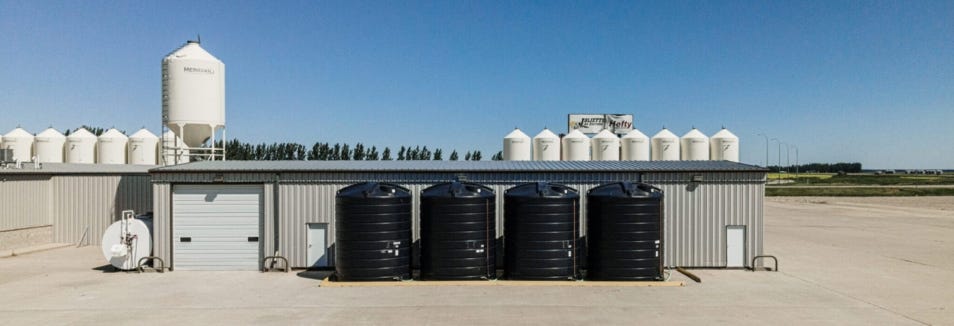
- The Opaque Defense: Our Black, Dark Green, and Mocha tanks from brands like Bushman and Norwesco are manufactured with high-density, opaque resins. These blocks 100% of light transmission, effectively "starving" algae before it can begin to grow.
- Heat Absorption vs. Water Quality: While darker colors absorb more exterior heat, the thick polyethylene walls act as an insulator. For potable water, the trade-off is clear: slightly warmer water is easier to treat than algae-contaminated water.
Safe Summer Sanitation (Bleach Ratios)
If you are storing non-chlorinated well water or harvested rainwater, you may need to shock the tank periodically.
- The Ratio: For a 5,000-gallon tank, a maintenance dose typically involves 2.5 to 3 cups of unscented, 6% household bleach.
- Pro-Tip: Always wait 24 hours after treatment before drinking or using for sensitive irrigation to allow the chlorine to dissipate.Here are more tips to keep your drinking water safe and clean.
A Note on Winter Tank Protection
While this guide focuses on summer storage, the 42,000 lb mass of a 5,000-gallon tank provides a natural thermal defense. Water loses heat slowly; however, the plumbing and fittings are at risk of bursting in a hard freeze.
- Key Action: Insulate your bulkhead fittings and use heat tape on exposed PVC lines.
- Here are a few innovative heating solutions to carry your large water tank through winter.
Logistics & Freight: Getting 42,000 lbs of Security to Your Site
The biggest hurdle to owning a 5,000-gallon tank is the "last mile." Because of their diameter (up to 129"), these tanks cannot be shipped via standard parcel or LTL (Less-Than-Truckload) carriers. They require specialized flatbed or step-deck trailers.
1. The "Shipping Near Me" Advantage
To keep freight costs manageable, we utilize a Multi-Hub Fulfillment Strategy. We ship directly from manufacturing plants across the U.S., including hubs in:
- West: Merced, CA & Tooele, UT
- Central: Shawnee, OK & Marked Tree, AR
- East: Lake Wales, FL & Hummelstown, PA
- Enduraplas Tanks: Neche, ND and Converse TX
By shipping from the hub closest to your zip code, we significantly reduce transit times and carbon footprints.
2. Site Accessibility Requirements
Before ordering, you must ensure your site can accommodate a 53-foot tractor-trailer.
- Turning Radius: Can a full-sized rig navigate your driveway or farm gate?
- Overhead Clearance: Watch for low-hanging power lines or tree branches (remember, some of these big tanks stand nearly 13 feet tall on the trailer).
- Offloading: Standard freight does not include offloading. You will need a forklift with extended tines, a crane, or a backhoe with straps ready at the time of delivery.
3. The "Freight Quote" Process
Because of the physical size, shipping rates fluctuate based on fuel surcharges and regional permit requirements. We provide custom freight quotes for every 5,000-gallon tank order to ensure you aren't overpaying for a "flat rate" that doesn't apply to your specific location.
Pro-Tip 1: Don’t Bottle-Neck Your Supply
When managing 5,000 gallons of water, flow rate is everything, especially during peak irrigation or emergency fire-suppression needs. Standard valves can create a "bottle-neck" that limits your pump's performance.
We recommend pairing your bulk water tank with the Norwesco 2" Full Port Blue Handle Valve. Unlike standard valves that restrict the internal bore, this "Full Port" design ensures the internal diameter matches your plumbing, allowing for unrestricted fluid transfer and maximum volumetric flow. Its chemical-resistant polypropylene construction and easy quarter-turn operation make it the ideal, durable gatekeeper for your bulk water supply.
Pro-Tip 2: Moving Your Water with Confidence
A 5,000-gallon tank provides the volume, but you need the right "engine" to deliver it to your taps. To ensure consistent, house-wide pressure, we recommend an all-in-one solution like the Walrus 1 HP Electronic Pump or source premium water pumps from Grundfos.
Secure Your Water Future Today with Tank Depot
A 5,000-gallon water tank is more than just a piece of equipment; it is a strategic investment in self-sufficiency and operational resilience. Whether you are combating the 2026 drought cycle or simply ensuring your family has a reliable backup for the decade to come, the "Magic Number" of 5,000 gallons offers the perfect balance of capacity, logistics, and value.
Don't wait for the next heatwave to test your limits. From high-capacity Norwesco vertical tanks to space-saving Bushman profiles, Tank Depot has the inventory and the regional shipping hubs to get your storage solution on-site before the summer peak.


