Steel Tanks for Mining: A Guide to Slurry & Tailings Solutions
Let’s talk numbers for a second: the U.S. metals and mining industry officially clocked a staggering $146.14 billion in revenue in 2024. That’s not just a "big" number. It’s a signal that the American industrial heartland is pumping harder than ever. But as we move into 2026, the game has changed.
We aren't just digging holes and crossing our fingers anymore. The industry is undergoing a massive, high-stakes pivot toward sustainable infrastructure. Between stricter environmental mandates and the urgent demand for battery metals like lithium and copper, the "old way" of managing waste, that is, massive earthen dams, is being replaced by precision engineering.
At Tank Depot, we’ve seen the trend firsthand. To keep pace with a 2.7% annual growth rate and a $250 billion waste management market, miners are ditching the dirt and turning to engineered steel tanks. Whether you’re handling high-abrasion gold slurry or corrosive lithium brines, your storage isn't just a bucket, it’s a critical asset in your operational uptime.
In this guide, we’re breaking down the current landscape: from why steel is crushing it in waste management to how you can optimize your site for the "circular" mining economy.
Why is Steel Dominating the Mining Waste Management Market?
The global mining waste management market is massive, valued at $250.77 billion in 2025. It’s no longer just about "getting rid of the gunk." It’s about managing liabilities. In the past, the default was to build a massive earthen dam (a Sub-aerial Tailings Storage Facility) and hope for the best. But in 2026, "hoping for the best" isn't a regulatory strategy.
The Shift from Earthen Dams to Bolted Steel Tanks
We are seeing an aggressive industry pivot toward dry-stack (filtered) and paste tailings. Why? Because traditional tailings dams are under fire. High-profile failures have forced a "prevention is cheaper than remediation" mindset.
Bolted steel tanks are the heroes here. Unlike earthen dams that are vulnerable to seepage and geotechnical instability, engineered steel tanks for mining provide a controlled, contained environment for dewatering and thickening. They allow operators to reach a higher solids content, shrinking the storage footprint and virtually eliminating the "catastrophic failure" risk that keeps insurance premiums high.
| Feature | Traditional Earthen Dams (TSFs) | Modern Steel Tank Containment |
| Risk Profile | High (Seepage & Collapse) | Low (Engineered Structural Integrity) |
| Water Recovery | Passive/Minimal | Active/High (Via Thickening) |
| Footprint | Massive / Land-Intensive | Compact / Modular |
| Regulatory Ease | Difficult/High Scrutiny | Faster Permitting (Standardized) |
| Sustainability | Low (High Environmental Impact) | High (Supports Circular Economy) |
Resilience Against Abrasive Slurry and Effluents
Handling mining waste isn't like moving water—it’s like moving liquid sandpaper. The slurry pump market is projected to hit $1.59 billion by 2026, and these pumps (especially horizontal and submersible units) create incredibly high-pressure environments.
Steel tanks are uniquely qualified to house these systems. They provide the structural rigidity needed to handle the vibration and yield stress of thick, abrasive slurries. When you're running 24/7 operations, you need a vessel that won't buckle under the pressure of a 45% revenue-share horizontal pump setup.
Corrosion Resistance for Battery Metals (Lithium & Copper)
The "Green Transition" is a metal-heavy transition. In 2024, copper alone accounted for 30% of U.S. metal mining revenue. As we ramp up lithium and copper production, we are dealing with increasingly aggressive chemical reagents.
This has created a surge in demand for acid-resistant leaching tanks. You can't just throw copper-leaching chemicals into a standard vat. These process tanks require specialized steel grades (like 316L) or high-performance polymeric linings to prevent the tank from being eaten from the inside out while it processes the very minerals that power our world.
How Do You Optimize Slurry Storage Tanks for Maximum Uptime?
In an industry where every hour of unscheduled downtime can cost millions in lost production, your storage tanks cannot be the weak link. Optimizing for uptime means moving away from "reactive" repairs and toward "predictive" engineering.
Balancing High-Chrome Liners with Slurry Tank Longevity
A mining tank normally won’t corrode and wear out evenly. To date, high-chrome iron remains the industry’s go-to for liners, holding a 54.92% market share, with a caveat. It’s quite heavy, and increasingly expensive. In 2026, we’re seeing a significant shift toward polymeric and ceramic composite liners, growing steadily at an 8.74% CAGR.
These composites offer a "Goldilocks" solution: they provide the chemical resistance needed for leaching while maintaining the impact resistance required for heavy slurry. By matching the liner material to the specific rheology of your ore, you can extend the interval between maintenance cycles by up to 30%.
Engineering for Agitation and Mixing
A slurry tank that isn't agitated is just a very expensive sandbox. If solids settle, you face "sanding in," which can require manual (and dangerous) tank cleaning. Modern steel tanks for mining are now engineered with internal baffles and reinforced bridge mounts to support high-torque agitators.
The goal is to maintain a homogenous mixture that the $1.59B slurry pump market can move efficiently. Proper tank geometry ensures there are no "dead zones" where stagnant slurry can lead to localized corrosion or sediment buildup.
Mining Storage Tank Integration with AI and Predictive Maintenance
The "Smart Mining" revolution has arrived. We are no longer guessing when a liner is thin. By integrating IoT sensors into the tank walls, operators can monitor:
- Yield Stress: Real-time data on slurry thickness to prevent pump clogging.
- Ultrasonic Wall Thinning: Measuring liner wear without entering the tank.
- Acoustic Emissions: Detecting early structural stress or leakages before they become visible.
Tank Maintenance Strategy Comparison: Reactive vs. Predictive
| Feature | Reactive Maintenance | Predictive (AI-Driven) Maintenance |
| Average Downtime | 48–72 Hours (Unplanned) | 4–8 Hours (Scheduled) |
| Component Life | Run-to-Failure | Optimized Replacement |
| Safety Risk | High (Emergency Repairs) | Low (Controlled Environment) |
| Cost Impact | 3x-5x Higher due to lost output | Stabilized O&M Budget |
| Data Utilization | None | Real-time IoT Monitoring |
What are the Critical Standards for Mining Water and Process Tanks?
In the $17.15 billion U.S. mining equipment sector, "off-the-shelf" doesn’t do. Every steel mining tank must be a fortress of compliance. Choosing the wrong engineering standard isn't just a budget error; it’s a massive liability risk under MSHA and CWA guidelines.
API 650 vs. AWWA D103: Which Should You Choose?
When you’re spec’ing out a new site, the "Welded vs. Bolted" debate usually comes down to these two benchmarks.
- API 650 (Welded Steel): This is the gold standard for oil, gas, and heavy chemical storage. If you are housing high-temperature fluids or volatile chemicals used in precious metal leaching, the airtight, seamless nature of a welded API 650 steel mining tank is often non-negotiable.
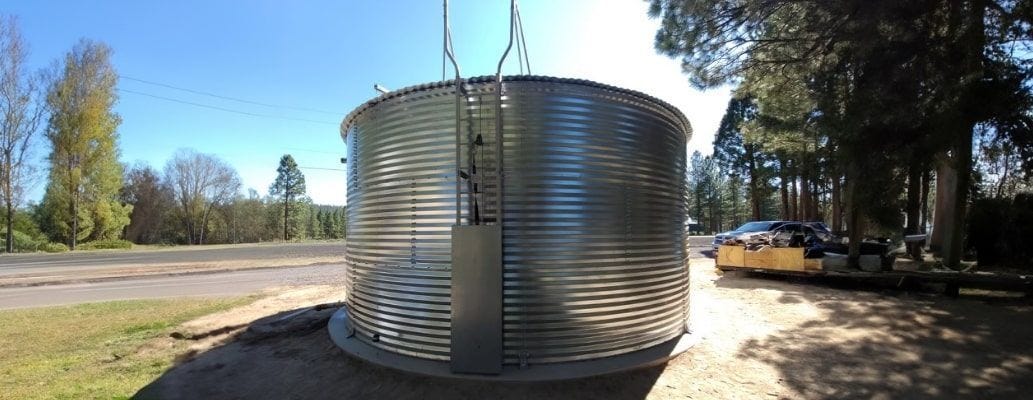
- AWWA D103 (Bolted Steel): For the rapidly expanding mid-scale mine segment, bolted steel is the clear winner. These tanks are factory-coated and shipped in panels, making them ideal for remote mountain or desert sites where field-welding a massive mine tank is logistically impossible. They are the go-to for process water and non-volatile slurry storage.
Special Focus: Lithium Mining Process Tanks
The U.S. is aiming for "strategic autonomy" in the battery supply chain. No wonder lithium mining has become more than just a niche—it’s a national priority. However, lithium extraction is a metallurgical nightmare for standard storage tanks. Whether you are processing spodumene (hard rock) or brine, the chemical environment is brutal.
- Spodumene Processing: Requires tanks that can withstand high-temperature acid roasting and aggressive leaching cycles.
- Brine Extraction: Involves high-salinity fluids that cause rapid pitting and galvanic corrosion in standard carbon steel.
For these applications, we recommend 316L Stainless Steel or specialized internal linings that can handle the specific chemical signatures of lithium reagents without degrading.
Dust Suppression and Utility Water Storage
Don't overlook the "auxiliary" infrastructure. Mining dust suppression is a $20M+ volume niche. These tanks are the besties keeping your site compliant with air quality regulations. Because these are often moved as the mine face advances, bolted galvanized steel tanks or temporary modular units are the most cost-effective solutions for utility water.
The Future of Mining is Circular
The mining industry is no longer in a "dig and discard" phase. With the $250.77B mining waste management market shifting toward reprocessing, your steel tanks are becoming the site of value recovery. Whether you are extracting residual cobalt from old tailings or recycling process water to meet ESG mandates, the right tank is your most strategic asset.
At Tank Depot, we don’t just provide containers; we provide the backbone for the next generation of American mining. From high-abrasion slurry storage to acid-resistant lithium leaching, our steel mining tank solutions are engineered for the 2026 industrial reality: efficient, compliant, and built for maximum uptime.
Ready to upgrade your site’s infrastructure? Explore our Industrial Steel Tank Category or contact our specialists for a free custom quote on API 650 or AWWA D103 compliant vessels.