Chemical Storage Tank Selection with Double Wall Tanks: The Complete Guide
The question every procurement decision starts with — and most get wrong
When a facility manager or EHS engineer begins the process of chemical storage tank selection, the first question is almost always: "How many gallons do I need?"
That's the third question. The first two are: what are you storing, and what will it do to the tank wall over time?
A 5,000-gallon tank specified for the wrong resin, the wrong specific gravity rating, or the wrong fitting material will fail faster and more expensively than a correctly specified tank half its size. The volume question is arithmetic. The chemical compatibility question is chemistry, physics, and long-term liability rolled into one.
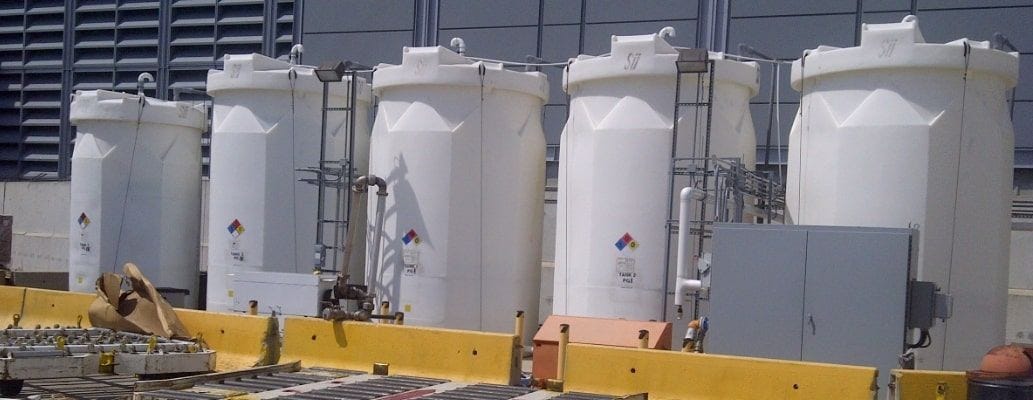
This guide works through both — and maps the answers to real facility scenarios, chemical families, and the Snyder Industries Captor double wall tank specification that governs the most common industrial installations. If you've read our comprehensive double wall tank guide or our ROI analysis comparing double wall tanks to concrete dikes, this is where the engineering gets specific.
The Four Variables That Determine Every Chemical Storage Tank Specification
Before any product selection, four variables must be established. Every other decision flows from these.
|
Variable |
Why it controls the specification |
|
Chemical identity and concentration |
Determines resin compatibility, fitting material, and gasket selection |
|
Specific gravity (SG) |
Determines required wall thickness — denser fluids exert higher hydrostatic pressure |
|
Operating temperature |
Determines whether HDLPE or XLPE is appropriate; derated above 100°F |
|
Indoor vs. outdoor installation |
Affects UV stabilizer requirements and thermal expansion behavior |
The Snyder Industries Captor specification — the manufacturing standard behind the double wall tanks Tank Depot supplies — requires all four to be declared before a chemical tank is manufactured. This isn't bureaucratic friction. It's how a tank gets wall thickness calculations that match the actual load it will carry for the next 20 years.
Resin Selection — HDLPE vs. XLPE, and When Each is Right
This is the decision that confuses the most buyers, because both materials look identical on the outside and both are described as "polyethylene." The structural difference between them is fundamental.
Type II HDLPE (High-Density Linear Polyethylene)
HDLPE is a thermoplastic. Its polymer chains are linear — connected like a rope. It is FDA-compliant for potable water contact under NSF/ANSI Standard 61, field-weldable for repairs, and cost-effective across a wide range of standard chemical applications. When it fails under chemical stress, it can fail progressively — giving maintenance teams time to respond.
Type I XLPE (Cross-Linked Polyethylene)
XLPE is a thermoset. During rotational molding, an organic peroxide initiates a cross-linking reaction that forms covalent bonds between polymer chains, creating what is effectively one continuous molecular structure. Per ASTM D2765, the gel content of a compliant XLPE tank must reach a minimum of 65% cross-linking in the inner wall. Once cured, the material cannot be remelted, rewelded, or field-repaired. What it gains in exchange: 10–20x greater environmental stress crack resistance (ESCR) than HDLPE, 3–5x greater impact strength, and a service life measured in decades rather than years under aggressive oxidizing chemistry.
One rule from the Snyder specification that carries regulatory weight: Type I XLPE and Type II HDLPE resins cannot be laminated or combined in the same tank wall. ASTM D1998 prohibits it explicitly. A tank advertised as a "hybrid" of the two resins does not meet the standard.
The Resin Decision By Chemical Family
|
Chemical family |
Recommended resin |
Notes from Snyder compatibility chart |
|
Potable water, brine, DEF (diesel exhaust fluid) |
HDLPE |
NSF/ANSI 61 compliant; FDA-approved |
|
Sodium hydroxide (caustic soda) up to 50% |
HDLPE or XLPE |
1.9 SG design; PVC fittings; EPDM gaskets |
|
Ferric chloride, ferrous chloride |
HDLPE or XLPE |
1.9 SG design; Hastelloy or titanium hardware |
|
Sulfuric acid up to 98% |
HDLPE (specific resin #880046) |
CPVC fittings mandatory; Viton gaskets; Hastelloy bolts |
|
Hydrochloric acid 37% |
HDLPE |
1.9 SG; PVC fittings; Viton gaskets; Hastelloy bolts |
|
Sodium hypochlorite up to 16.5% (indoor) |
HDLPE |
1.9 SG; PVC fittings; Viton gaskets; titanium bolts |
|
Sodium hypochlorite up to 16.5% (outdoor/UV) |
HDLPE resin #880059 or insulated |
UV-specific resin mandatory for outdoor installations |
|
Surfactants, acrylic emulsions, polymers |
XLPE |
XLPE preferred; polymer blends require SDS review |
|
Hydrogen peroxide up to 50% |
HDLPE |
1.9 SG; PVC fittings; Viton gaskets |
|
Urea solution 50% |
HDLPE or XLPE |
1.35 SG; PP or PVC fittings; EPDM gaskets |
|
Phosphoric acid 85% |
HDLPE |
1.9 SG; PVC fittings; Viton gaskets |
Source: Snyder Industries Vertical Double Wall Captor Polyethylene Tank Specification, Revised March 2026, Table — Chemical Compatibility.
One pattern worth noting: sulfuric acid and sodium hypochlorite are both common at 1.9 SG in HDLPE — but they require different specific HDLPE resin formulations (#880046 for sulfuric, #880059 for outdoor hypochlorite). Specifying "HDLPE, 1.9 SG" without the resin number for these two chemicals is an incomplete specification.
Specific Gravity — The Wall Thickness Driver
Specific gravity (SG) is the ratio of a chemical's density to the density of water. It determines the hydrostatic head pressure the tank wall must resist at any given fill height — and therefore the required wall thickness per the ASTM D1998 formula:
T = (0.433 × SG × H × OD) ÷ (2 × SD)
Where T is minimum wall thickness, H is fluid column height in feet, OD is tank outside diameter in inches, and SD is the hydrostatic design stress for the resin (≤660 PSI at 73°F for both Type I and Type II).
For practical purposes: a tank storing a chemical at 1.9 SG must have substantially thicker walls at the same diameter and fill height than a tank storing water at 1.0 SG — because the pressure against the lower wall courses is nearly twice as high.
The standard Snyder design SG ratings are 1.5 and 1.9. Most common industrial chemicals fall within one of these two brackets:
|
SG range |
Typical chemicals |
Standard Snyder design SG |
|
1.0–1.1 |
Potable water, dilute brine, DEF |
1.0–1.35 |
|
1.1–1.5 |
Calcium chloride 40%, aluminum sulfate 50%, sodium carbonate 30% |
1.5 |
|
1.5–1.9 |
Sulfuric acid, ferric chloride, sodium hydroxide 50%, hydrochloric acid 37%, sodium hypochlorite |
1.9 |
Specifying a 1.5 SG tank for a chemical that runs at 1.9 SG is not a cost saving — it is an underspecification that places the chemical tank in continuous overstress at the lower sidewall courses. This is one of the most common procurement errors in chemical storage tank selection.
Facility Scenarios — Matching The Specification To The Application
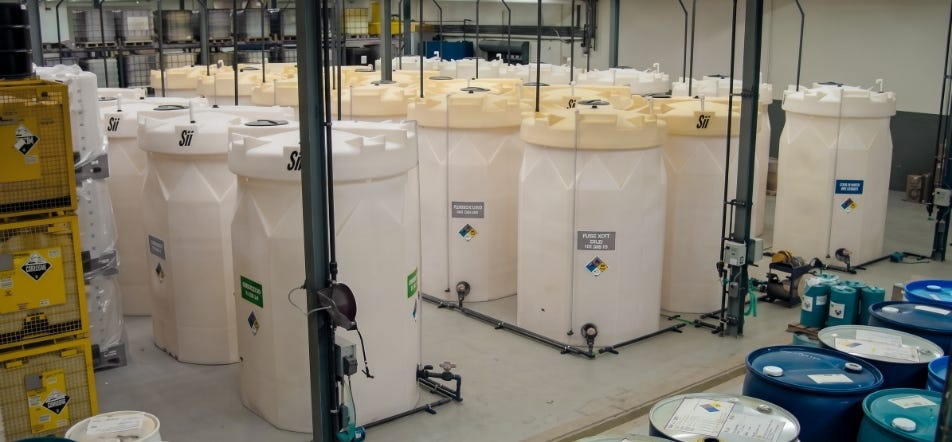
This is where the variables above translate into real purchase decisions. The following six scenarios cover the most common double wall tank applications Tank Depot encounters across industrial, municipal, and agricultural facilities.
Scenario 1: Municipal Water Treatment — Sodium Hypochlorite Storage
Facility type: Surface water or groundwater treatment plant, outdoor installation
Chemical: Sodium hypochlorite (NaOCl), up to 16.5% concentration
Specific gravity: 1.9
Key challenge: NaOCl degrades rapidly when exposed to heat, UV light, and metal contamination. Outdoor installations face continuous solar exposure. HDLPE in standard formulation will degrade under UV-accelerated oxidation, typically failing in 12–36 months in outdoor hypochlorite service.
Correct specification:
- Resin: HDLPE resin #880059 (UV-specific outdoor hypochlorite formulation) or insulated tank configuration
- SG design: 1.9
- Fittings: PVC
- Gaskets: Viton
- Bolts: Titanium (316SS is not acceptable — it pits upon drying in hypochlorite service)
- Secondary containment: Double wall Captor system mandatory for EPA SPCC compliance
Tank Depot recommendation: Snyder Industries Captor double wall, HDLPE #880059, 1.9 SG, PVC fittings, Viton gaskets, titanium hardware. Interstitial leak sensor with NEMA 4X indicator panel.
***Interlink: See our LinkedIn article on spill prevention for documented cases where open secondary containment failed in chemical storage scenarios — and why the enclosed double wall design is the standard for water treatment.
Scenario 2: Industrial Wastewater Treatment — Caustic Soda (Sodium Hydroxide)
Facility type: Manufacturing plant, indoor or covered installation
Chemical: Sodium hydroxide (NaOH), 50% concentration
Specific gravity: 1.9
Key challenge: Caustic soda is highly exothermic on dilution and attacks metals aggressively. Fitting and gasket selection is critical. The chemical is compatible with both HDLPE and XLPE, making resin selection a lifecycle and budget decision rather than a compatibility decision.
Correct specification:
- Resin: HDLPE or XLPE (XLPE preferred for facilities with long design life requirements or cyclic loading)
- SG design: 1.9
- Fittings: PVC
- Gaskets: EPDM (40–50 durometer)
- Bolts: 316SS (acceptable for caustic; note that 316SS pits upon drying in chloride environments — do not cross-specify with hypochlorite hardware)
- Secondary containment: Double wall Captor
Note on temperature: Sodium hydroxide exotherms during dilution. If process temperatures approach 100°F, the hydrostatic design stress must be derated per ASTM D1998 Section 1.08.A.2. This affects wall thickness calculations — alert your specifying engineer.
Scenario 3: Agricultural Bulk Storage — Liquid Fertilizer And Urea Solutions
Facility type: Agricultural terminal, outdoor installation, high-volume throughput
Chemical: Urea ammonium nitrate (UAN) solution or urea solution 50%
Specific gravity: 1.33–1.35
***Key challenge: This is the exact chemical family involved in the Allied Terminals collapse documented in our LinkedIn article on industrial spill failures. Open earthen berm secondary containment failed catastrophically. The agricultural sector has historically underspecified secondary containment for fertilizer storage.
Correct specification:
- Resin: HDLPE or XLPE
- SG design: 1.35
- Fittings: PP or PVC
- Gaskets: EPDM
- Bolts: 316SS
- Secondary containment: Double wall system — the enclosed outer shell prevents the hydrodynamic surge failure mode documented in the CSB investigation
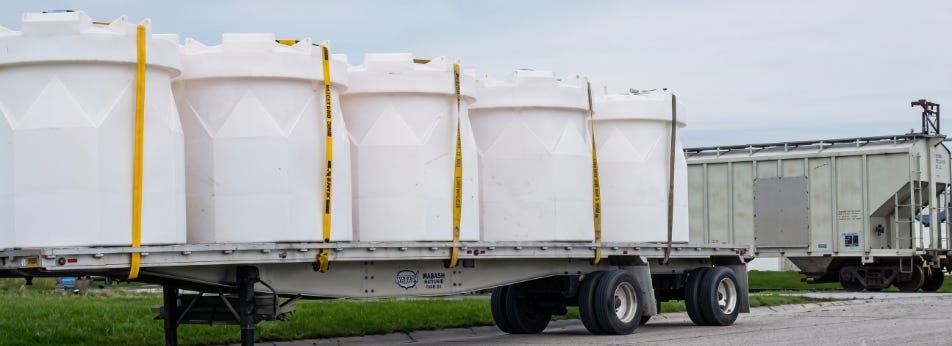
Sizing note: Agricultural liquid storage applications often involve full truck load deliveries. Confirm usable volume (the volume between the drain outlet and the full line) against truck delivery volume — specified ag tank capacity is larger than usable capacity.
Scenario 4: Chemical Processing — Sulfuric Acid Bulk Storage
Facility type: Metal finishing, battery manufacturing, or chemical processing plant
Chemical: Sulfuric acid (H₂SO₄), 93–98% concentration
Specific gravity: 1.9
Key challenge: Concentrated sulfuric acid is one of the most aggressively corrosive common industrial chemicals. It reacts violently with water, making stormwater management in open secondary containment a genuine safety hazard beyond a regulatory one. Standard PVC fittings are not compatible — CPVC is mandatory.
Correct specification:
- Resin: HDLPE resin #880046 (specific sulfuric acid formulation — standard HDLPE is not an acceptable substitution)
- SG design: 1.9
- Fittings: CPVC (not standard PVC)
- Gaskets: Viton (60–70 durometer)
- Bolts: Hastelloy C276
- Secondary containment: Double wall mandatory — rain contact with spilled sulfuric acid in an open basin creates a hazardous exothermic reaction and generates reportable wastewater immediately
Critical note: The UFO (Unified Fitting Outlet) bottom discharge system is strongly recommended for sulfuric acid applications. Top-draw suction configurations introduce continuous vapor lock risk and elevated maintenance burden with this chemical.
Scenario 5: Fleet And Automotive Operations — Diesel Exhaust Fluid (Def)
Facility type: Commercial fleet depot, logistics facility, or truck stop
Chemical: Diesel exhaust fluid (DEF), 32.5% urea solution
Specific gravity: 1.35
Key challenge: DEF is extremely sensitive to contamination. Even trace amounts of iron, copper, or zinc render it non-compliant with ISO 22241 — the international quality standard for DEF used in SCR emissions control systems. Steel tanks corrode and contaminate DEF in exactly the ways that fail compliance testing. Poly double wall DEF tanks are corrosion-free by material.
Correct specification:
- Resin: HDLPE or XLPE
- SG design: 1.35
- Fittings: 316 stainless steel (not PVC — DEF requires metal-free contact surfaces in some configurations; confirm with fleet compliance requirements)
- Gaskets: EPDM
- Bolts: 316SS
- Secondary containment: Double wall Captor
Temperature note: DEF freezes at 12°F (-11°C). Facilities in cold climates should specify heat tracing and insulation packages available at Tank Depot. Heating panels are limited to 0.06 watts per square centimeter maximum heating density on the secondary containment shell.
Scenario 6: Day Tanks And Chemical Dosing Systems
Facility type: Water treatment dosing station, laboratory, or manufacturing process line
Chemical: Variable — typically a diluted process chemical at lower concentration
Specific gravity: 1.0–1.5 depending on chemical
Key challenge: Day tanks operate at smaller volumes (35–550 gallons) and cycle frequently — filling and emptying multiple times per shift. The 12" integrated pump recess platform on smaller Captor configurations directly supports pump-mounting without additional structural support.
Correct specification:
- Size range: 35–550 gallons
- The integrated pump recess platform is rated for 225 lbs direct load — sufficient for most chemical feed metering pumps
- Flexible couplers on all piping connections are mandatory — day tank cycling causes thermal and load-driven dimensional movement; rigid connections will crack fittings at the tank wall
For a full breakdown of how day tanks compare to bulk storage in terms of compliance architecture, see our comprehensive double wall tank guide.
Part 5: The Fitting And Gasket Matrix — Where Most Specifications Fail Silently
The chemical tank body gets most of the specification attention. The fittings and gaskets are where most in-service failures actually originate — because they're the interface between the tank's chemical resistance and the rest of the process piping.
The Snyder specification defines five fitting types, each with distinct installation constraints:
|
Fitting type |
Available sizes |
Installation location |
Max wall thickness |
|
Threaded bulkhead |
½"–2" |
Curved cylindrical section, above liquid level |
2" |
|
Self-aligning threaded bulkhead |
Up to 3" (64"–142" diameter tank) |
Spherical dome, vapor phase applications |
1" |
|
Bolted double 150 lb flange |
2"–8" (diameter dependent) |
Below liquid level |
2.5" |
|
Bolted stainless steel |
Up to 4" (64"–142" diameter) |
Below liquid level |
2.5" |
|
UFO (Unified Fitting Outlet) |
2", 3", 4" |
Sidewall, dual-wall transition |
N/A — flexible seal |
The UFO deserves particular attention. It is the only fitting type that maintains secondary containment integrity through both tank walls simultaneously. Any bottom-drain configuration on a double wall tank that does not use the UFO or an equivalent flexible containment seal creates a potential breach point in the outer containment shell — defeating the purpose of the double wall design.
Gasket selection follows chemical compatibility, not convenience:
|
Gasket material |
Durometer |
Recommended for |
|
EPDM |
40–50 |
Caustic, water, fertilizer, most standard chemicals |
|
Viton |
60–70 |
Acids, hypochlorite, oxidizers, solvents |
|
Aflas |
|
Peracetic acid specifically |
Part 6: Reading The Snyder Chemical Compatibility Chart — A Practical Guide
The full chemical compatibility table in the Snyder March 2026 specification covers 40+ named chemicals with specific resin, SG, fitting, gasket, and bolt material assignments. Three principles make it usable in practice:
First, when a chemical appears with both HDLPE and XLPE listed as acceptable, the deciding factors are operating temperature, expected service life, and whether field repairability matters. HDLPE can be hot-welded for field repair; XLPE cannot.
Second, when you see an asterisk on a chemical entry (e.g., HDLPE #880046* for sulfuric acid, or HDLPE #880059 for outdoor hypochlorite), that asterisk means a specific resin formulation is required — not just the resin family. Ordering "HDLPE, 1.9 SG" without specifying the resin number for these chemicals will result in a non-compliant specification.
Third, for chemicals not on the chart — including blended chemicals, proprietary process streams, and chemicals listed as "contact manufacturer" — do not proceed without a specific compatibility review from Tank Depot. Blended chemicals can behave differently than their components. The polymer SDS review process exists for exactly this reason.
Connecting Dual Containment Specification To Compliance
A correctly specified double wall tank — right resin, right SG, right fittings, right gaskets — arrives at your facility as a factory-tested system that satisfies EPA 40CFR-264.193 secondary containment requirements out of the box, without concrete, without a dike, and without ongoing stormwater management.
An incorrectly specified tank — wrong resin for the chemical, SG underspecified, standard PVC fittings on a sulfuric acid application — creates a failure timeline rather than a storage solution. The failure may take 14 months (typical HDLPE in hypochlorite service) or 3 years. It will not take 20.
The specification work done at procurement is the only moment you control the outcome. After the chemical goes in, the chemistry decides.
Tank Depot's industrial sales team works through complete specifications before any order is placed — chemical identity, concentration, SG, temperature, fitting material, gasket selection, and secondary containment configuration. If you're specifying a system for one of the scenarios above, or for a chemical not covered here, request a free custom quote or call our industrial specialists directly at (866) 721-6281.