Meeting the Demands of Modern Industrial Liquid Logistics with Reconditioned & Rebottled IBC Totes
It's 2 a.m. and a 330-gallon tote of liquid fertilizer just split open in the back of a delivery truck, soaking the trailer floor and shutting down the route until cleanup crews arrive. The tote looked fine. It passed a visual check. But nobody checked whether it was actually rated to hold something that heavy.
This happens more often than you'd think, and it's almost always avoidable. The fix isn't complicated, it just comes down to one number that most buyers never ask about: the SG rating.
If you're sourcing reconditioned IBC totes or rebottled IBC totes for fertilizers, pesticides, or light industrial chemicals, this guide breaks down everything in plain language: what 1.9 SG actually means, which gaskets keep your product from leaking, and how to set up your storage area so you're not on the wrong side of an EPA inspection.
What Is an IBC Tote, Anyway?
Quick refresher for anyone newer to the industry: an IBC (Intermediate Bulk Container) tote is that big plastic tank wrapped in a metal cage, usually sitting on a pallet, holding 275 or 330 gallons of liquid. You've seen them everywhere, on farms, at chemical plants, behind warehouses.
A reconditioned ibc tote is one that's been used before, then washed, pressure-tested, and certified safe for reuse. A rebottled ibc tote keeps that same sturdy outer cage but gets a brand-new plastic bladder inside. Both options save you serious money compared to buying new, but they're not interchangeable for every job, more on that below.
The Number That Actually Matters: What Is SG (Specific Gravity)?
Here's the term that trips up most buyers: Specific Gravity, or SG.
In simple terms, SG just compares how heavy your liquid is compared to plain water.
Water = 1.0 SG, and one gallon of water weighs 8.34 pounds.
So when a tote is rated for 1.9 SG, that tells you the maximum weight per gallon it can safely hold:
1.9 × 8.34 lbs = 15.87 lbs per gallon
Why does this matter?
Because a lot of the liquids handled by ag and chemical businesses, fertilizers, caustic solutions, certain brines, are way heavier than water. If your IBC tote container isn't rated for that extra weight, you're setting yourself up for trouble.
Table 1: Tote Weight Limits by SG Rating
Who this is for: Procurement and warehouse managers comparing tote options before placing an order.
Why it matters: This shows the real weight difference between a standard tote and a 1.9 SG tote, so you know exactly how much product you can safely load.
|
Tote Size |
1.7 SG Max Weight |
1.9 SG Max Weight |
Extra Capacity |
|
275 Gallons |
3,902 lbs |
4,364 lbs |
+462 lbs |
|
330 Gallons |
4,683 lbs |
5,237 lbs |
+554 lbs |
That extra 500+ pounds isn't just a number on a spec sheet. It's the buffer that keeps your tote's steel cage from buckling and the plastic bladder from cracking when the truck hits a pothole or brakes hard.
Why an Underrated IBC Tote Is a Hidden Hazard
Here's what actually happens inside a tote during transport: every time the truck brakes, turns, or hits a bump, the liquid inside sloshes around. With a heavy liquid in an underrated container, that sloshing creates sudden pressure spikes that the tote was never built to handle.
Over time (or sometimes immediately), this leads to:
- Stress cracks in the plastic bladder
- In the worst cases, a sudden rupture and spill
Choosing a 1.9 SG reconditioned ibc tote for dense liquids gives you a built-in safety cushion against all of this. It's cheap insurance against a very expensive cleanup.
What Makes These Totes Tough Enough? (The Material Explained)
You don't need an engineering degree to understand this part. The plastic bladder inside premium rebottled totes is made from something called HMW-HDPE, which stands for High-Molecular-Weight High-Density Polyethylene.
Think of it like the difference between a thin sandwich bag and a heavy contractor trash bag. Same basic material family, but one is built to take a beating and the other isn't.
These totes also get blended with UV inhibitors during manufacturing. If you're storing totes outdoors (and let's be honest, most ag and industrial operations do), regular plastic gets brittle and starts cracking after a few months in the sun. The UV additives stop that breakdown, so your tote holds up season after season.
Matching Your Liquid to the Right IBC Tote and Gasket
This is where a lot of buyers get tripped up, not on the tote itself, but on the rubber seals (called gaskets) around the valves and lid. Pick the wrong gasket material, and you'll get leaks even if the tote itself is perfectly fine.
Storing Liquid Fertilizers (UAN 28, UAN 32)
Liquid fertilizers are heavy, typically 10.6 to 11.1 lbs per gallon, which is exactly why you want that 1.9 SG rating. For the gasket, EPDM (a type of synthetic rubber) is the industry go-to. It stands up well to the high pH and salt content in fertilizer, and it doesn't dry out or crack in outdoor sun the way some other rubbers do.
Storing Pesticides, Herbicides & Light Oils
Here's the catch with crop chemicals and oils: many contain solvents that slowly attack EPDM, causing it to swell up and lose its seal over months of use. For these products, switch to Viton (also called FKM). It resists oils, fuels, and acidic treatments without breaking down.
Storing Industrial Caustics (like Sodium Hydroxide)
These need the full 1.9 SG rating and an EPDM gasket, similar to fertilizer setups, but typically on a heavier-duty rebottled tote since purity matters more for industrial-grade chemical processing.
Table 2: Quick Reference for Common Industrial Liquids
Who this is for: Operations teams placing repeat orders for specific chemicals and trying to standardize their tote/gasket combos across a facility. Why it matters: Use this as a cheat sheet when ordering, so you're not guessing which gasket goes with which product.
|
Chemical Application Profile |
Common Liquid Payload |
Required Specific Gravity |
Recommended Gasket Material |
Container Selection Strategy |
|
Agricultural Fertigation |
UAN 28, UAN 32, Ammonium Polyphosphate |
1.5 SG to 1.9 SG |
EPDM |
Standard Reconditioned or Rebottled Totes |
|
Crop Protection Chemicals |
Concentrated Pesticides, Herbicides, Adjuvants |
1.35 SG to 1.7 SG |
Viton (FKM) |
Bulk Rebottled Totes (Prevents cross-contamination) |
|
Industrial Caustics |
Sodium Hydroxide (NaOH) up to 50% |
1.9 SG |
EPDM |
Heavy-Duty Rebottled Totes |
|
Light Petroleum & Lubricants |
Machining Oils, Fuel Additives, Soluble Lubricants |
0.85 SG to 1.1 SG |
Viton (FKM) |
Standard Reconditioned Totes (Washed and certified) |
Real-World Uses for Rebottled & Reconditioned Totes
Once you've got the right tote and seals, these containers become genuinely versatile pieces of equipment. Here's how businesses across different industries actually use them:
- Agricultural Operations: Beyond just storing UAN fertilizer in the yard, smaller chemical IBC totes (120-220 gallons) often get strapped onto truck beds or ATV/UTV rigs for spot-spraying herbicides and pesticides across fields. It's a lighter, cheaper alternative to dedicated spray equipment.
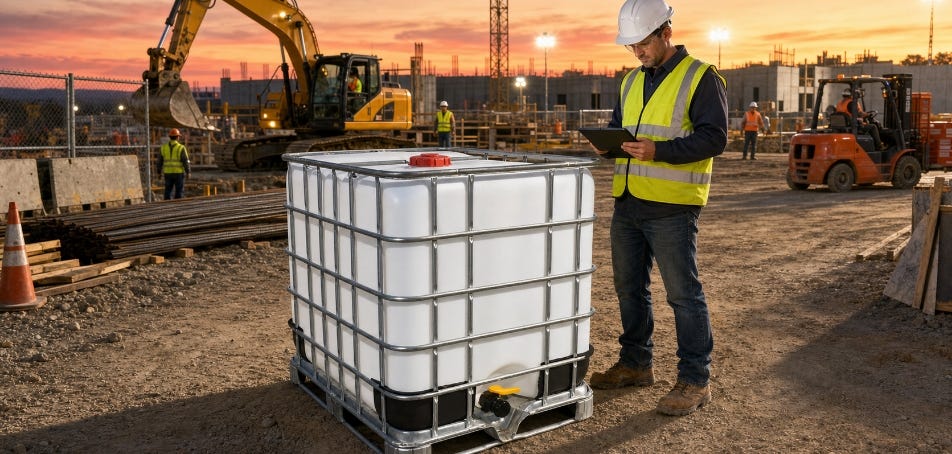
- Construction Sites: Reconditioned totes are commonly used to store and meter concrete admixtures (the additives that control how fast concrete sets), pumping product directly into mixing trucks. They're also handy for collecting hazardous washout water for proper disposal later.
- Oil & Gas Field Operations: Rebottled IBC totes rated at 1.9 SG store and inject chemicals like corrosion inhibitors and scale control agents directly into pipelines. The UV-resistant build matters a lot here since these often sit outdoors at remote well sites.
- Water Storage & Irrigation: Standard reconditioned totes (not chemical IBCs) are popular for non-potable water, think rainwater harvesting for irrigation or dust control on job sites. Just remember: these should never be used for drinking water or anything food-grade, since trace residues can remain in the plastic.
NOTE: Although the standard IBC totes feature 2 primary sizes (275 gallon totes and 330 gallons), we offer heavy duty chemical IBC totes in sizes from 120 gallons up to the 550 gallon megatainer monolith.
Don't Skip This: Spill Containment Requirements
Here's something a lot of buyers overlook until an inspector shows up: secondary containment.
Under EPA regulations (specifically 40 CFR § 264.175), if you're storing hazardous chemicals in IBC totes, federal law requires a containment system underneath capable of holding either:
● 100% of the volume of your single largest tote, OR
● 10% of your total stored volume (all totes combined)
...whichever number ends up bigger.
For a single tote out in the field, an IBC tote spill containment pallet does the job. It's a heavy-duty plastic platform with a built-in catch basin underneath, so any drips from hose connections or valve leaks get captured before hitting the ground.
If you've got multiple totes staged together at a filling station, you'll want a multi-tote containment basin instead. These link together and route spills into one collection point.
Table 3: Containment Setup by Storage Scenario
Who this is for: Facility managers setting up or auditing their chemical storage areas for compliance. Why it matters: Matches your specific setup to the right containment equipment, helping you avoid fines and pass inspections without overspending on equipment you don't need.
|
Your Setup |
Recommended Containment |
Why |
|
Single tote in the field |
Spill containment pallet |
Catches valve/hose drips, mobile |
|
2-4 totes at a filling station |
Multi-unit containment basin |
Handles aggregate volume requirement |
|
Wash/decon area |
Sump with removable grating |
Captures runoff during cleaning |
Strategic Logistics Recommendations
Industrial bulk packaging is not a one-size-fits-all asset choice. Optimizing a shipping and storage fleet requires balancing operational expenditures with material safety, regulatory compliance, and the chemical properties of the payload.
                    [ STRATEGIC PACKAGING MATRIX ]
                                  │
         ┌────────────────────────┼────────────────────────┐
         ▼                        ▼                        ▼
[ Standard Reconditioned ]  [ Bulk Rebottled ]    [ Freestanding Heavy-Duty ]
 • Non-hazardous fluids      • High-purity inputs  • Closed-loop returnable
 • Low-viscosity lubes       • Zero cross-contam     networks
 • One-way shipping paths    • 1.9 SG performance  • Highly corrosive acids
For enterprises moving non-hazardous, low-viscosity industrial fluids, standard reconditioned intermediate bulk containers provide a highly economical solution. These containers feature the lowest upfront purchase cost and are suited for one-way shipping corridors where capturing and returning empty containers is logistically difficult. By choosing reconditioned units, companies save on raw packaging costs while supporting environmental sustainability by reducing the energy consumption required to manufacture virgin steel cages.
When handling high-purity industrial compounds, sensitive agricultural pesticides, or liquid fertilizers where contamination cannot be tolerated, bulk rebottled units are the recommended standard. Incorporating a brand-new, factory-tested HMW-HDPE inner bladder eliminates the risks of chemical leaching, cross-contamination, and structural stress fatigue. These units provide the physical performance of a new tote while keeping procurement costs manageable by leveraging a reconditioned outer steel structure.
Finally, managing highly aggressive solutions, concentrated mineral acids, or volatile solvents within closed-loop returnable networks justifies investing in thick-walled, rotationally molded polymer IBC tote tanks. Although these freestanding industrial plastic units require a higher initial capital expenditure, their ability to withstand severe forklift impacts and resist external environmental degradation generates a lower total cost of ownership over their multi-trip lifecycle.
Whether you're storing fertilizer on the farm, staging chemicals at a filling yard, or running injection systems out in the field, the right reconditioned IBC tote or rebottled IBC tote comes down to three things: the right SG rating for your liquid's weight, the right gasket material for its chemistry, and proper spill containment to keep you compliant. Get those three right, and these totes will serve you reliably, trip after trip, without any 2 a.m. surprises.
Contact Tank Depot or request a free customized quote for your IBC operations today.