| Best For | Bulk storage of liquid fertilizers, mobile transport to fields, precision mixing, and secure spill containment |
| Key Strengths | High storage capacity with multiple volume options, UV-stabilized polyethylene for durability, chemical-resistant construction, cone-bottom drainage for zero waste, and DOT-compliant hauling options |
| Primary Certifications | EPA Mandates, OSHA Standards, DHS and DOT Certifications, and Foundational Industry Standards and Codes |
| Shipping Options | Nationwide delivery, Freight consolidation for farms ordering in bulk, Local pickup at Tank Depot partner locations, and Expedited shipping available |
| Warranty | 3–10 Year Manufacturer’s Warranty (varies by brand and model) |
The Best Bulk Fertilizer Tanks for Farms: A Review of High-Volume Poly Tanks for Efficiency & Yield
The best liquid fertilizer storage tanks for farms are designed to store, protect, and transport high-volume fertilizers with maximum efficiency. Their purpose is to help farmers cut input losses, maintain fertilizer quality, and streamline field application. Whether for bulk on-site storage, hauling to the field, or safe containment, industrial-grade fertilizer tanks provide reliable, long-lasting performance. Here’s a detailed review of our steel, fiberglass, and plastic fertilizer tanks for reliable farms.
The best fertilizer tanks are engineered not only for safe fertilizer handling but also for maximizing farm efficiency. By choosing the right configuration, vertical, horizontal, or cone-bottom, farmers ensure they can balance storage capacity, mobility, and environmental compliance. For more on fertilizer storage tank options, see our detailed review below.
Certifications & Compliance: A Deep Dive into Safety & Trust
Fertilizer storage tanks are more than just storage vessels—they operate at the intersection of agriculture, environmental protection, and public safety. Because fertilizers are both chemically active and regulated, tanks must comply with recognized certifications that validate their material safety, structural durability, and environmental reliability. Farmers, distributors, and agribusinesses should consider meeting the following key standards from renowned regulatory boards when selecting fertilizer tanks.
Environmental Protection Agency (EPA) Mandates: Environmental Protection and Spill Prevention
The U.S. Environmental Protection Agency (EPA) requires proper containment for bulk fertilizer storage to prevent groundwater contamination. Double wall fertilizer storage tanks, or those within containment basins comply with EPA regulations, protecting farms from costly fines and ensuring alignment with best practices in nutrient management.
For additional protection, farmers often pair their tanks with secondary containment basins which are ideal for tanks without double walls (single-walled tanks). Two key regulations are of particular relevance to fertilizer storage facilities.
The Spill Prevention, Control, and Countermeasure (SPCC) Rule (40 CFR Part 112)
The SPCC rule is fundamentally designed to prevent the discharge of oil into navigable waters. While it does not directly regulate fertilizers unless they are mixed with oil, its principles and specifications for secondary containment are widely regarded as a "best management practice" across the chemical storage industry. Moreover, these principles are frequently mirrored or directly incorporated into state-level regulations for agrichemicals, making a thorough understanding of SPCC essential.
Pesticide Container and Containment (PCC) Rule (40 CFR Part 165)
The EPA's PCC rule is directly applicable when fertilizers are mixed with, or themselves contain, pesticides. This regulation establishes stringent requirements for the storage of agricultural pesticides in stationary containers with a capacity of 500 gallons or larger.
Occupational Safety and Health Administration (OSHA) Standards: Worker Safety and Hazardous Chemicals
OSHA's mission is to ensure safe and healthful working conditions. Its regulations apply to any workplace where employees may be exposed to chemical hazards, which includes nearly all bulk fertilizer storage facilities. The certifications required include:
Hazard Communication Standard (HCS) (29 CFR 1910.1200)
This is a universal standard that applies to all workplaces where hazardous chemicals are present, a category that encompasses a wide range of fertilizer products. The HCS is foundational to worker safety and requires employers to:
- Develop and maintain a written hazard communication program.
- Maintain a comprehensive inventory list of all hazardous chemicals stored on-site.
- Ensure that Safety Data Sheets (SDSs) for each hazardous chemical are readily accessible to employees.
- Provide effective training to employees on the specific hazards of the chemicals in their work area and the protective measures to be taken.
Regulations for Specific Hazardous Fertilizers
While the HCS is a general standard, OSHA has promulgated highly specific and legally binding regulations for certain fertilizers that pose significant acute risks.
- Ammonium Nitrate (29 CFR 1910.109(i)): This is a critical, chemical-specific standard that applies to the storage of ammonium nitrate and mixtures containing 60% or more ammonium nitrate by weight.
- Anhydrous Ammonia (29 CFR 1910.111): This standard governs the storage and handling of anhydrous ammonia, a hazardous material stored as a liquefied gas under high pressure.
- Flammable and Combustible Liquids (29 CFR 1926.152): This standard becomes relevant for fertilizer storage operations if the fertilizers are blended with or contain flammable liquids, or if flammable liquids are stored in the same facility.
Department of Homeland Security (DHS) and Department of Transportation (DOT)
Beyond environmental and worker safety, certain fertilizers are regulated due to security concerns.
UN/DOT Certification – Transporting Fertilizer Safely
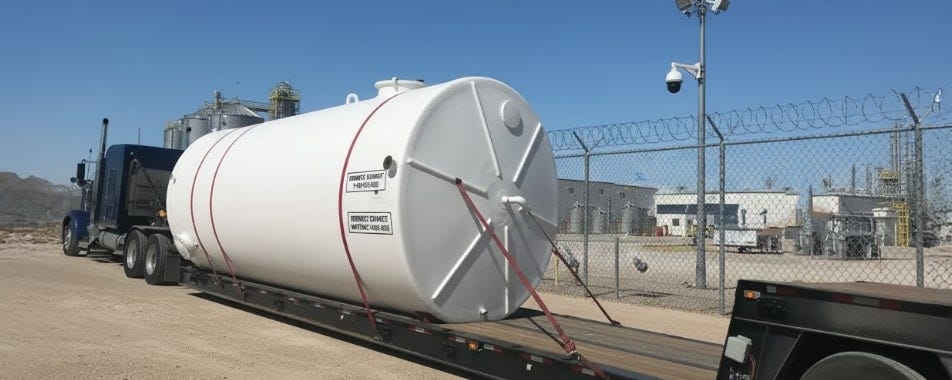
Horizontal and cone-bottom transport tanks used for liquid fertilizer hauling must meet UN/DOT standards. This includes resistance to impact, vibration, and stacking pressure during transit. Certified tanks are marked with UN codes and can legally be used on public roadways for moving hazardous agricultural solutions, providing farmers peace of mind during distribution.
Chemical Facility Anti-Terrorism Standards (CFATS)
Administered by the DHS, the CFATS program identifies and regulates high-risk chemical facilities to ensure they have security measures in place to reduce the risks associated with certain hazardous chemicals.
Foundational Industry Standards and Codes
While federal regulations establish what must be done to ensure safety and environmental protection, a suite of non-governmental, consensus-based industry standards provides the detailed technical specifications for how to achieve compliance. These standards represent the backbone of tank design, construction, inspection, and safety. They include:
- American Petroleum Institute (API): The Gold Standard for Steel Tanks
- ASTM International: The Benchmark for Polyethylene and Fiberglass
- American Society of Mechanical Engineers (ASME): The Authority on Pressure Vessels
- National Fire Protection Association (NFPA): Fire Safety and Hazardous Materials
For more on storage tank maintenance, certifications, and regulations, check out our 3-part blog series on storage tank maintenance.
Competitive Comparison: How It Stacks Up
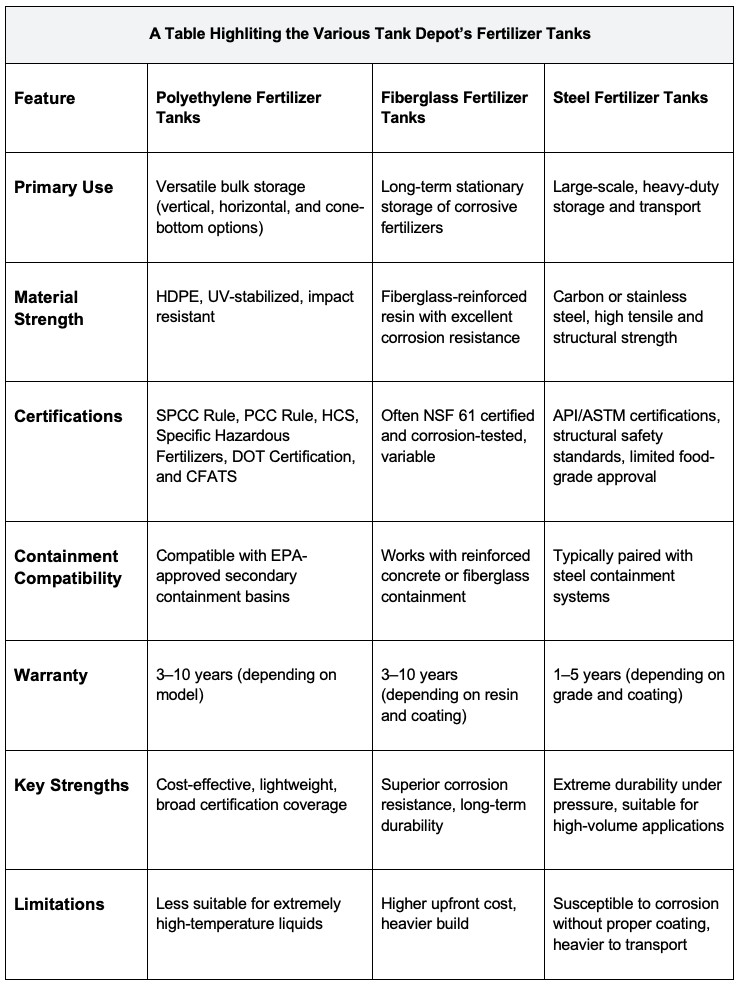
Tank Depot provides a full range of fertilizer storage solutions in polyethylene, fiberglass, and steel, giving buyers the ability to select the material that best suits their operation. Each option comes with its own strengths in terms of durability, certification coverage, and application fit. Below is a breakdown of how these three tank categories compare when used for bulk fertilizer storage.
This comparison demonstrates how Tank Depot delivers solutions for every scale of agricultural operation. Whether buyers prioritize affordability and compliance (polyethylene), long-term resistance to harsh fertilizers (fiberglass), or maximum strength for industrial-scale applications (steel), all options are available under one trusted supplier.
Bulk Fertilizer Tank Performance in Key Applications
Bulk Fertilizer Tank Performance in Key Applications Bulk farm chemical tanks are engineered for straightforward yet vital agricultural tasks, and their versatility makes them indispensable across multiple operations. Their high-capacity design, durable polyethylene construction, and chemical compatibility enable them to handle demanding applications involving fertilizers, herbicides, pesticides, and other liquid inputs with ease.
Chemical Mixing & Blending
Tank Depot’s chemical-ready mix tanks provide the stable environment needed for mixing liquid fertilizers, herbicides, and micronutrients. Their smooth interiors minimize residue buildup, ensuring consistent blends without cross-contamination.
Chemical Storage
Tank Depot’s chemical storage tanks provide the stable environment needed for mixing liquid fertilizers, herbicides, and micronutrients. Their smooth interiors minimize residue buildup, ensuring consistent blends without cross-contamination.
Chemical Distribution
Cone-bottom and horizontal models support efficient distribution systems, allowing farmers to transfer liquid inputs directly to sprayers, irrigation setups, or mobile application units. Their drainage-focused design ensures minimal product loss.
Other Agricultural & Industrial Uses
Beyond fertilizers and crop protection products, these tanks are also suitable for agricultural water storage, irrigation support, livestock feed mixes, and certain industrial chemicals. Farmers exploring additional needs can look into Tank Depot’s water storage tanks, farm fuel storage tanks, or chemical tanks, ensuring the right fit for every stage of farm and industrial operations.
Installation & Accessories: Setting Up for Fertilizer Storage
Installation
Bulk fertilizer tanks are designed for ease of setup, even in demanding agricultural environments. Most units arrive pre-fitted with essential components such as secure lids, large outlet fittings, and molded-in calibration markers for volume tracking. Installation in open fields typically requires a stable, level foundation, preferably a concrete or compacted gravel pad, to support the tank’s weight when filled. Because of their size, anchoring may be necessary in high-wind areas.
Cone-bottom models may require a stand or frame for full-drain capability, while horizontal farm tanks can be skid-mounted for transport or integration into irrigation systems. Farmers simply connect standard outlet valves to pumps, sprayers, or plumbing lines using commonly available adapters.
Accessories
Fertilizer tanks often come with accessories tailored for agricultural applications. These include lids and valves crafted from EPDM or Viton for chemical resistance, specialized fittings for blending liquid fertilizers, and additional basins to safeguard the environment.
Optional sight gauges and level sensors allow continuous monitoring of tank contents, while plumbing kits make integration with existing irrigation or fertigation systems straightforward. For operations requiring mobility, skid and trailer assemblies can convert stationary tanks into portable fertilizer distribution units.
A full range of compatible fittings and enhancements can be found in Tank Depot’s tank add-ons, ensuring that users have flexible solutions for both large-scale farming and smaller operations.
The Tank Depot Customization Edge
Bulk fertilizer storage tanks often need project-specific tweaks. Tank Depot supports configurable options on select models (as noted on each product page) to match chemistry, volume, and handling requirements—without overspecifying what isn’t needed.
Available options (where offered by the manufacturer):
- Outlet/valve packages: Camlock or Banjo-style assemblies, 2"–3" outlets, EPDM or Viton gasket choices for UAN, ATS, and phosphate solutions.
- Specific-gravity ratings: Upgrades to higher SG (e.g., 1.5–2.0) for dense liquids and temperature swings.
- Manways & vents: 16"–24" lids, pressure/vacuum vents, and anti-vortex fittings to aid safe filling and transfer.
- Fitting locations: Side/bottom draws, extra bulkheads, molded gallon markers, and sight tubes for inventory control.
- Color/opacity: Black or dark pigments to limit algae growth; translucent options for quick level checks.
- Secondary containment pairing: Compatible basins or double-wall alternatives to meet on-farm spill rules.
Form-factor choices
Vertical flat-bottom fertilizer tanks are ideal for economical yard storage, horizontal mobile tanks for nurse/transfer rigs, and cone-bottom tanks with stands for fast, complete drainage during mixing or turnover.
Important notes
Customization availability, lead times, and pricing vary by material (HDPE vs. XLPE), capacity, accessory package, and buyer preferences. Municipal or large-enterprise projects may require longer approval cycles. Always confirm chemical compatibility and SG rating against the product Safety Data Sheet (SDS)—misapplication shortens service life.
Final Verdict: Who Should Buy This Fertilizer Tank?
For growers, agricultural retailers, and cooperatives that require secure, regulation-compliant bulk storage, dedicated fertilizer tanks are a practical long-term solution. Built from UV-stabilized HDPE or cross-linked polyethylene with specific gravity ratings suited for UAN, ATS, and phosphate mixes, these tanks handle both seasonal storage and year-round inventory with confidence. Their compatibility with standard fittings and vent packages means faster setups and fewer downtime risks during application windows.
Tank Depot’s catalog includes vertical flat-bottom fertilizer tanks, horizontal leg tanks, and cone-bottom options. With capacities ranging from hundreds to tens of thousands of gallons, buyers can align storage precisely with demand. If you’re ready to improve reliability and compliance while cutting handling inefficiencies, explore our fertilizer storage tanks today and find the model designed for your operation.